
Alcoholic Mobsters and Welfare Criminals: Xenophobia, Welfare Chauvinism and Populism in Gyurcsány Ferenc’s Facebook Posts on Ukrainian Citizens Prior to the War
Petra Andits
Introduction
Since the Russian invasion of Ukraine in February 2022, the publication of academic articles, books, and policy briefs focusing on Ukraine has proliferated. In this paper, I discuss the campaign of Gyurcsány Ferenc, the most prominent figure of the Hungarian opposition in 2018, leading up to the 2018 parliamentary elections and I argue that anti-Ukrainian sentiment constituted a significant building block of the campaign. In particular, I examine two infamous Facebook posts on Ukrainians posted by the politician. I investigate how Ukrainians were perceived outside the Russian–Ukrainian context and analyze the historical, cultural, and political references that they evoked. Specifically, I shall investigate three elements of the campaign: xenophobia, welfare chauvinism, and, above all, populism.
The campaign was not only deeply xenophobic but also deployed well-worn welfare-chauvinistic criticisms against Ukrainian citizens: ‘Do you agree that Ukrainian citizens who have never paid pension contributions in Hungary should not be allowed to receive pensions in Hungary?’ Gyurcsány asks voters, having announced in 2018 at the enlarged inaugural meeting of the DK National Council that a petition to this effect would be launched. He stated that hordes of Ukrainians enter Hungary and illegally claim pensions and, subsequently, citizenship rights.
The campaign – and the Facebook posts, in particular – also echoed essentially populist undertones. Interestingly, to date, Gyurcsány’s populist rhetoric has gone entirely unexamined, highlighting a key shortcoming of populist research, whereby the heterogeneity in what may be categorized as ‘populist’ rhetoric is underexplored (Kovács et al., 2022). I argue that ‘populism’ can take various shapes and often operates in accordance with a place-based logic that does not necessarily echo official political discourses (ibid). The Facebook posts reveal a populist moral struggle in which the popular hero (Gyurcsány himself) defeats the devil (Ukrainian welfare criminals backed by Prime Minister Viktor Orbán), and features urgency, crisis, and simplistic solutions – well-known ingredients in populist rhetoric.
The Demokratikus Koalíció’s narrative about Ukrainian pension fraud began to surface near the end of the 2018 election campaign A particularly striking aspect of the campaign is its intentional merging of two wholly distinct issues: first, the planned citizenship rights for minority Hungarians in Ukraine and, second, the pension benefits that some Ukrainians receive from the Hungarian state. Around that time, Orbán was engaged in initial negotiations with the Ukrainian authorities concerning the question of whether dual citizenship should be granted to minority Hungarians. These negotiations were sensitive, given that Ukraine does not allow dual citizenship, and the alignment between Orbán and Russia’s Vladimir Putin further overshadowed the talks. Hungary also has a treaty with Ukraine, based on a 1963 intergovernmental agreement with the Soviet Union, according to which retired Ukrainian citizens who reside permanently in Hungary can apply to have their pensions paid there in Hungarian forints (HUF) (Caglar et al., 2011).
The Hungarian pension system does not simply convert their Ukrainian pensions into HUF but rather determines the amount on the basis of the beneficiary’s former employment using Hungarian mechanisms, as if they had worked in Hungary throughout their lives. This special pension entitlement is associated with residence and ostensibly has nothing to do with Hungarian citizenship,[i] given that any Ukrainian citizen with a permanent address in Hungary is eligible to receive it. Nevertheless, the opposition has intentionally blurred the two issue and incited an anti-Ukrainian hysteria.
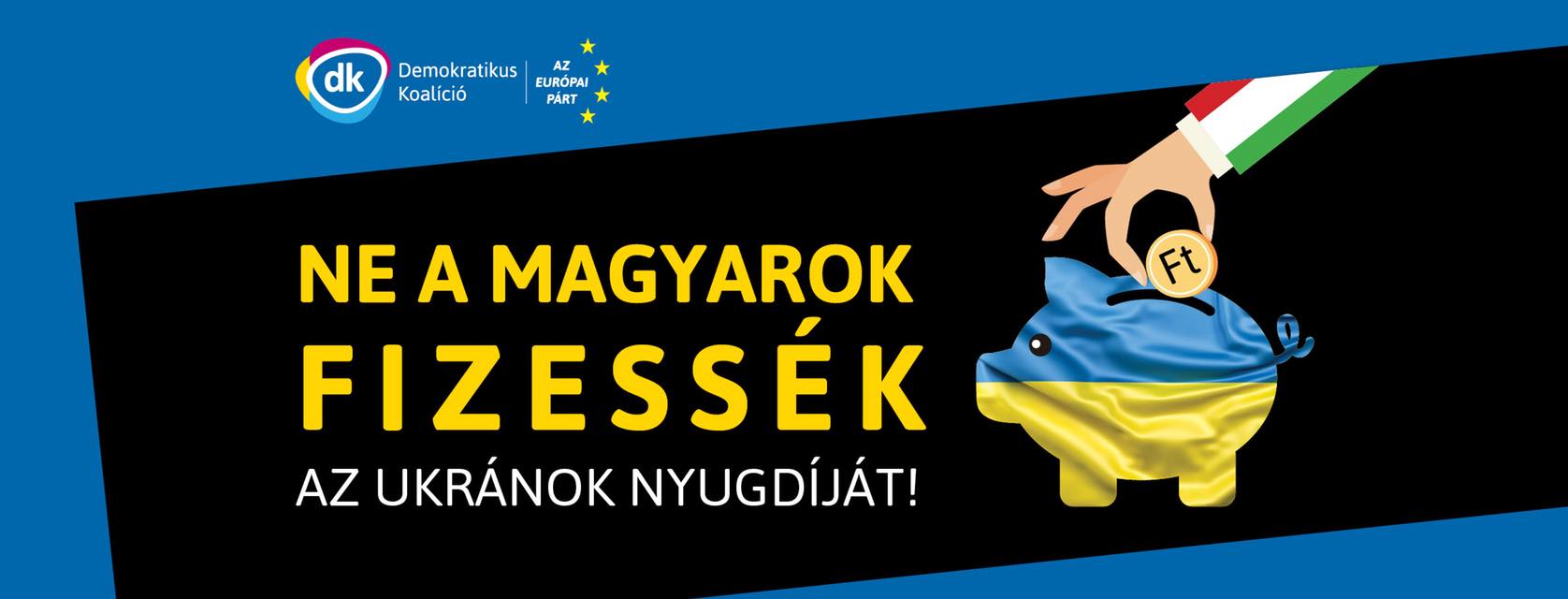
In this paper, I have selected for analysis two consecutively published Facebook posts from the campaign in which Gyurcsány disseminated visual materials pertaining to Ukrainian migrants in Hungary. The first is a fact-finding video, entitled ‘In search of the 300,000 Ukrainian pensions’ and featuring Gyurcsány in the guise of a private detective[ii]; the other is a short educational cartoon.[iii] The posts sparked controversy and criticism both in Hungary and from Ukrainian officials, who accused Gyurcsány of spreading false information and promoting anti-Ukrainian sentiment in Hungary.[iv]The incident proved highly significant, as the first video became the second most-watched Hungarian political video of all time on social media,[v] surpassing, for instance, any video made by Orbán.
Methodological Notes
Although ‘political communication today is built on a visual foundation’ (Schill, 2012: 119), research into political communication often ignores its visual aspects, with the primary focus remaining on texts and text-based methods. Often dismissed as mere illustrations to textual or verbal communication, images are rarely objects of interest in their own right (Stocchetti & Kukkonen, 2011). Yet, recent studies have called for deeper theoretical engagement with the role of digital imagery in political life, particularly within the contexts of propaganda, algorithmic circulation, and meme warfare (e.g. Gross & Colson, 2025; Nowotny & Reidy, 2025; Kalynovska, 2025). These works move beyond foundational debates to explore how visual content—often AI-generated or platform-optimized—is central to ideological influence and affective mobilization in digital political arenas. The present study contributes to this body of scholarship by examining politicians’ visual communication strategies, as demonstrated by their social media presence. I use qualitative visual analysis to examine the material presented in the paper. Visual analysis in social media research is a specific methodology that entails the systematic analysis of visual content on social media platforms.
Recent methodological debates have increasingly emphasized multimodal and computational approaches to visual political communication, including large-scale image classification, platform-based visual analytics, and AI-assisted pattern detection (e.g. Knaflic, 2020; Bateman et al., 2017; Manovich, 2020). While such methods are particularly suited to the analysis of large image corpora, this study adopts a qualitative, interpretive visual analysis in order to examine meaning-making, symbolism, and affective framing at the level of individual artifacts. This study offers depth-oriented interpretation, thus complementing computational approaches. In this study, content, discourse, and semiotic analysis were combined. Content analysis facilitated the systematic categorization and interpretation of visual data. Discourse analysis was applied to examine the social, cultural, and political factors that shape visual content and to analyze how these factors influence its meaning. Finally, semiotics was used to analyze how signs and symbols in the material convey meaning to the audience. These methods helped to identify the cultural, social, and political meanings of visual data; to situate them within their broader contexts; and to deconstruct the ideologies behind the images.
The analysis followed a stepwise qualitative procedure. First, the videos were viewed repeatedly to produce a detailed descriptive account of visual elements such as setting, camera movement, editing tempo, soundtrack, character positioning, and recurring motifs. In a second step, these elements were grouped into thematic and generic patterns (e.g. thriller aesthetics, documentary realism, cartoon pedagogy), drawing on content analysis. Third, these patterns were interpreted through discourse-analytic and semiotic lenses, focusing on how visual choices construct moral hierarchies, political antagonisms, and orientalist distinctions. Finally, the videos were contextualized within the campaign and broader Hungarian political discourse to assess their propagandist and hegemonic implications. This procedure ensured analytical transparency while allowing for close, interpretive reading of visual material.
While several videos were released during the campaign, only two employed the distinctive visual and narrative format that is the focus of this study. These two videos combined staged visual storytelling, symbolic imagery, and emotionally charged narrative structure—elements do not present in the campaign’s shorter, informational, or event-recap videos. Moreover, both selected videos became highly popular, achieving substantially higher visibility and engagement than other audiovisual outputs. Their prominence, together with their unique use of cinematic devices and symbolic framing, made them the most analytically rich materials for understanding the campaign’s visual strategy.
This study has several limitations. The focus on two videos means the findings are not generalizable to all campaign materials in a statistical sense. Rather, they should be read as illustrative of how this particular genre of visual communication operates.
Theoretical Underpinnings
The paper’s theoretical framework coheres around the concept of populism. In this section, I discuss the ways in which populism is considered a political style and how it relates to moral panic, migration, welfare chauvinism, and social media.
Populism is not necessarily tied to any particular ideology or political position (Mudde, 2017) it can simply designate a specific political style (Moffitt, 2016; Monteiro, 2025; Olvera, 2026). As a political style, populism emphasizes the virtues of ordinary people and their common sense, seeking to create a direct connection between leaders and followers. Jagers and Walgrave (2007) defined populism as ‘a political communication style of political actors that refers to the people.’ Moffitt and Tormey (2014: 387) have moved ‘beyond the purely communicative and rhetorical elements [...] and emphasize the performative and relational elements of political style,’ defined as ‘the repertoires of performance that are used to create political relations.’ Populist rhetoric is often emotional and moralistic, framing political issues in terms of good versus evil and appealing to the fears and frustrations of ordinary people (Demertzis, 2006; Wirz, 2018). Finally, charismatic leadership has been a central element in the analysis of populist phenomena, which has inspired some scholars (Moffitt, 2016; Mudde, 2017) to approach populism as a political style rather than a discourse or ideology. Although Gyurcsány has not ostensibly been labeled as populist in academic writings, the below discussion shall demonstrate that his political style can be clearly populist.
Several scholars have already pointed out that moral panics can enrich the toolboxes of populist politicians (Bernáth & Messing, 2015; Gerő-Sik, 2020; Joosse, 2018; Krzyżanowski, 2020; Pepin et al., 2021). Moral panic and populism can be conveyed in multiple ways – for example, populist leaders or movements may exploit the language and imagery of moral panic to mobilize support. They may identify a particular issue or group that is perceived as threatening to the well-being of ordinary people and use that group as a means of rallying their base and creating a sense of urgency around their cause (Critcher, 2008). They may also generate moral panic as a means of controlling and regulating the behavior of the masses. Critcher suggests that this is particularly effective when combined with appeals to emotion and simplistic solutions to complex problems.
Mudde (2004) describes how populism can contribute to the creation of moral panic by emphasizing the interests and opinions of ordinary people over those of the elite. According to Mudde, this can lead to a simplification of complex issues and a tendency to blame particular groups or behaviors for societal problems even if such claims may be unfounded or exaggerated. Wodak and Reisigl (2003) suggested that the language and imagery associated with moral panic can be used to stigmatize and marginalize certain groups. This can be exploited by populist leaders as a means of mobilizing support from those who feel threatened by the identified group or behavior.
Populist rhetoric commonly frames migration in terms of a collective threat (Hogan & Haltinner, 2015; Huysmans & Buonfino, 2008; Krzyżanowski, 2020; Lutz, 2019; Ruzza, 2018), whereby migrants are characterized as ‘freeloaders,’ ‘parasites,’ ‘terrorists,’ and ‘criminals’ (Hogan & Haltinner, 2015). Indeed, Cohen (2011: 242), who devised the moral panic concept, has argued that ‘anything connected with immigration’ will serve as the most important site for moral panics, not least because ‘[t]his subject is more political, more edgy and more amenable to violence.’ A core assumption underlying Gyurcsány’s Facebook posts is the belief that immigration is unjust and must be stopped and that immigrants are ‘free riders’ who are not entitled to receive social benefits on the grounds that they have not adequately contributed to Hungary’s economy.
In recent years, several studies have explored the so-called ‘deservingness’ debate, which addresses the question of whether and why the public at large considers particular social groups or categories to be more or less entitled to welfare (Van Oorschot & Roosma, 2017). This combination of egalitarian and restrictive views regarding who is deserving is known as ‘welfare chauvinism’ (see Mudde, 2007; van der Waal et al., 2010; van der Waal et al., 2013). Welfare chauvinism and populism can be clearly linked. Indeed, welfare populism has recently emerged as a prominent political phenomenon in several countries as a manifestation of various political phenomena, ranging from progressive and redistributive social movements to right-wing nationalist and xenophobic political parties (Abts et al., 2021; Efthymiou, 2020; Greve, 2019). At its core, however, welfare populism may be understood as a political strategy that seeks to mobilize popular support by appealing to the interests and concerns of citizens who are most vulnerable to economic and social insecurities. This typically involves promising to protect and expand social welfare programs, while also targeting the elites and institutions perceived as responsible for these insecurities.
Welfare populism has also emerged as a significant political phenomenon in many post-socialist countries (Benczes, 2022; Fesnic, 2008). The traumatic process of transition from state socialism to a market-based economy has created a fertile ground for the emergence of welfare-populist parties and movements that promise to address these social and economic challenges. Typically, the post-socialist welfare-populistic rhetoric combines a focus on social welfare policies with anti-establishment rhetoric and a call for greater national sovereignty. In this paper, I shall examine the specific version of this rhetoric that argues that national sovereignty must be defended not from EU institutions but from dubious Eastern influences.
One of the most important strategies of contemporary populism is the use of social media, which allows populist leaders to bypass traditional media channels and communicate directly with their followers (Gerbaudo, 2018; Moffitt, 2016). The affinity between populism and social media has been theorized and demonstrated in manifold ways (Berti, 2021; Bobba, 2019; Das, 2018; Engesser et al., 2017; Jacobs & Spierings, 2019; Larsson, 2022). Hopster (2021) argues that the current social media ecology offers several distinct affordances to populism, compared to the previous media ecology. First, social media platforms allow politicians to circumvent editorial filters and interact with citizens in ways that offline media do not permit and pave the way for sensational claims to spread relatively easily. Social media’s low-level affordances invite a ‘populist style’ of communication and facilitate the real-time expression – and measurement – of the ‘general will’ of the people. Moreover, social media platforms favor emotional communication, which suits the highly emotionalized style of many populists (Cossarini & Vallespín, 2019).
It is thus unsurprising that Facebook has emerged as a key site of research aimed at understanding populism on the global level. Indeed, Hungary has one of the highest percentages of Facebook posts that contain indicators of populist discourse in Europe,[vi] and Facebook is the preferred social media platform among Hungarian politicians. In early 2018, during the national election campaign, Facebook emerged as the central platform for political communication in Hungary (Bátorfy & Urbán, 2018; Szőcs, 2018). While opposition parties relied more intensively on social media, ruling Fidesz’s politiciansbenefitted from a broader media ecosystem and engaged less frequently in organic social media activity (Bátorfy & Urbán, 2018; Mérték, 2018). Although social media-based visual communication appears to be naturally conducive to populist communication (Kriesi, 2014), no studies to date have verified the existence of a distinct populist visual communication style exists.
The Rise and Fall of Gyurcsány Ferenc
Although Hungarian politics has received abundant scholarly attention, the government and the country’s current prime minister have occupied the spotlight, while the activities and personages of the opposition have gone largely overlooked.[vii]
Gyurcsány Ferenc’s political ascendancy is the culmination of an extraordinarily expedited rise through the ranks. Indeed, Körösényi et al.’s (2017) study of Gyurcsány’s career identifies him as the ‘meteoric leader’ type. He joined the Socialist Party in 2000 and became Prime Minister by September 2004, and following his re-election in 2006, he occupied this post until his resignation in March 2009. Several studies have noted that personalization is becoming an integral aspect of Hungarian campaigns: analysis of political actors’ trajectories reveals that from 2002 onwards, the observable autonomy of political personalities in relation to institutions can be clearly identified (Kiss, 2016). Gyurcsány successfully presented himself as the modernizer of the old-fashioned, post-communist Hungarian Socialist Party (Magyar Szocialista Párt; MSZP) (Debreczeni, 2006; Körösényi et al., 2017; Lakner, 2011), capitalizing on his strong rhetorical skills and ability to engage emotions and convey an appealing political vision (Körösényi et al., 2017).
In 2006, Gyurcsány became the first Hungarian prime minister to be re-elected to office, by which time he had become a champion, a hero of the liberal left electorate and the liberal left media (Debreczeni, 2006; Körösényi, 2006; Körösényi et al., 2017). However, his rapid ascent to political power was reversed by a series of evasions, scandals, and missteps (Körösényi et al., 2017). Scholars estimate that 2006 served as a key turning point in Hungary’s crisis of liberal democracy (Bíró-Nagy et al., 2015; Bozóki, 2014; Körösényi and Patkós, 2015). That year, several months after his re-election, Gyurcsány’s trustworthiness[viii] – one of the fundamental elements of political leadership – was devastated by his rapid policy switch and the leaking of his ‘Őszöd speech,’ as well as by the unprecedented brutality that the police exhibited during the protests that ensued in the aftermath of the leak (Körösényi et al., 2017).
On September 17, 2006, several media outlets disseminated a recording of excerpts from a confidential speech that Gyurcsány had delivered several months before the MSZP caucus at a meeting held at the government-owned holiday resort at Balatonőszöd. The speech included statements such as ‘we were lying noon and night,’ ‘I made tremendous efforts to look as if I was governing,’ ‘we played hundreds of tricks with Veress János (Minister of Finance) against the EU.’ The speech was particularly notable for its frequent use of expletives. The revelation of the speech triggered street protests on an unprecedented level, which were brutally repressed by the police. The scandal not only eroded the prime minister’s popularity but also affected his position within the party elite (Beck et al., 2011; Körösényi et al., 2017; Tóth, 2011). Despite repeated demands by the opposition and former president Sólyom László (2000–2005), Gyurcsány refused to resign. At the end of 2006, the MSZP’s popularity plummeted to an all-time low (Beck et al., 2011; Lakner, 2011), and during the turbulent years of the second Gyurcsány government, all its reform programs failed. During the 2010 election, both his comrades and the public linked the defeats of the left and the country’s poor performance to his person. In 2011, however, Gyurcsány staged a political resurrection and founded the DK together with some of Fidesz’ most determined liberal and conservative opponents.
Gyurcsány’s outburst against Ukrainians was not the Hungarian left’s first xenophobic mobilization against neighboring nations and the Hungarian minority groups living there. In most examples that I outline here, the neighboring nations and the minority Hungarians are merged into a single enemy figure. The first notable episode of anti-Romanian/anti-minority Hungarian populist mobilization took place in 2002 in the lead up to the implementation of a law granting rights to minority Hungarians in surrounding countries (Ukraine, Romania, Serbia, and Slovakia). Several left and liberal politicians, including Gyurcsány himself, incited nationwide hysteria with the claim that 23 million Romanians (Romania’s entire population) would invade the country and flood Hungary’s labor market (Csigó & Merkovity, 2016). Later, in 2004, prior to a referendum on the granting of citizenship rights to minority Hungarians in the Carpathian Basin, the fearmongering resurged as the left-liberal campaign cited ‘threats to labor market positions’ and the ‘abuse of the welfare system.’
The term ‘Romanian’ – accompanied by highly vulgar racial stereotypes, such as ‘hairy-soled’ (szőröstalpú in Hungarian) – was an umbrella term for Hungarians living in various surrounding countries, regardless of their country of residence. These stereotypes evoked fears of an uneducated, primitive, rural, and brutal Eastern horde. The suggestion that 23 million Romanians, in addition to millions of Serbs and Ukrainians, would take over Hungarian jobs, overburden the school system, and exploit the local pension system was successful in mobilizing voters, preventing the Fidesz government’s re-election in 2002, and deterring voters from participating in the referendum in 2004. Later in 2019, prior to the municipality elections, Socialist MEP Újhelyi István said, ‘Tens of thousands of Hungarians are now losing their jobs as the government has invited thousands from Ukraine, India, Turkey and Mongolia who are slashing the salaries of Hungarians.’[ix]
Around that time, other leftist politicians, such as DK deputy group leader Arató Gergely and ex-MP Bangóné Borbély Ildikó, expressed similar views.[x] The latest incarnation of such fearmongering is similarly associated with Gyurcsány’s Facebook posts, published prior to the 2022 parliamentary election. In the above-mentioned video, Gyurcsány’s travels to Kolozsvár to conduct interviews with the city’s Hungarian inhabitants.[xi] The video presents the interviewees with blanked-out faces and manipulated voices, portraying the inhabitants as primitive, uneducated, aggressive, and politically dangerous. These earlier and later examples show that exclusionary narrative can also be part of the leftist narrative repertoire. Seen against this longer history of left-liberal actors mobilizing xenophobic tropes against neighboring nations and minority Hungarians, Gyurcsány’s 2018 intervention appears less an isolated misstep than a strategic attempt to re-activate a familiar exclusionary repertoire: in seeking electoral gains, he effectively tried to appropriate Orbán’s anti-migrant framing and reposition himself as a rival guardian of Hungarians against purportedly threatening “newcomers.”
Discussion
In this section, I shall scrutinize each video individually. Subsequently, I shall analyze the hegemonic underpinnings inherent in this propagandist material.
Video 1: ‘In search of the 300,000 HUF Ukrainian pensions’ [xii]
It is a general tendency that Gyurcsány reveals as much of his extra-political existence as possible in public, seeking to dissolve the boundary between his private and public personas. This effort may be interpreted as suggesting that the politician is authentic and a representative of the common people (Kiss, 2019). In the first of his Facebook performances analyzed herein, Gyurcsány visits several villages close to the Hungarian–Ukrainian border, where he attempts to investigate the issue of Ukrainian citizens residing there and claiming pensions that are three times the Hungarian average or higher. In this ‘fact-finding’ video – in reality, a 4.42-minute thriller – he appears in the guise of a private detective tackling a dark and dangerous problem.
Politicians’ use of fact-finding videos is not a new phenomenon, but the rise of social media and other digital platforms has made it easier for politicians to produce and share such content with greater frequency. Carmichael and Archibald (2019) argue that video logs may be considered part of a wider trend toward ‘performative democracy,’ in which politicians use media to present themselves as authentic and responsive to the needs of the public. A clear connection may be traced between populism and fact-finding videos, which can be used as a tool to appeal to voters by presenting the politician as a champion of the people who is willing to venture out and gather information directly from the source and to take the time and effort to personally get to know his/her constituents and their concerns (Dahlberg & Linde, 2019; Koechlin, 2018).
These videos can help to humanize politicians by showing their interactions with people and places outside the usual political context, presenting them as more approachable and relatable.[xiii] Here, it is appropriate to emphasize the personalization of political communication that social media platforms particularly facilitate. Populist leaders often use simple, emotional, and polarizing messages that focus on their personal qualities and connection with ordinary citizens. Stanyer (2019) argues that the emphasis on personalization and performance can undermine the substantive content of political debate and lead to a focus on trivial or sensational issues at the expense of more important policy questions.
In this video, Gyurcsány is both the protagonist (a private detective) and the narrator of the story. He posted the video with the following moralizing caption: “There are things that everyone in the country is silent about. Often, even the people involved are afraid to talk about it for fear of the consequences. But DK will not remain silent when it sees injustice!”
The story begins with dramatic music that resembles the soundtracks that accompany heroic acts in historical movies, with subtitles popping up in a similarly dramatic design: ‘I traveled right to the Hungarian–Ukrainian border to investigate an injustice’ (00:1) The next scene shows Gyurcsány in casual dress and driving the car himself. The absence of a driver signifies that he is an ordinary man, a man of the people, but also emphasizes the secretive and deeply personal nature of the endeavor. This sense of ordinariness is further emphasized by the image of his dirty car and even dirtier windshield. In these first shots, he begins to narrate the story of the ‘Ukrainian pension business’ (00:18-33).
In terms of genre, the film resembles a dark and naturalistic ethnographic ‘documentary’ infused with elements of thriller and action movies. The apocalyptic mood that characterizes the entire film is evoked from the beginning, as shots of the villages portray a scene of profound poverty, backwardness, and misery: backyards are neglected; the small – likely the only – shop is non-operational; buildings are run down and in need of attention; and poverty-stricken characters are visible in their wretched interiors.
The film’s tempo is dynamic, as the characters, including Gyurcsány himself, speak for just a few seconds before the camera shifts to another person, thereby increasing the viewer’s tension. The mystery is further heightened by selected dramatic props. A thriller-like soundtrack swiftly replaces the dramatic music that opened the film (00:40). At the height of the drama, as Gyurcsány drives alongside the abandoned ghost houses in which more than 200 invisible Ukrainians are resident, the camera stops moving and tense music of the kind that typically accompanies cinematic moments when the killer stalks his prey is heard (02:34, 03:13-19). Gyurcsány repeatedly describes the situation as ‘mysterious’ and ‘unexplainable’ (01:28, 03:20), and the mystery’s sinister character is reinforced by the blanked-out faces: sometimes only the interviewees’ legs are visible, sometimes only their backs, as though participation in the film was a dangerous endeavor (00:11, 00:42-49, 00:56-01: 05, 01:31-32, 01:48-01: 57, 02:28-35, 02:38-48, 03:47-56) . Gyurcsány even has a secret assistant whose voice is heard, even though they remain unseen (02:18-34).
This is unsurprising when we consider that the film is constructed around the core idea that the Ukrainian mafia is operating the ‘pension business’ hand in hand with Orbán. Orbán is portrayed similarly to the Ukrainian ‘welfare criminals,’ as a mysterious invader. The talking heads in the film receive letters from him, which are presented as a flood of propaganda letters laid out on a table (01:54-02:07). The selection of a particularly backward frontier village was also guided by propagandist motivations. The film presents this region, which is portrayed in a wholly negative light, as though it were Orbán’s playground, where he conducts his underhanded business with the Eastern mafia. This, in itself, characterizes him as backward, Eastern, and criminal.
The Ukrainian welfare mobsters, who live in a hana’ana of plenty after receiving large pensions of 300,000–500,000 HUF,[xiv] are pitted against the hardworking, earnest, often sick and desperately poor Hungarian inhabitants, whose meager pensions were recently taken away and given to the Eastern incomers. Although the intergovernmental agreement with Ukraine allows some Ukrainians to receive their pensions in Hungary, the film suggests that these migrants also receive social, healthcare, child, and baby benefits after destroying the original documents and presenting falsified paperwork. Orbán and his government are also clearly implicated in this crime, as the film insinuates that these people will vote in the upcoming national elections. This is blatant propaganda that omits key facts, including that negotiations surrounding the issue of citizenship were only in the initial stages at that time and that only those with an ethnic Hungarian background could vote.
The film’s conclusion is clear: DK will save you. Gyurcsány and his party believe that this part of Hungary is not destined to be backward forever and will do everything to save the hardworking people from the Eastern forces.
Video 2: Igor versus József [xv]
The second post was a short educational cartoon featuring József, an earnest Hungarian citizen and Igor, a Ukrainian drunkard. Online cartoons have been examined from various perspectives, including their use in various political contexts and the different functions they serve in political communication, such as expressing criticism, promoting humor, and creating solidarity (Kida, 2019; Kukkonen, 2017). They also highlight the contradictions, ironies, and emotions of political campaigns, reflecting the broader political and cultural contexts in which they are produced (Miladi, 2019).
This educational cartoon once again employs orientalist tropes to portray Ukrainian citizens as a menace to the country’s welfare system. It compares József, a man who has studied, worked, and paid taxes in Hungary his whole life and who receives a pension of a mere HUF 90,000 (EUR 280) (00:15) with Igor, who was born in Ukraine, spoke Ukrainian, and lived there but had a registered address in Hungary. Although Igor has not worked or paid taxes in Hungary, he is shown to receive a pension of HUF 300,000 from the Orbán government – more precisely, from Viktor Orbán personally (00:34). The cartoon concludes with Igor also receiving Hungarian citizenship within a few weeks so that he can vote for Fidesz in the 2018 election in exchange for his pension (00:39-48).
József, the jovial Hungarian character (i.e., the personification of the ordinary hardworking Hungarian), is born, goes to school, graduates, gets married and children, goes to work, and grows old within a few seconds (00:02-18). His dedication is further emphasized by the fact that he becomes old while working in his office. By contrast, the only activity performed by the Ukrainian man, dressed in a traditional Russian fur hat, is to drink vodka in a pub and take his pension and Hungarian citizenship from Orbán (00:19-42). While József’s facial expression changes to one of sadness when he receives his disappointingly meager pension (00:15), Igor remains emotionless – that is, dehumanized – throughout the video. While József is portrayed with the family he obviously provides for (00:08), Igor’s only companion is the barman (00:19-26). His appearance and behavior emphasize the typical characteristics of Homo Sovieticus.
This degrading, pathological representation of Ukrainian citizens/minority Hungarians as the stereotypically archaic alcoholic Eastern other compounds the earlier xenophobic representation of them as mafia criminals. Orbán appears in the final section of the cartoon, when he takes away József’s pension and hands it to Igor. He is represented with an awkward smile and red lipstick, moving oddly and artificially sideways, as though controlled by an invisible hand, thus giving the expression of a sinister clown puppet (00:29-36).
Analysis: Populist and Orientalizing Traits in the Campaign
Both videos evoke a dark criminal underbelly populated by fraudsters from Ukraine, their accomplices in Hungary (i.e., the Fidesz-led government), and their innocent victims (the ordinary hardworking people). In the videos, Gyurcsány metaphorically shouts, ‘How can the alcoholic mafia guy get three times more than you, even though he never worked or paid tax here?!’ The populists’ approach to defining ‘the enemy’ (as migrants, civil society actors, ethnic minorities, etc.) varies from context to context and across time. In these propagandist videos, the image of the enemy is a complex amalgamation molded from migrants, ethnic Hungarians, and the ‘Eastern other,’ all well-known stereotypically negative protagonists in previous political narratives both in Hungary and elsewhere. The core assumptions underlying these narratives are that immigration is unjust and must be stopped, that ethnic Hungarians are not only ‘free riders’ but are also politically corrupt, and that Hungary’s Eastern neighbors represent only crime and barbarity.
Populist narratives often use images of deluge and invasion to portray migrants as a threat to the host society. This invocation of natural disasters with the potential to overwhelm the country and its resources is powerful and emotive, creating a sense of urgency and crisis that justifies the measures taken to combat the perceived threat. Similarly, in Gyurcsány’s posts, the imagery of invasion is disproportionate and volatile as it exaggerates the numbers of Ukrainians arriving and their actual effect on the receiving society. Furthermore, the videos depict their arrival as uncontrollable and unpredictable, thus further fulfilling the moral panic criteria.
The practice of stripping minority Hungarians living in neighboring states of their ethnicity and portraying them as an economic and political menace to Hungary is a well-established populist maneuver (but one that is largely unexplored), as outlined above.
The xenophobic representation of Ukrainians aligns with the colonial hierarchy dictated by European geopolitics: that is, the alleged moral, political, and ‘civil’ superiority of Western Europe vis-à-vis Eastern Europe. Melegh (2006) visualizes this hierarchy as a slope, with some nations higher up than others. In both videos, Ukrainian citizens are presented as the quintessential Eastern other, with the symbols and signs of post-Soviet identity clearly visible. Criminality is the primary characteristic ascribed to Ukrainians. Prior to the outbreak of the Russian–Ukrainian war in 2022, the Ukrainian oligarchs were a key factor in international perceptions of Ukrainian identity as post-Soviet and pro-Russian. Indeed, in addition to other symbols of post-Soviet identity and mentality, such as corruption, feudalism in political structures, and nepotism, the oligarchs were the quintessential symbols of Ukraine’s post-Soviet identity. The oligarchs were also associated with a non-transparent economy, a gray area replete with corruption, that linked Ukraine to Russia while separating it from Europe, and Gyurcsány has successfully mobilized this well-established stereotype.
Populist leaders often portray their opponents as corrupt, out-of-touch elites working against the ‘general will of the people’ (Mudde & Kaltwasser, 2017). Aside from this, Gyurcsány further reinforces the characterization of Orbán as the enemy. The prime minister, through his close connection to the Ukrainian gang, is also tainted by Eastern associations. This connection indicated an undemocratic, authoritarian governance and insinuated a post-Soviet identity. Broadly speaking, he was indirectly portrayed as an obstacle to the transition to democracy and Europe. The association of Orbán with the Eastern part of Europe was a powerful strategic maneuver in light of Western Europe’s alleged moral, political, and ‘civil’ superiority vis-à-vis Eastern Europe (and the rest of the non-Western world).
Gyurcsány himself and the hardworking ordinary people, disadvantaged by the ‘Eastern hordes,’ were portrayed in the videos as morally superior. Populist politicians often use personalization as a strategy to connect with their supporters and to present themselves as authentic and relatable leaders who represent the interests of ‘the people’ against the ‘corrupt elites’ (Hawkins & Rovira Kaltwasser, 2017; Mazzoleni, 2017; Rooduijn, 2019). Populist narratives commonly contrast the corrupt elite with the pure leader, who can govern the country according to the people’s needs.
By dramatizing the alleged threat, Gyurcsány, in accordance with the populist manifesto, conveyed a need to act decisively and immediately, while styling himself as the only source of salvation. The typical populist construction of ‘pure people’ is used strategically by Gyurcsány in two ways: the common people and the people as the nation. Characters in both videos represent the common people as benevolent and hardworking, as well as poor and uneducated. Not only does Gyurcsány reach out to them, travel on his own to meet them, and listen to their sorrows, but he also promises to save the entire nation from the Eastern hordes. This is encapsulated in both videos’ closing lines, which are also DK’s campaign slogan: “Hungarians should not pay the pensions of Ukrainians!”
Conclusion
While social media-based political communication has become a popular research field, the visual dimensions of such communication remain comparatively underexplored. Empirical research, such as that reported herein, constitutes an important step toward developing solid methodological frameworks for analyzing social media-based visual propaganda and persuasive messages. This paper analyzed two visual Facebook posts by Gyurcsány Ferenc produced during the parliamentary election campaign of the then largest Hungarian opposition force, the DK. The analysis demonstrated how the politician merged two separate policy issues and two distinct ethnic categories in order to generate moral panic through racism, populist rhetoric, and welfare-chauvinist arguments. These videos served to mobilize emotions and to identify actors, categories, ideals, and anti-ideals: good and bad politics and politicians. Three populist techniques emerged: the construction of groups and people as threats, the exaggeration of these threats, and the proposal of simplistic solutions to complex problems.
Importantly, the narrative logic of the campaign hinges on an insinuated connection between Ukrainian welfare fraud and Orbán himself. Across both videos, Gyurcsány constructs this association not through empirical evidence but through a set of symbolic and narrative cues: the depiction of a Ukrainian ‘mafia’ orchestrating the pension scheme, the repeated display of propaganda letters sent by the prime minister, the suggestion that fraudulent pension recipients will vote for Fidesz, and, in the cartoon, the visual trope of Orbán literally transferring pension money from a Hungarian citizen to a Ukrainian beneficiary. These elements function as the internal justification for Gyurcsány’s claim that the Ukrainian criminals are backed by the Orbán government.
DK quickly dropped the narrative after its electoral defeat. As media attention faded and the opposition shifted focus to corruption and local governance, the issue quietly disappeared from DK’s agenda. This article is particularly relevant at present, given that the hate campaign features Ukrainian citizens. While Gyurcsány and the DK are now attempting to present themselves as warriors on Ukraine’s behalf, these claims must be taken with a grain of salt, considering that their anti-Ukrainian campaign was active a mere few years ago.
Beyond this specific campaign, the findings shed light on broader dynamics of Hungarian opposition politics and post-socialist populism. The videos illustrate how opposition actors may appropriate and redeploy populist and exclusionary repertoires commonly associated with governing parties, drawing on post-socialist moral hierarchies and orientalist distinctions to construct political antagonism.
Acknowledgement
The research for this paper was funded by the Province of Bolzano in the form of the Seal of Excellence Fellowship
Footnotes
[i] The issue of foreign citizens claiming Hungarian pensions, however, was a controversial topic in Hungary at that time, with some opposition politicians and media outlets framing it as a widespread problem that imposed a significant burden on the Hungarian social welfare system. A cursory glance at the statistics renders these claims exaggerated and unfounded. According to official statistics, in 2017, approximately 16,000 people living outside Hungary received a Hungarian pension, representing less than 1% of the total number of pensioners. Of those, approximately 10,000 were Hungarian citizens living abroad, and the rest were foreign nationals who had worked in Hungary or were entitled to a pension by virtue of a family connection with a Hungarian citizen.
[ii] https://www.facebook.com/gyurcsanyf/videos/1836851956347258/
[iii] https://www.facebook.com/gyurcsanyf/videos/1843350715697382/
[iv] Ukrinform: ‘Ukrainian Embassy in Hungary sends note of protest to authorities over Gyurcsány's statements,’ https://www.ukrinform.net/rubric-polytics/2418825-ukrainian-embassy-in-hungary-sends-note-of-protest-to-authorities-over-gyurcsanys-statements.html.
Kyiv Post: ‘Hungarian opposition leader sparks controversy over cartoon on Ukrainian migrants,’ https://www.kyivpost.com/ukraine-politics/hungarian-opposition-leader-sparks-controversy-over-cartoon-on-ukrainian-migrants.html.
Interfax-Ukraine: ‘Ukrainian Foreign Ministry protests over Hungarian politician's statements about Ukrainians,’ https://en.interfax.com.ua/news/general/480924.html.
[v] https://444.hu/2018/01/30/a-fidesz-kormany-legdurvabb-menekultellenes-uszitasan-is-tultesz-gyurcsany-ukranellenes-hecckampanya
[vi] https://demos-h2020.eu/en/about-demos
[vii] Indeed, Google Scholar’s advanced search function returns 1090 results with ‘Orbán’ in the title, while the same search for Gyurcsány returns only 40 works.
[viii] Research carried out by the Pew Center (2009) comparing levels of trust in democracy and the free market between transitional countries in 1991 and 2009 concluded, ‘In Hungary, there is clear frustration with the current state of democracy, despite the public’s acceptance of the shift to a multi- party system.’ The study found that 77 percent of Hungarians are dissatisfied with democracy’s functionality, in line with the country’s extremely negative public morale; 91 percent thought that the country was on the wrong track. Hungarians were found to be most frustrated by the gap between what they want from democracy and what they perceive themselves as having.
[ix] https://24.hu/kulfold/2019/05/21/ujhelyi-istvan-mszp-ep-valasztas-interju/
[x] https://mandiner.hu/belfold/2019/04/bangone-borbely-ildiko-interju
https://www.youtube.com/watch?v=qnRxz9jmLkI
[xi] https://www.youtube.com/watch?v=qHl8lydTQMg
[xii] https://www.facebook.com/gyurcsanyf/videos/1840189502680170/
[xiii] The former Italian Deputy Prime Minister Matteo Salvini, for instance, frequently used Facebook Live to broadcast his visits to migrant reception centers and other locations to highlight what he saw as the failures of Italy’s immigration policies (Politico: ‘Matteo Salvini’s Facebook Live-fueled campaign to shut Italian ports’) (https://www.politico.eu/article/matteo-salvini-facebook-live-fueled-campaign-to-shut-italian-ports/).
[xiv] According to the National Pension Insurance Directorate General, the average pension paid by the convention in 2016 was HUF 98,984, well below the average Hungarian pension.
[xv] https://www.facebook.com/gyurcsanyf/videos/1843350715697382/
References
Abts, K., Dalle Mulle, E., Van Kessel, S., & Michel, E. (2021). “The welfare agenda of the populist radical right in Western Europe: Combining welfare chauvinism, producerism and populism.” Swiss Political Science Review, 27(1), 21-40.
Bateman, S., Wildfeuer, J., & Hiippala, T. (2017). Multimodality: foundations, research and analysis. Berlin: De Gruyter Mouton.
Bátorfy, A., & Urbán, Á. (2018). Facebook as the main political battleground. Mérték Médiaelemző Műhely.
Beck, L., Nagy, A.B., and Róna D. (2011). “Szabadesésben. Az MSZP 2006–2010. közötti népszerűségvesztésének politikai napirendi magyarázatai.” In: Enyedi Zs., Tardos R. and Szabó A. Új Képlet. A 2010-es választások Magyarországon. Budapest: Demokrácia Kutatások Magyar Központja lapítvány, pp.193–216.
Benczes, I. (2022). “Taking back control over the economy: From economic populism to the economic consequences of populism.” European Policy Analysis, 8(1), 109-123.
Bernáth, Gábor and Vera Messing (2015), ’Bedarálva: Menekültekkel kapcsolatos kormányzati kampány és a tőle független megszólalás terepei’, Médiakutató 2015(4) pp. 7-17.
Berti, C. (2021). Right-wing populism and the criminalization of sea-rescue NGOs: the ‘Sea-Watch 3’case in Italy, and Matteo Salvini’s communication on Facebook. Media, Culture & Society, 43(3), 532-550.
Bíró-Nagy, A., Győri, G., & Kadlót, T. (2015). “A populizmus az új korszellem?” Policy Solutions.
Bobba, G. (2019). “Social media populism: Features and ‘likeability’of Lega Nord communication on Facebook.” European Political Science, 18, 11-23.
Bozóki, A. (2015). “Broken democracy, predatory state, and nationalist populism.” In: P. Krasztev & J. Van Til (Eds.), The Hungarian patient: Social opposition to an illiberal democracy (pp. 3–36). Central European University Press.
Caglar, A., Sillo, T., & Jozwiak, I. (2011). Circular migration between Ukraine and Hungary: Background report.European University Institute.
Carmichael, S. G. (2019). Politicians' video logs as part of a performative democracy: An analysis of three UK political leaders. Media, Culture & Society, 41(5), 697-712.
Carmichael, D., & Archibald, J. (2019). “A data analysis of the academic use of social media.” International Journal of Information Technology and Computer Science, 11(5), 1-10.
Cohen, S. (2011). Folk devils and moral panics. Routledge.
Cossarini, P., & Vallespín, F. (Eds.). (2019). Populism and passions: Democratic legitimacy after austerity. Routledge.
Critcher, C. (2008). “Moral Panic Analysis: Past, Present and Future.” Sociology Compass, 2(4), 1127–1144.
Csigó, P., & Merkovity, N. (2016). “Hungary: Home of empty populism.” In: Populist political communication in Europe (pp. 299-310). Routledge.
Dahlberg, L., & Linde, J. (2019). “Populism as communicative practice: Exploring politicians' use of social media in the European context.” European Journal of Communication, 34(2), 147-162.
Das, R. (2018). “Populist discourse on a British social media patient-support community: the case of the Charlie Gard support campaign on Facebook.” Discourse, Context & Media, 24, 76-84.
Debreczeni, J. (2006). Az új miniszterelnök. Budapest: Osiris.
Demertzis, N. (2006). Emotions and populism. Emotion, politics and society, 103-122.
Efthymiou, D. E. (2020). “EU immigration, welfare rights and populism: A normative appraisal of welfare populism.” Global Justice: Theory Practice Rhetoric, 12(02), 161-188.
Engesser, S., Ernst, N., Esser, F., & Büchel, F. (2017). “Populism and social media: How politicians spread a fragmented ideology.” Information, Communication & Society, 20(8), 1109-1126.
Fesnic, F. N. (2008). Welfare Chauvinism East and West: Romania and France. University of Illinois at Urbana-Champaign.
Gerbaudo, P. (2018). “Social media and populism: an elective affinity?” Media, Culture & Society, 40(5), 745-753.
Gerő, M., & Sik, E. (2020). “The Moral Panic Button 1: Construction and Consequences.” In: Europe and the Refugee Response (pp. 39-58). Routledge.
Greve, B. (2019). Welfare, populism and welfare chauvinism. Policy Press.
Gross, E. C., & Colson, A. J. M. (2025). “AI-Slop and political propaganda: The role of AI-generated content in memes and influence campaigns.” EON: Explorations in Online Narratives, 6(3), 289–298.
Hawkins, K. A., & Rovira Kaltwasser, C. (2017). “Populism and democracy in the 21st century.” The Oxford handbook of populism, 1-22.
Hogan, J., & Haltinner, K. (2015). “Floods, invaders, and parasites: Immigration threat narratives and right-wing populism in the USA, UK and Australia.” Journal of Intercultural Studies, 36(5), 520-543.
Hopster, J. (2021). “Mutual affordances: the dynamics between social media and populism.” Media, Culture & Society, 43(3), 551-560.
Huysmans, J., & Buonfino, A. (2008). “Politics of exception and unease: Immigration, asylum and terrorism in parliamentary debates in the UK.” Political Studies, 56(4), 766-788.
Jagers, J., & Walgrave, S. (2007). Populism as political communication style: An empirical study of political parties' discourse in Belgium. European journal of political research, 46(3), 319-345.
Joosse, P. (2018). “Expanding moral panic theory to include the agency of charismatic entrepreneurs.” The British Journal of Criminology, 58(4), 993-1012.
Kalynovska, I. (2025). “Visual counter-narratives: Political cartoons as weapons against Russian disinformation in Canadian digital media (2022–2024).” Пріоритети германської та романської філології, Conference Proceedings, 15–22.
Kiss, B. (2016). Orbán, Vona, Gyurcsány. Politikai vezetők integrációs tevékenysége a migrációs válság idején. Politikatudományi Szemle, 25(3), 10-32.
Kiss, B. (2019). A centralizáció évei. Politikai kommunikáció Magyarországon, 2006-2015. Akadémiai Kiadó.
Knaflic, C. N. (2020). Storytelling with data: let’s practice! Hoboken, NJ: Wiley.
Koechlin, 2018). “The use of Twitter and Facebook by populist parties in the 2014 European Parliament elections.” European Journal of Communication, 33(6), 677-693.
Kovács, E. K., Bachórz, A., Bunzl, N., Mincyte, D., Parasecoli, F., Piras, S., & Varga, M. (2022). “The war in Ukraine and food security in Eastern Europe.” Gastronomica: The Journal of Food and Culture, 22(3), 1-7.
Körösényi, A. (2006). Gyurcsány-vezér. In Sándor, P. and Vass, L. Magyarország Politikai Évkönyve 2006. Budapest: Demokrácia Kutatások Magyar Központja Alapítvány, pp.141–9.
Körösényi, A., & Patkós, V. (2015). “Liberális és illiberális populizmus. Berlusconi és Orbán politikai vezetése.” Politikatudományi Szemle, 24(2.), 29-55.
Körösényi, A., Ondré, P., & Hajdú, A. (2017). A “meteoric” career in Hungarian politics. The Leadership Capital Index: A New Perspective on Political Leadership, 82-100. Palgrave Macmillan.
Kriesi, H. (2014). The populist challenge. West European Politics, 37(2), 361-378.
Krzyżanowski, M. (2020). “Discursive shifts and the normalisation of racism: imaginaries of immigration, moral panics and the discourse of contemporary right-wing populism.” Social Semiotics, 30(4), 503-527.
Lakner, Z. (2011). Utak és útvesztők. Az MSZP húsz éve. Budapest: Napvilág Kiadó.
Larsson, A. O. (2022). Picture-perfect populism: Tracing the rise of European populist parties on Facebook. New Media & Society, 24(1), 227-245.
Lutz, P. (2019). Variation in policy success: radical right populism and migration policy. West European Politics, 42(3), 517-544.
Manovich, L. (2020). Cultural analytics. Cambridge, MA: MIT Press.
Mazzoleni, G. (2017). “Populism and the Media.” In: C. de la Torre (Ed.), Populism around the World (pp. 137-153). Oxford University Press.
Melegh, A. (2006). On the East-West slope: Globalization, nationalism, racism an discourses on Eastern Europe. Central European University Press.
Mérték Médiaelemző Műhely. (2018). State of the Public Sphere in Hungary in 2018.
Moffitt, B. (2016). The global rise of populism: Performance, political style, and representation. Stanford University Press.
Moffitt, B., & Tormey, S. (2014). “Rethinking populism: Politics, mediatisation and political style.” Political Studies, 62(2), 381-397.
Monteiro, E. N. (2025). “Populism in power: Discourse and performativity in SYRIZA and Donald Trump.” Revista Brasileira de Política Internacional.
Mudde, C. (2004). “The populist Zeitgeist.” Government and Opposition, 39(4), 541-563.
Mudde, C. (2017). “An ideational approach.” The Oxford handbook of populism, 27-47.
Mudde, C., & Kaltwasser, C. R. (2017). Populism: A very short introduction. Oxford University Press.
Nowotny, J., & Reidy, J. (2025). The meme as the message: Digital culture between algorithm, affect, and aesthetics. Routledge.
Olvera, A. J. (2026). The AMLO administration in Mexico: Polity, politics and populism. Routledge.
Pepin-Neff, C., & Cohen, A. (2021). “President Trump’s transgender moral panic.” Policy Studies, 42(5-6), 646-661.
Rooduijn, M. (2019). What unites the voter bases of populist parties? Comparing the electorates of 15 populist parties. European Political Science Review, 11(3), 305-325.
Ruzza, C. (2018). “Populism, migration, and xenophobia in Europe.” In: Routledge Handbook of Global Populism (pp. 201-216). Routledge.
Spierings, N., & Jacobs, K. (2019). “Political parties and social media campaigning: A qualitative comparative analysis of parties’ professional Facebook and Twitter use in the 2010 and 2012 Dutch elections.” Acta Politica, 54, 145-173.
Stanyer, J. (2019). Political communication in the digital age. Polity Press.
Schill, D. (2012). “The visual image and the political image: A review of visual communication research in the field of political communication.” Review of Communication, 12(2), 118-142.
Stocchetti, M., & Kukkonen, K. (2011). Critical media analysis: An introduction for media professionals. Peter Lang.
Szőcs, A. (2018). “Facebook-politikai aktivitás a 2018-as választási kampányban.” Médiakutató, 2, 59–69.
Tóth, Cs. (2011). “A márkajellemzők szerepe az MSZP összeomlásában.” In: Enyedi Zs., Tardos R. and Szabó A. Új Képlet. A 2010-es választások Magyarországon. Budapest: Demokrácia Kutatások Magyar Központja Alapítvány, pp.167–89.
Van der Waal, J., Achterberg, P., Houtman, D., De Koster, W., & Manevska, K. (2010). “‘Some are more equal than others’: Economic egalitarianism and welfare chauvinism in the Netherlands.” Journal of European Social Policy, 20(4) pp. 350-363.
Van Der Waal, J., De Koster, W., & Van Oorschot, W. (2013). “Three worlds of welfare chauvinism? How welfare regimes affect support for distributing welfare to immigrants in Europe.” Journal of Comparative Policy Analysis: Research and Practice, 15(2), 164-181.
Van Oorschot, W., & Roosma, F. (2017). The social legitimacy of targeted welfare and welfare deservingness. In The social legitimacy of targeted welfare (pp. 3-34). Edward Elgar Publishing.
Wirz, D. (2018). “Persuasion through emotion? An experimental test of the emotion-eliciting nature of populist communication.” International Journal of Communication, 12, 1114-1138.
Wodak, R., & Reisigl, M. (2003). Discourse and Discrimination: Rhetorics of Racism and Antisemitism. Routledge.
Alcoholic Mobsters and Welfare Criminals: Xenophobia, Welfare Chauvinism and Populism in Gyurcsány Ferenc’s Facebook Posts on Ukrainian Citizens Prior to the War
Petra Andits
Introduction
Since the Russian invasion of Ukraine in February 2022, the publication of academic articles, books, and policy briefs focusing on Ukraine has proliferated. In this paper, I discuss the campaign of Gyurcsány Ferenc, the most prominent figure of the Hungarian opposition in 2018, leading up to the 2018 parliamentary elections and I argue that anti-Ukrainian sentiment constituted a significant building block of the campaign. In particular, I examine two infamous Facebook posts on Ukrainians posted by the politician. I investigate how Ukrainians were perceived outside the Russian–Ukrainian context and analyze the historical, cultural, and political references that they evoked. Specifically, I shall investigate three elements of the campaign: xenophobia, welfare chauvinism, and, above all, populism.
The campaign was not only deeply xenophobic but also deployed well-worn welfare-chauvinistic criticisms against Ukrainian citizens: ‘Do you agree that Ukrainian citizens who have never paid pension contributions in Hungary should not be allowed to receive pensions in Hungary?’ Gyurcsány asks voters, having announced in 2018 at the enlarged inaugural meeting of the DK National Council that a petition to this effect would be launched. He stated that hordes of Ukrainians enter Hungary and illegally claim pensions and, subsequently, citizenship rights.
The campaign – and the Facebook posts, in particular – also echoed essentially populist undertones. Interestingly, to date, Gyurcsány’s populist rhetoric has gone entirely unexamined, highlighting a key shortcoming of populist research, whereby the heterogeneity in what may be categorized as ‘populist’ rhetoric is underexplored (Kovács et al., 2022). I argue that ‘populism’ can take various shapes and often operates in accordance with a place-based logic that does not necessarily echo official political discourses (ibid). The Facebook posts reveal a populist moral struggle in which the popular hero (Gyurcsány himself) defeats the devil (Ukrainian welfare criminals backed by Prime Minister Viktor Orbán), and features urgency, crisis, and simplistic solutions – well-known ingredients in populist rhetoric.
The Demokratikus Koalíció’s narrative about Ukrainian pension fraud began to surface near the end of the 2018 election campaign A particularly striking aspect of the campaign is its intentional merging of two wholly distinct issues: first, the planned citizenship rights for minority Hungarians in Ukraine and, second, the pension benefits that some Ukrainians receive from the Hungarian state. Around that time, Orbán was engaged in initial negotiations with the Ukrainian authorities concerning the question of whether dual citizenship should be granted to minority Hungarians. These negotiations were sensitive, given that Ukraine does not allow dual citizenship, and the alignment between Orbán and Russia’s Vladimir Putin further overshadowed the talks. Hungary also has a treaty with Ukraine, based on a 1963 intergovernmental agreement with the Soviet Union, according to which retired Ukrainian citizens who reside permanently in Hungary can apply to have their pensions paid there in Hungarian forints (HUF) (Caglar et al., 2011).
The Hungarian pension system does not simply convert their Ukrainian pensions into HUF but rather determines the amount on the basis of the beneficiary’s former employment using Hungarian mechanisms, as if they had worked in Hungary throughout their lives. This special pension entitlement is associated with residence and ostensibly has nothing to do with Hungarian citizenship,[i] given that any Ukrainian citizen with a permanent address in Hungary is eligible to receive it. Nevertheless, the opposition has intentionally blurred the two issue and incited an anti-Ukrainian hysteria.
In this paper, I have selected for analysis two consecutively published Facebook posts from the campaign in which Gyurcsány disseminated visual materials pertaining to Ukrainian migrants in Hungary. The first is a fact-finding video, entitled ‘In search of the 300,000 Ukrainian pensions’ and featuring Gyurcsány in the guise of a private detective[ii]; the other is a short educational cartoon.[iii] The posts sparked controversy and criticism both in Hungary and from Ukrainian officials, who accused Gyurcsány of spreading false information and promoting anti-Ukrainian sentiment in Hungary.[iv]The incident proved highly significant, as the first video became the second most-watched Hungarian political video of all time on social media,[v] surpassing, for instance, any video made by Orbán.
Methodological Notes
Although ‘political communication today is built on a visual foundation’ (Schill, 2012: 119), research into political communication often ignores its visual aspects, with the primary focus remaining on texts and text-based methods. Often dismissed as mere illustrations to textual or verbal communication, images are rarely objects of interest in their own right (Stocchetti & Kukkonen, 2011). Yet, recent studies have called for deeper theoretical engagement with the role of digital imagery in political life, particularly within the contexts of propaganda, algorithmic circulation, and meme warfare (e.g. Gross & Colson, 2025; Nowotny & Reidy, 2025; Kalynovska, 2025). These works move beyond foundational debates to explore how visual content—often AI-generated or platform-optimized—is central to ideological influence and affective mobilization in digital political arenas. The present study contributes to this body of scholarship by examining politicians’ visual communication strategies, as demonstrated by their social media presence. I use qualitative visual analysis to examine the material presented in the paper. Visual analysis in social media research is a specific methodology that entails the systematic analysis of visual content on social media platforms.
Recent methodological debates have increasingly emphasized multimodal and computational approaches to visual political communication, including large-scale image classification, platform-based visual analytics, and AI-assisted pattern detection (e.g. Knaflic, 2020; Bateman et al., 2017; Manovich, 2020). While such methods are particularly suited to the analysis of large image corpora, this study adopts a qualitative, interpretive visual analysis in order to examine meaning-making, symbolism, and affective framing at the level of individual artifacts. This study offers depth-oriented interpretation, thus complementing computational approaches. In this study, content, discourse, and semiotic analysis were combined. Content analysis facilitated the systematic categorization and interpretation of visual data. Discourse analysis was applied to examine the social, cultural, and political factors that shape visual content and to analyze how these factors influence its meaning. Finally, semiotics was used to analyze how signs and symbols in the material convey meaning to the audience. These methods helped to identify the cultural, social, and political meanings of visual data; to situate them within their broader contexts; and to deconstruct the ideologies behind the images.
The analysis followed a stepwise qualitative procedure. First, the videos were viewed repeatedly to produce a detailed descriptive account of visual elements such as setting, camera movement, editing tempo, soundtrack, character positioning, and recurring motifs. In a second step, these elements were grouped into thematic and generic patterns (e.g. thriller aesthetics, documentary realism, cartoon pedagogy), drawing on content analysis. Third, these patterns were interpreted through discourse-analytic and semiotic lenses, focusing on how visual choices construct moral hierarchies, political antagonisms, and orientalist distinctions. Finally, the videos were contextualized within the campaign and broader Hungarian political discourse to assess their propagandist and hegemonic implications. This procedure ensured analytical transparency while allowing for close, interpretive reading of visual material.
While several videos were released during the campaign, only two employed the distinctive visual and narrative format that is the focus of this study. These two videos combined staged visual storytelling, symbolic imagery, and emotionally charged narrative structure—elements do not present in the campaign’s shorter, informational, or event-recap videos. Moreover, both selected videos became highly popular, achieving substantially higher visibility and engagement than other audiovisual outputs. Their prominence, together with their unique use of cinematic devices and symbolic framing, made them the most analytically rich materials for understanding the campaign’s visual strategy.
This study has several limitations. The focus on two videos means the findings are not generalizable to all campaign materials in a statistical sense. Rather, they should be read as illustrative of how this particular genre of visual communication operates.
Theoretical Underpinnings
The paper’s theoretical framework coheres around the concept of populism. In this section, I discuss the ways in which populism is considered a political style and how it relates to moral panic, migration, welfare chauvinism, and social media.
Populism is not necessarily tied to any particular ideology or political position (Mudde, 2017) it can simply designate a specific political style (Moffitt, 2016; Monteiro, 2025; Olvera, 2026). As a political style, populism emphasizes the virtues of ordinary people and their common sense, seeking to create a direct connection between leaders and followers. Jagers and Walgrave (2007) defined populism as ‘a political communication style of political actors that refers to the people.’ Moffitt and Tormey (2014: 387) have moved ‘beyond the purely communicative and rhetorical elements [...] and emphasize the performative and relational elements of political style,’ defined as ‘the repertoires of performance that are used to create political relations.’ Populist rhetoric is often emotional and moralistic, framing political issues in terms of good versus evil and appealing to the fears and frustrations of ordinary people (Demertzis, 2006; Wirz, 2018). Finally, charismatic leadership has been a central element in the analysis of populist phenomena, which has inspired some scholars (Moffitt, 2016; Mudde, 2017) to approach populism as a political style rather than a discourse or ideology. Although Gyurcsány has not ostensibly been labeled as populist in academic writings, the below discussion shall demonstrate that his political style can be clearly populist.
Several scholars have already pointed out that moral panics can enrich the toolboxes of populist politicians (Bernáth & Messing, 2015; Gerő-Sik, 2020; Joosse, 2018; Krzyżanowski, 2020; Pepin et al., 2021). Moral panic and populism can be conveyed in multiple ways – for example, populist leaders or movements may exploit the language and imagery of moral panic to mobilize support. They may identify a particular issue or group that is perceived as threatening to the well-being of ordinary people and use that group as a means of rallying their base and creating a sense of urgency around their cause (Critcher, 2008). They may also generate moral panic as a means of controlling and regulating the behavior of the masses. Critcher suggests that this is particularly effective when combined with appeals to emotion and simplistic solutions to complex problems.
Mudde (2004) describes how populism can contribute to the creation of moral panic by emphasizing the interests and opinions of ordinary people over those of the elite. According to Mudde, this can lead to a simplification of complex issues and a tendency to blame particular groups or behaviors for societal problems even if such claims may be unfounded or exaggerated. Wodak and Reisigl (2003) suggested that the language and imagery associated with moral panic can be used to stigmatize and marginalize certain groups. This can be exploited by populist leaders as a means of mobilizing support from those who feel threatened by the identified group or behavior.
Populist rhetoric commonly frames migration in terms of a collective threat (Hogan & Haltinner, 2015; Huysmans & Buonfino, 2008; Krzyżanowski, 2020; Lutz, 2019; Ruzza, 2018), whereby migrants are characterized as ‘freeloaders,’ ‘parasites,’ ‘terrorists,’ and ‘criminals’ (Hogan & Haltinner, 2015). Indeed, Cohen (2011: 242), who devised the moral panic concept, has argued that ‘anything connected with immigration’ will serve as the most important site for moral panics, not least because ‘[t]his subject is more political, more edgy and more amenable to violence.’ A core assumption underlying Gyurcsány’s Facebook posts is the belief that immigration is unjust and must be stopped and that immigrants are ‘free riders’ who are not entitled to receive social benefits on the grounds that they have not adequately contributed to Hungary’s economy.
In recent years, several studies have explored the so-called ‘deservingness’ debate, which addresses the question of whether and why the public at large considers particular social groups or categories to be more or less entitled to welfare (Van Oorschot & Roosma, 2017). This combination of egalitarian and restrictive views regarding who is deserving is known as ‘welfare chauvinism’ (see Mudde, 2007; van der Waal et al., 2010; van der Waal et al., 2013). Welfare chauvinism and populism can be clearly linked. Indeed, welfare populism has recently emerged as a prominent political phenomenon in several countries as a manifestation of various political phenomena, ranging from progressive and redistributive social movements to right-wing nationalist and xenophobic political parties (Abts et al., 2021; Efthymiou, 2020; Greve, 2019). At its core, however, welfare populism may be understood as a political strategy that seeks to mobilize popular support by appealing to the interests and concerns of citizens who are most vulnerable to economic and social insecurities. This typically involves promising to protect and expand social welfare programs, while also targeting the elites and institutions perceived as responsible for these insecurities.
Welfare populism has also emerged as a significant political phenomenon in many post-socialist countries (Benczes, 2022; Fesnic, 2008). The traumatic process of transition from state socialism to a market-based economy has created a fertile ground for the emergence of welfare-populist parties and movements that promise to address these social and economic challenges. Typically, the post-socialist welfare-populistic rhetoric combines a focus on social welfare policies with anti-establishment rhetoric and a call for greater national sovereignty. In this paper, I shall examine the specific version of this rhetoric that argues that national sovereignty must be defended not from EU institutions but from dubious Eastern influences.
One of the most important strategies of contemporary populism is the use of social media, which allows populist leaders to bypass traditional media channels and communicate directly with their followers (Gerbaudo, 2018; Moffitt, 2016). The affinity between populism and social media has been theorized and demonstrated in manifold ways (Berti, 2021; Bobba, 2019; Das, 2018; Engesser et al., 2017; Jacobs & Spierings, 2019; Larsson, 2022). Hopster (2021) argues that the current social media ecology offers several distinct affordances to populism, compared to the previous media ecology. First, social media platforms allow politicians to circumvent editorial filters and interact with citizens in ways that offline media do not permit and pave the way for sensational claims to spread relatively easily. Social media’s low-level affordances invite a ‘populist style’ of communication and facilitate the real-time expression – and measurement – of the ‘general will’ of the people. Moreover, social media platforms favor emotional communication, which suits the highly emotionalized style of many populists (Cossarini & Vallespín, 2019).
It is thus unsurprising that Facebook has emerged as a key site of research aimed at understanding populism on the global level. Indeed, Hungary has one of the highest percentages of Facebook posts that contain indicators of populist discourse in Europe,[vi] and Facebook is the preferred social media platform among Hungarian politicians. In early 2018, during the national election campaign, Facebook emerged as the central platform for political communication in Hungary (Bátorfy & Urbán, 2018; Szőcs, 2018). While opposition parties relied more intensively on social media, ruling Fidesz’s politiciansbenefitted from a broader media ecosystem and engaged less frequently in organic social media activity (Bátorfy & Urbán, 2018; Mérték, 2018). Although social media-based visual communication appears to be naturally conducive to populist communication (Kriesi, 2014), no studies to date have verified the existence of a distinct populist visual communication style exists.
The Rise and Fall of Gyurcsány Ferenc
Although Hungarian politics has received abundant scholarly attention, the government and the country’s current prime minister have occupied the spotlight, while the activities and personages of the opposition have gone largely overlooked.[vii]
Gyurcsány Ferenc’s political ascendancy is the culmination of an extraordinarily expedited rise through the ranks. Indeed, Körösényi et al.’s (2017) study of Gyurcsány’s career identifies him as the ‘meteoric leader’ type. He joined the Socialist Party in 2000 and became Prime Minister by September 2004, and following his re-election in 2006, he occupied this post until his resignation in March 2009. Several studies have noted that personalization is becoming an integral aspect of Hungarian campaigns: analysis of political actors’ trajectories reveals that from 2002 onwards, the observable autonomy of political personalities in relation to institutions can be clearly identified (Kiss, 2016). Gyurcsány successfully presented himself as the modernizer of the old-fashioned, post-communist Hungarian Socialist Party (Magyar Szocialista Párt; MSZP) (Debreczeni, 2006; Körösényi et al., 2017; Lakner, 2011), capitalizing on his strong rhetorical skills and ability to engage emotions and convey an appealing political vision (Körösényi et al., 2017).
In 2006, Gyurcsány became the first Hungarian prime minister to be re-elected to office, by which time he had become a champion, a hero of the liberal left electorate and the liberal left media (Debreczeni, 2006; Körösényi, 2006; Körösényi et al., 2017). However, his rapid ascent to political power was reversed by a series of evasions, scandals, and missteps (Körösényi et al., 2017). Scholars estimate that 2006 served as a key turning point in Hungary’s crisis of liberal democracy (Bíró-Nagy et al., 2015; Bozóki, 2014; Körösényi and Patkós, 2015). That year, several months after his re-election, Gyurcsány’s trustworthiness[viii] – one of the fundamental elements of political leadership – was devastated by his rapid policy switch and the leaking of his ‘Őszöd speech,’ as well as by the unprecedented brutality that the police exhibited during the protests that ensued in the aftermath of the leak (Körösényi et al., 2017).
On September 17, 2006, several media outlets disseminated a recording of excerpts from a confidential speech that Gyurcsány had delivered several months before the MSZP caucus at a meeting held at the government-owned holiday resort at Balatonőszöd. The speech included statements such as ‘we were lying noon and night,’ ‘I made tremendous efforts to look as if I was governing,’ ‘we played hundreds of tricks with Veress János (Minister of Finance) against the EU.’ The speech was particularly notable for its frequent use of expletives. The revelation of the speech triggered street protests on an unprecedented level, which were brutally repressed by the police. The scandal not only eroded the prime minister’s popularity but also affected his position within the party elite (Beck et al., 2011; Körösényi et al., 2017; Tóth, 2011). Despite repeated demands by the opposition and former president Sólyom László (2000–2005), Gyurcsány refused to resign. At the end of 2006, the MSZP’s popularity plummeted to an all-time low (Beck et al., 2011; Lakner, 2011), and during the turbulent years of the second Gyurcsány government, all its reform programs failed. During the 2010 election, both his comrades and the public linked the defeats of the left and the country’s poor performance to his person. In 2011, however, Gyurcsány staged a political resurrection and founded the DK together with some of Fidesz’ most determined liberal and conservative opponents.
Gyurcsány’s outburst against Ukrainians was not the Hungarian left’s first xenophobic mobilization against neighboring nations and the Hungarian minority groups living there. In most examples that I outline here, the neighboring nations and the minority Hungarians are merged into a single enemy figure. The first notable episode of anti-Romanian/anti-minority Hungarian populist mobilization took place in 2002 in the lead up to the implementation of a law granting rights to minority Hungarians in surrounding countries (Ukraine, Romania, Serbia, and Slovakia). Several left and liberal politicians, including Gyurcsány himself, incited nationwide hysteria with the claim that 23 million Romanians (Romania’s entire population) would invade the country and flood Hungary’s labor market (Csigó & Merkovity, 2016). Later, in 2004, prior to a referendum on the granting of citizenship rights to minority Hungarians in the Carpathian Basin, the fearmongering resurged as the left-liberal campaign cited ‘threats to labor market positions’ and the ‘abuse of the welfare system.’
The term ‘Romanian’ – accompanied by highly vulgar racial stereotypes, such as ‘hairy-soled’ (szőröstalpú in Hungarian) – was an umbrella term for Hungarians living in various surrounding countries, regardless of their country of residence. These stereotypes evoked fears of an uneducated, primitive, rural, and brutal Eastern horde. The suggestion that 23 million Romanians, in addition to millions of Serbs and Ukrainians, would take over Hungarian jobs, overburden the school system, and exploit the local pension system was successful in mobilizing voters, preventing the Fidesz government’s re-election in 2002, and deterring voters from participating in the referendum in 2004. Later in 2019, prior to the municipality elections, Socialist MEP Újhelyi István said, ‘Tens of thousands of Hungarians are now losing their jobs as the government has invited thousands from Ukraine, India, Turkey and Mongolia who are slashing the salaries of Hungarians.’[ix]
Around that time, other leftist politicians, such as DK deputy group leader Arató Gergely and ex-MP Bangóné Borbély Ildikó, expressed similar views.[x] The latest incarnation of such fearmongering is similarly associated with Gyurcsány’s Facebook posts, published prior to the 2022 parliamentary election. In the above-mentioned video, Gyurcsány’s travels to Kolozsvár to conduct interviews with the city’s Hungarian inhabitants.[xi] The video presents the interviewees with blanked-out faces and manipulated voices, portraying the inhabitants as primitive, uneducated, aggressive, and politically dangerous. These earlier and later examples show that exclusionary narrative can also be part of the leftist narrative repertoire. Seen against this longer history of left-liberal actors mobilizing xenophobic tropes against neighboring nations and minority Hungarians, Gyurcsány’s 2018 intervention appears less an isolated misstep than a strategic attempt to re-activate a familiar exclusionary repertoire: in seeking electoral gains, he effectively tried to appropriate Orbán’s anti-migrant framing and reposition himself as a rival guardian of Hungarians against purportedly threatening “newcomers.”
Discussion
In this section, I shall scrutinize each video individually. Subsequently, I shall analyze the hegemonic underpinnings inherent in this propagandist material.
Video 1: ‘In search of the 300,000 HUF Ukrainian pensions’ [xii]
It is a general tendency that Gyurcsány reveals as much of his extra-political existence as possible in public, seeking to dissolve the boundary between his private and public personas. This effort may be interpreted as suggesting that the politician is authentic and a representative of the common people (Kiss, 2019). In the first of his Facebook performances analyzed herein, Gyurcsány visits several villages close to the Hungarian–Ukrainian border, where he attempts to investigate the issue of Ukrainian citizens residing there and claiming pensions that are three times the Hungarian average or higher. In this ‘fact-finding’ video – in reality, a 4.42-minute thriller – he appears in the guise of a private detective tackling a dark and dangerous problem.
Politicians’ use of fact-finding videos is not a new phenomenon, but the rise of social media and other digital platforms has made it easier for politicians to produce and share such content with greater frequency. Carmichael and Archibald (2019) argue that video logs may be considered part of a wider trend toward ‘performative democracy,’ in which politicians use media to present themselves as authentic and responsive to the needs of the public. A clear connection may be traced between populism and fact-finding videos, which can be used as a tool to appeal to voters by presenting the politician as a champion of the people who is willing to venture out and gather information directly from the source and to take the time and effort to personally get to know his/her constituents and their concerns (Dahlberg & Linde, 2019; Koechlin, 2018).
These videos can help to humanize politicians by showing their interactions with people and places outside the usual political context, presenting them as more approachable and relatable.[xiii] Here, it is appropriate to emphasize the personalization of political communication that social media platforms particularly facilitate. Populist leaders often use simple, emotional, and polarizing messages that focus on their personal qualities and connection with ordinary citizens. Stanyer (2019) argues that the emphasis on personalization and performance can undermine the substantive content of political debate and lead to a focus on trivial or sensational issues at the expense of more important policy questions.
In this video, Gyurcsány is both the protagonist (a private detective) and the narrator of the story. He posted the video with the following moralizing caption: “There are things that everyone in the country is silent about. Often, even the people involved are afraid to talk about it for fear of the consequences. But DK will not remain silent when it sees injustice!”
The story begins with dramatic music that resembles the soundtracks that accompany heroic acts in historical movies, with subtitles popping up in a similarly dramatic design: ‘I traveled right to the Hungarian–Ukrainian border to investigate an injustice’ (00:1) The next scene shows Gyurcsány in casual dress and driving the car himself. The absence of a driver signifies that he is an ordinary man, a man of the people, but also emphasizes the secretive and deeply personal nature of the endeavor. This sense of ordinariness is further emphasized by the image of his dirty car and even dirtier windshield. In these first shots, he begins to narrate the story of the ‘Ukrainian pension business’ (00:18-33).
In terms of genre, the film resembles a dark and naturalistic ethnographic ‘documentary’ infused with elements of thriller and action movies. The apocalyptic mood that characterizes the entire film is evoked from the beginning, as shots of the villages portray a scene of profound poverty, backwardness, and misery: backyards are neglected; the small – likely the only – shop is non-operational; buildings are run down and in need of attention; and poverty-stricken characters are visible in their wretched interiors.
The film’s tempo is dynamic, as the characters, including Gyurcsány himself, speak for just a few seconds before the camera shifts to another person, thereby increasing the viewer’s tension. The mystery is further heightened by selected dramatic props. A thriller-like soundtrack swiftly replaces the dramatic music that opened the film (00:40). At the height of the drama, as Gyurcsány drives alongside the abandoned ghost houses in which more than 200 invisible Ukrainians are resident, the camera stops moving and tense music of the kind that typically accompanies cinematic moments when the killer stalks his prey is heard (02:34, 03:13-19). Gyurcsány repeatedly describes the situation as ‘mysterious’ and ‘unexplainable’ (01:28, 03:20), and the mystery’s sinister character is reinforced by the blanked-out faces: sometimes only the interviewees’ legs are visible, sometimes only their backs, as though participation in the film was a dangerous endeavor (00:11, 00:42-49, 00:56-01: 05, 01:31-32, 01:48-01: 57, 02:28-35, 02:38-48, 03:47-56) . Gyurcsány even has a secret assistant whose voice is heard, even though they remain unseen (02:18-34).
This is unsurprising when we consider that the film is constructed around the core idea that the Ukrainian mafia is operating the ‘pension business’ hand in hand with Orbán. Orbán is portrayed similarly to the Ukrainian ‘welfare criminals,’ as a mysterious invader. The talking heads in the film receive letters from him, which are presented as a flood of propaganda letters laid out on a table (01:54-02:07). The selection of a particularly backward frontier village was also guided by propagandist motivations. The film presents this region, which is portrayed in a wholly negative light, as though it were Orbán’s playground, where he conducts his underhanded business with the Eastern mafia. This, in itself, characterizes him as backward, Eastern, and criminal.
The Ukrainian welfare mobsters, who live in a hana’ana of plenty after receiving large pensions of 300,000–500,000 HUF,[xiv] are pitted against the hardworking, earnest, often sick and desperately poor Hungarian inhabitants, whose meager pensions were recently taken away and given to the Eastern incomers. Although the intergovernmental agreement with Ukraine allows some Ukrainians to receive their pensions in Hungary, the film suggests that these migrants also receive social, healthcare, child, and baby benefits after destroying the original documents and presenting falsified paperwork. Orbán and his government are also clearly implicated in this crime, as the film insinuates that these people will vote in the upcoming national elections. This is blatant propaganda that omits key facts, including that negotiations surrounding the issue of citizenship were only in the initial stages at that time and that only those with an ethnic Hungarian background could vote.
The film’s conclusion is clear: DK will save you. Gyurcsány and his party believe that this part of Hungary is not destined to be backward forever and will do everything to save the hardworking people from the Eastern forces.
Video 2: Igor versus József [xv]
The second post was a short educational cartoon featuring József, an earnest Hungarian citizen and Igor, a Ukrainian drunkard. Online cartoons have been examined from various perspectives, including their use in various political contexts and the different functions they serve in political communication, such as expressing criticism, promoting humor, and creating solidarity (Kida, 2019; Kukkonen, 2017). They also highlight the contradictions, ironies, and emotions of political campaigns, reflecting the broader political and cultural contexts in which they are produced (Miladi, 2019).
This educational cartoon once again employs orientalist tropes to portray Ukrainian citizens as a menace to the country’s welfare system. It compares József, a man who has studied, worked, and paid taxes in Hungary his whole life and who receives a pension of a mere HUF 90,000 (EUR 280) (00:15) with Igor, who was born in Ukraine, spoke Ukrainian, and lived there but had a registered address in Hungary. Although Igor has not worked or paid taxes in Hungary, he is shown to receive a pension of HUF 300,000 from the Orbán government – more precisely, from Viktor Orbán personally (00:34). The cartoon concludes with Igor also receiving Hungarian citizenship within a few weeks so that he can vote for Fidesz in the 2018 election in exchange for his pension (00:39-48).
József, the jovial Hungarian character (i.e., the personification of the ordinary hardworking Hungarian), is born, goes to school, graduates, gets married and children, goes to work, and grows old within a few seconds (00:02-18). His dedication is further emphasized by the fact that he becomes old while working in his office. By contrast, the only activity performed by the Ukrainian man, dressed in a traditional Russian fur hat, is to drink vodka in a pub and take his pension and Hungarian citizenship from Orbán (00:19-42). While József’s facial expression changes to one of sadness when he receives his disappointingly meager pension (00:15), Igor remains emotionless – that is, dehumanized – throughout the video. While József is portrayed with the family he obviously provides for (00:08), Igor’s only companion is the barman (00:19-26). His appearance and behavior emphasize the typical characteristics of Homo Sovieticus.
This degrading, pathological representation of Ukrainian citizens/minority Hungarians as the stereotypically archaic alcoholic Eastern other compounds the earlier xenophobic representation of them as mafia criminals. Orbán appears in the final section of the cartoon, when he takes away József’s pension and hands it to Igor. He is represented with an awkward smile and red lipstick, moving oddly and artificially sideways, as though controlled by an invisible hand, thus giving the expression of a sinister clown puppet (00:29-36).
Analysis: Populist and Orientalizing Traits in the Campaign
Both videos evoke a dark criminal underbelly populated by fraudsters from Ukraine, their accomplices in Hungary (i.e., the Fidesz-led government), and their innocent victims (the ordinary hardworking people). In the videos, Gyurcsány metaphorically shouts, ‘How can the alcoholic mafia guy get three times more than you, even though he never worked or paid tax here?!’ The populists’ approach to defining ‘the enemy’ (as migrants, civil society actors, ethnic minorities, etc.) varies from context to context and across time. In these propagandist videos, the image of the enemy is a complex amalgamation molded from migrants, ethnic Hungarians, and the ‘Eastern other,’ all well-known stereotypically negative protagonists in previous political narratives both in Hungary and elsewhere. The core assumptions underlying these narratives are that immigration is unjust and must be stopped, that ethnic Hungarians are not only ‘free riders’ but are also politically corrupt, and that Hungary’s Eastern neighbors represent only crime and barbarity.
Populist narratives often use images of deluge and invasion to portray migrants as a threat to the host society. This invocation of natural disasters with the potential to overwhelm the country and its resources is powerful and emotive, creating a sense of urgency and crisis that justifies the measures taken to combat the perceived threat. Similarly, in Gyurcsány’s posts, the imagery of invasion is disproportionate and volatile as it exaggerates the numbers of Ukrainians arriving and their actual effect on the receiving society. Furthermore, the videos depict their arrival as uncontrollable and unpredictable, thus further fulfilling the moral panic criteria.
The practice of stripping minority Hungarians living in neighboring states of their ethnicity and portraying them as an economic and political menace to Hungary is a well-established populist maneuver (but one that is largely unexplored), as outlined above.
The xenophobic representation of Ukrainians aligns with the colonial hierarchy dictated by European geopolitics: that is, the alleged moral, political, and ‘civil’ superiority of Western Europe vis-à-vis Eastern Europe. Melegh (2006) visualizes this hierarchy as a slope, with some nations higher up than others. In both videos, Ukrainian citizens are presented as the quintessential Eastern other, with the symbols and signs of post-Soviet identity clearly visible. Criminality is the primary characteristic ascribed to Ukrainians. Prior to the outbreak of the Russian–Ukrainian war in 2022, the Ukrainian oligarchs were a key factor in international perceptions of Ukrainian identity as post-Soviet and pro-Russian. Indeed, in addition to other symbols of post-Soviet identity and mentality, such as corruption, feudalism in political structures, and nepotism, the oligarchs were the quintessential symbols of Ukraine’s post-Soviet identity. The oligarchs were also associated with a non-transparent economy, a gray area replete with corruption, that linked Ukraine to Russia while separating it from Europe, and Gyurcsány has successfully mobilized this well-established stereotype.
Populist leaders often portray their opponents as corrupt, out-of-touch elites working against the ‘general will of the people’ (Mudde & Kaltwasser, 2017). Aside from this, Gyurcsány further reinforces the characterization of Orbán as the enemy. The prime minister, through his close connection to the Ukrainian gang, is also tainted by Eastern associations. This connection indicated an undemocratic, authoritarian governance and insinuated a post-Soviet identity. Broadly speaking, he was indirectly portrayed as an obstacle to the transition to democracy and Europe. The association of Orbán with the Eastern part of Europe was a powerful strategic maneuver in light of Western Europe’s alleged moral, political, and ‘civil’ superiority vis-à-vis Eastern Europe (and the rest of the non-Western world).
Gyurcsány himself and the hardworking ordinary people, disadvantaged by the ‘Eastern hordes,’ were portrayed in the videos as morally superior. Populist politicians often use personalization as a strategy to connect with their supporters and to present themselves as authentic and relatable leaders who represent the interests of ‘the people’ against the ‘corrupt elites’ (Hawkins & Rovira Kaltwasser, 2017; Mazzoleni, 2017; Rooduijn, 2019). Populist narratives commonly contrast the corrupt elite with the pure leader, who can govern the country according to the people’s needs.
By dramatizing the alleged threat, Gyurcsány, in accordance with the populist manifesto, conveyed a need to act decisively and immediately, while styling himself as the only source of salvation. The typical populist construction of ‘pure people’ is used strategically by Gyurcsány in two ways: the common people and the people as the nation. Characters in both videos represent the common people as benevolent and hardworking, as well as poor and uneducated. Not only does Gyurcsány reach out to them, travel on his own to meet them, and listen to their sorrows, but he also promises to save the entire nation from the Eastern hordes. This is encapsulated in both videos’ closing lines, which are also DK’s campaign slogan: “Hungarians should not pay the pensions of Ukrainians!”
Conclusion
While social media-based political communication has become a popular research field, the visual dimensions of such communication remain comparatively underexplored. Empirical research, such as that reported herein, constitutes an important step toward developing solid methodological frameworks for analyzing social media-based visual propaganda and persuasive messages. This paper analyzed two visual Facebook posts by Gyurcsány Ferenc produced during the parliamentary election campaign of the then largest Hungarian opposition force, the DK. The analysis demonstrated how the politician merged two separate policy issues and two distinct ethnic categories in order to generate moral panic through racism, populist rhetoric, and welfare-chauvinist arguments. These videos served to mobilize emotions and to identify actors, categories, ideals, and anti-ideals: good and bad politics and politicians. Three populist techniques emerged: the construction of groups and people as threats, the exaggeration of these threats, and the proposal of simplistic solutions to complex problems.
Importantly, the narrative logic of the campaign hinges on an insinuated connection between Ukrainian welfare fraud and Orbán himself. Across both videos, Gyurcsány constructs this association not through empirical evidence but through a set of symbolic and narrative cues: the depiction of a Ukrainian ‘mafia’ orchestrating the pension scheme, the repeated display of propaganda letters sent by the prime minister, the suggestion that fraudulent pension recipients will vote for Fidesz, and, in the cartoon, the visual trope of Orbán literally transferring pension money from a Hungarian citizen to a Ukrainian beneficiary. These elements function as the internal justification for Gyurcsány’s claim that the Ukrainian criminals are backed by the Orbán government.
DK quickly dropped the narrative after its electoral defeat. As media attention faded and the opposition shifted focus to corruption and local governance, the issue quietly disappeared from DK’s agenda. This article is particularly relevant at present, given that the hate campaign features Ukrainian citizens. While Gyurcsány and the DK are now attempting to present themselves as warriors on Ukraine’s behalf, these claims must be taken with a grain of salt, considering that their anti-Ukrainian campaign was active a mere few years ago.
Beyond this specific campaign, the findings shed light on broader dynamics of Hungarian opposition politics and post-socialist populism. The videos illustrate how opposition actors may appropriate and redeploy populist and exclusionary repertoires commonly associated with governing parties, drawing on post-socialist moral hierarchies and orientalist distinctions to construct political antagonism.
Acknowledgement
The research for this paper was funded by the Province of Bolzano in the form of the Seal of Excellence Fellowship
Footnotes
[i] The issue of foreign citizens claiming Hungarian pensions, however, was a controversial topic in Hungary at that time, with some opposition politicians and media outlets framing it as a widespread problem that imposed a significant burden on the Hungarian social welfare system. A cursory glance at the statistics renders these claims exaggerated and unfounded. According to official statistics, in 2017, approximately 16,000 people living outside Hungary received a Hungarian pension, representing less than 1% of the total number of pensioners. Of those, approximately 10,000 were Hungarian citizens living abroad, and the rest were foreign nationals who had worked in Hungary or were entitled to a pension by virtue of a family connection with a Hungarian citizen.
[ii] https://www.facebook.com/gyurcsanyf/videos/1836851956347258/
[iii] https://www.facebook.com/gyurcsanyf/videos/1843350715697382/
[iv] Ukrinform: ‘Ukrainian Embassy in Hungary sends note of protest to authorities over Gyurcsány's statements,’ https://www.ukrinform.net/rubric-polytics/2418825-ukrainian-embassy-in-hungary-sends-note-of-protest-to-authorities-over-gyurcsanys-statements.html.
Kyiv Post: ‘Hungarian opposition leader sparks controversy over cartoon on Ukrainian migrants,’ https://www.kyivpost.com/ukraine-politics/hungarian-opposition-leader-sparks-controversy-over-cartoon-on-ukrainian-migrants.html.
Interfax-Ukraine: ‘Ukrainian Foreign Ministry protests over Hungarian politician's statements about Ukrainians,’ https://en.interfax.com.ua/news/general/480924.html.
[v] https://444.hu/2018/01/30/a-fidesz-kormany-legdurvabb-menekultellenes-uszitasan-is-tultesz-gyurcsany-ukranellenes-hecckampanya
[vi] https://demos-h2020.eu/en/about-demos
[vii] Indeed, Google Scholar’s advanced search function returns 1090 results with ‘Orbán’ in the title, while the same search for Gyurcsány returns only 40 works.
[viii] Research carried out by the Pew Center (2009) comparing levels of trust in democracy and the free market between transitional countries in 1991 and 2009 concluded, ‘In Hungary, there is clear frustration with the current state of democracy, despite the public’s acceptance of the shift to a multi- party system.’ The study found that 77 percent of Hungarians are dissatisfied with democracy’s functionality, in line with the country’s extremely negative public morale; 91 percent thought that the country was on the wrong track. Hungarians were found to be most frustrated by the gap between what they want from democracy and what they perceive themselves as having.
[ix] https://24.hu/kulfold/2019/05/21/ujhelyi-istvan-mszp-ep-valasztas-interju/
[x] https://mandiner.hu/belfold/2019/04/bangone-borbely-ildiko-interju
https://www.youtube.com/watch?v=qnRxz9jmLkI
[xi] https://www.youtube.com/watch?v=qHl8lydTQMg
[xii] https://www.facebook.com/gyurcsanyf/videos/1840189502680170/
[xiii] The former Italian Deputy Prime Minister Matteo Salvini, for instance, frequently used Facebook Live to broadcast his visits to migrant reception centers and other locations to highlight what he saw as the failures of Italy’s immigration policies (Politico: ‘Matteo Salvini’s Facebook Live-fueled campaign to shut Italian ports’) (https://www.politico.eu/article/matteo-salvini-facebook-live-fueled-campaign-to-shut-italian-ports/).
[xiv] According to the National Pension Insurance Directorate General, the average pension paid by the convention in 2016 was HUF 98,984, well below the average Hungarian pension.
[xv] https://www.facebook.com/gyurcsanyf/videos/1843350715697382/
References
Abts, K., Dalle Mulle, E., Van Kessel, S., & Michel, E. (2021). “The welfare agenda of the populist radical right in Western Europe: Combining welfare chauvinism, producerism and populism.” Swiss Political Science Review, 27(1), 21-40.
Bateman, S., Wildfeuer, J., & Hiippala, T. (2017). Multimodality: foundations, research and analysis. Berlin: De Gruyter Mouton.
Bátorfy, A., & Urbán, Á. (2018). Facebook as the main political battleground. Mérték Médiaelemző Műhely.
Beck, L., Nagy, A.B., and Róna D. (2011). “Szabadesésben. Az MSZP 2006–2010. közötti népszerűségvesztésének politikai napirendi magyarázatai.” In: Enyedi Zs., Tardos R. and Szabó A. Új Képlet. A 2010-es választások Magyarországon. Budapest: Demokrácia Kutatások Magyar Központja lapítvány, pp.193–216.
Benczes, I. (2022). “Taking back control over the economy: From economic populism to the economic consequences of populism.” European Policy Analysis, 8(1), 109-123.
Bernáth, Gábor and Vera Messing (2015), ’Bedarálva: Menekültekkel kapcsolatos kormányzati kampány és a tőle független megszólalás terepei’, Médiakutató 2015(4) pp. 7-17.
Berti, C. (2021). Right-wing populism and the criminalization of sea-rescue NGOs: the ‘Sea-Watch 3’case in Italy, and Matteo Salvini’s communication on Facebook. Media, Culture & Society, 43(3), 532-550.
Bíró-Nagy, A., Győri, G., & Kadlót, T. (2015). “A populizmus az új korszellem?” Policy Solutions.
Bobba, G. (2019). “Social media populism: Features and ‘likeability’of Lega Nord communication on Facebook.” European Political Science, 18, 11-23.
Bozóki, A. (2015). “Broken democracy, predatory state, and nationalist populism.” In: P. Krasztev & J. Van Til (Eds.), The Hungarian patient: Social opposition to an illiberal democracy (pp. 3–36). Central European University Press.
Caglar, A., Sillo, T., & Jozwiak, I. (2011). Circular migration between Ukraine and Hungary: Background report.European University Institute.
Carmichael, S. G. (2019). Politicians' video logs as part of a performative democracy: An analysis of three UK political leaders. Media, Culture & Society, 41(5), 697-712.
Carmichael, D., & Archibald, J. (2019). “A data analysis of the academic use of social media.” International Journal of Information Technology and Computer Science, 11(5), 1-10.
Cohen, S. (2011). Folk devils and moral panics. Routledge.
Cossarini, P., & Vallespín, F. (Eds.). (2019). Populism and passions: Democratic legitimacy after austerity. Routledge.
Critcher, C. (2008). “Moral Panic Analysis: Past, Present and Future.” Sociology Compass, 2(4), 1127–1144.
Csigó, P., & Merkovity, N. (2016). “Hungary: Home of empty populism.” In: Populist political communication in Europe (pp. 299-310). Routledge.
Dahlberg, L., & Linde, J. (2019). “Populism as communicative practice: Exploring politicians' use of social media in the European context.” European Journal of Communication, 34(2), 147-162.
Das, R. (2018). “Populist discourse on a British social media patient-support community: the case of the Charlie Gard support campaign on Facebook.” Discourse, Context & Media, 24, 76-84.
Debreczeni, J. (2006). Az új miniszterelnök. Budapest: Osiris.
Demertzis, N. (2006). Emotions and populism. Emotion, politics and society, 103-122.
Efthymiou, D. E. (2020). “EU immigration, welfare rights and populism: A normative appraisal of welfare populism.” Global Justice: Theory Practice Rhetoric, 12(02), 161-188.
Engesser, S., Ernst, N., Esser, F., & Büchel, F. (2017). “Populism and social media: How politicians spread a fragmented ideology.” Information, Communication & Society, 20(8), 1109-1126.
Fesnic, F. N. (2008). Welfare Chauvinism East and West: Romania and France. University of Illinois at Urbana-Champaign.
Gerbaudo, P. (2018). “Social media and populism: an elective affinity?” Media, Culture & Society, 40(5), 745-753.
Gerő, M., & Sik, E. (2020). “The Moral Panic Button 1: Construction and Consequences.” In: Europe and the Refugee Response (pp. 39-58). Routledge.
Greve, B. (2019). Welfare, populism and welfare chauvinism. Policy Press.
Gross, E. C., & Colson, A. J. M. (2025). “AI-Slop and political propaganda: The role of AI-generated content in memes and influence campaigns.” EON: Explorations in Online Narratives, 6(3), 289–298.
Hawkins, K. A., & Rovira Kaltwasser, C. (2017). “Populism and democracy in the 21st century.” The Oxford handbook of populism, 1-22.
Hogan, J., & Haltinner, K. (2015). “Floods, invaders, and parasites: Immigration threat narratives and right-wing populism in the USA, UK and Australia.” Journal of Intercultural Studies, 36(5), 520-543.
Hopster, J. (2021). “Mutual affordances: the dynamics between social media and populism.” Media, Culture & Society, 43(3), 551-560.
Huysmans, J., & Buonfino, A. (2008). “Politics of exception and unease: Immigration, asylum and terrorism in parliamentary debates in the UK.” Political Studies, 56(4), 766-788.
Jagers, J., & Walgrave, S. (2007). Populism as political communication style: An empirical study of political parties' discourse in Belgium. European journal of political research, 46(3), 319-345.
Joosse, P. (2018). “Expanding moral panic theory to include the agency of charismatic entrepreneurs.” The British Journal of Criminology, 58(4), 993-1012.
Kalynovska, I. (2025). “Visual counter-narratives: Political cartoons as weapons against Russian disinformation in Canadian digital media (2022–2024).” Пріоритети германської та романської філології, Conference Proceedings, 15–22.
Kiss, B. (2016). Orbán, Vona, Gyurcsány. Politikai vezetők integrációs tevékenysége a migrációs válság idején. Politikatudományi Szemle, 25(3), 10-32.
Kiss, B. (2019). A centralizáció évei. Politikai kommunikáció Magyarországon, 2006-2015. Akadémiai Kiadó.
Knaflic, C. N. (2020). Storytelling with data: let’s practice! Hoboken, NJ: Wiley.
Koechlin, 2018). “The use of Twitter and Facebook by populist parties in the 2014 European Parliament elections.” European Journal of Communication, 33(6), 677-693.
Kovács, E. K., Bachórz, A., Bunzl, N., Mincyte, D., Parasecoli, F., Piras, S., & Varga, M. (2022). “The war in Ukraine and food security in Eastern Europe.” Gastronomica: The Journal of Food and Culture, 22(3), 1-7.
Körösényi, A. (2006). Gyurcsány-vezér. In Sándor, P. and Vass, L. Magyarország Politikai Évkönyve 2006. Budapest: Demokrácia Kutatások Magyar Központja Alapítvány, pp.141–9.
Körösényi, A., & Patkós, V. (2015). “Liberális és illiberális populizmus. Berlusconi és Orbán politikai vezetése.” Politikatudományi Szemle, 24(2.), 29-55.
Körösényi, A., Ondré, P., & Hajdú, A. (2017). A “meteoric” career in Hungarian politics. The Leadership Capital Index: A New Perspective on Political Leadership, 82-100. Palgrave Macmillan.
Kriesi, H. (2014). The populist challenge. West European Politics, 37(2), 361-378.
Krzyżanowski, M. (2020). “Discursive shifts and the normalisation of racism: imaginaries of immigration, moral panics and the discourse of contemporary right-wing populism.” Social Semiotics, 30(4), 503-527.
Lakner, Z. (2011). Utak és útvesztők. Az MSZP húsz éve. Budapest: Napvilág Kiadó.
Larsson, A. O. (2022). Picture-perfect populism: Tracing the rise of European populist parties on Facebook. New Media & Society, 24(1), 227-245.
Lutz, P. (2019). Variation in policy success: radical right populism and migration policy. West European Politics, 42(3), 517-544.
Manovich, L. (2020). Cultural analytics. Cambridge, MA: MIT Press.
Mazzoleni, G. (2017). “Populism and the Media.” In: C. de la Torre (Ed.), Populism around the World (pp. 137-153). Oxford University Press.
Melegh, A. (2006). On the East-West slope: Globalization, nationalism, racism an discourses on Eastern Europe. Central European University Press.
Mérték Médiaelemző Műhely. (2018). State of the Public Sphere in Hungary in 2018.
Moffitt, B. (2016). The global rise of populism: Performance, political style, and representation. Stanford University Press.
Moffitt, B., & Tormey, S. (2014). “Rethinking populism: Politics, mediatisation and political style.” Political Studies, 62(2), 381-397.
Monteiro, E. N. (2025). “Populism in power: Discourse and performativity in SYRIZA and Donald Trump.” Revista Brasileira de Política Internacional.
Mudde, C. (2004). “The populist Zeitgeist.” Government and Opposition, 39(4), 541-563.
Mudde, C. (2017). “An ideational approach.” The Oxford handbook of populism, 27-47.
Mudde, C., & Kaltwasser, C. R. (2017). Populism: A very short introduction. Oxford University Press.
Nowotny, J., & Reidy, J. (2025). The meme as the message: Digital culture between algorithm, affect, and aesthetics. Routledge.
Olvera, A. J. (2026). The AMLO administration in Mexico: Polity, politics and populism. Routledge.
Pepin-Neff, C., & Cohen, A. (2021). “President Trump’s transgender moral panic.” Policy Studies, 42(5-6), 646-661.
Rooduijn, M. (2019). What unites the voter bases of populist parties? Comparing the electorates of 15 populist parties. European Political Science Review, 11(3), 305-325.
Ruzza, C. (2018). “Populism, migration, and xenophobia in Europe.” In: Routledge Handbook of Global Populism (pp. 201-216). Routledge.
Spierings, N., & Jacobs, K. (2019). “Political parties and social media campaigning: A qualitative comparative analysis of parties’ professional Facebook and Twitter use in the 2010 and 2012 Dutch elections.” Acta Politica, 54, 145-173.
Stanyer, J. (2019). Political communication in the digital age. Polity Press.
Schill, D. (2012). “The visual image and the political image: A review of visual communication research in the field of political communication.” Review of Communication, 12(2), 118-142.
Stocchetti, M., & Kukkonen, K. (2011). Critical media analysis: An introduction for media professionals. Peter Lang.
Szőcs, A. (2018). “Facebook-politikai aktivitás a 2018-as választási kampányban.” Médiakutató, 2, 59–69.
Tóth, Cs. (2011). “A márkajellemzők szerepe az MSZP összeomlásában.” In: Enyedi Zs., Tardos R. and Szabó A. Új Képlet. A 2010-es választások Magyarországon. Budapest: Demokrácia Kutatások Magyar Központja Alapítvány, pp.167–89.
Van der Waal, J., Achterberg, P., Houtman, D., De Koster, W., & Manevska, K. (2010). “‘Some are more equal than others’: Economic egalitarianism and welfare chauvinism in the Netherlands.” Journal of European Social Policy, 20(4) pp. 350-363.
Van Der Waal, J., De Koster, W., & Van Oorschot, W. (2013). “Three worlds of welfare chauvinism? How welfare regimes affect support for distributing welfare to immigrants in Europe.” Journal of Comparative Policy Analysis: Research and Practice, 15(2), 164-181.
Van Oorschot, W., & Roosma, F. (2017). The social legitimacy of targeted welfare and welfare deservingness. In The social legitimacy of targeted welfare (pp. 3-34). Edward Elgar Publishing.
Wirz, D. (2018). “Persuasion through emotion? An experimental test of the emotion-eliciting nature of populist communication.” International Journal of Communication, 12, 1114-1138.
Wodak, R., & Reisigl, M. (2003). Discourse and Discrimination: Rhetorics of Racism and Antisemitism. Routledge.