
From Economic Crisis to Democratic Backsliding: Evidence from Thailand, Argentina, the United States, and Greece
Akis Kalaitzidis
Do economic crises necessarily lead to democratic backsliding? My argument in this paper is that it does. Economic crises lead to increased populism, which ultimately erodes public confidence in the political system and degrades not only democratic regimes (Levitsky & Murillo, 2008) but also authoritarian ones (O’Donnell, 1999; Schedler, 2013). Bunce and Wolchik (2011) argued that the exclusionary populist politics of Slobodan Milosevic destroyed the multicultural authoritarian regime in Yugoslavia. Others have argued it is not necessarily the economic crises that produce populism but the conflict between the “winners and losers” of said economic crisis, which increases the feeling of loss among the many, something in conflict studies we call the Relative Deprivation thesis (Gurr, 1970). Others argue that it is race and status that are responsible for the increasing populism worldwide (Palmer, 2019). Finally, some blame global migratory patterns for being zero-sum, arguing that every newcomer is a net negative for the country that receives them (Palmer, 2019).
Populist regimes are, par excellence, illiberal, argues Pappas (2019). In this sense, democracies decline step by step, embracing new institutional structures that undermine the preceding democratic ones and replace them with illiberal ones. Often personalistic, these new regimes create institutions closer to authoritarianism than to actual democracy and dominate their countries for a long time, for example, Hungary, Turkey, Argentina, etc.
In this paper, I will examine four cases, in the order of the economic crises that affected them: Thailand in 1997, Argentina in 2001, the US in 2008, and Greece in 2015. It is my argument that economic crises arising from global economic dislocations and contagion (Desai, 2003) produce populist regimes that wreak havoc on established institutions and lead countries to political backsliding (Foa & Mounk, 2017). I will explain how populism works in light of severe financial crises, addressing the key elements such as a) its social base, b) the policies associated with the regime, c) its rhetoric, d) the organizational strategy of the regime, e) its leadership style, f) the mobilization associated with regime change, and finally, g) the legacy of each regime.
Populism and Its Discontents
What is populism? And how does it affect different countries? Before I analyze my case studies, it is important to examine how these populist movements form and what they mean. Considering the variation in regimes and political cultures that produce populism, as well as the nebulousness of the concept, it is essential to define it as precisely as possible. Generically, the definition of populism is “a thin center ideology that considers society to be ultimately separated into two homogenous and antagonistic camps, ‘the pure people’ versus the ‘corrupt elite’ and which argues that politics should be an expression of the volonté générale (general will) of the people.” (Mudde & Kaltwasser, 2017). Although Ernesto Laclau (2005) argued that populism does not lead to authoritarianism, my research finds evidence to the contrary. In fact, using populism as an intermediary variable, one can see that economic crisis can lead to political backsliding that takes the form of authoritarianism (Thailand, the USA) or not (Argentina and Greece), depending on political culture. I agree with Laclau that populism is a form of politics, not an ideology, but unlike Laclau, I view populism as a challenge to democracy and argue it should be viewed as such.
Benjamin Moffit describes the various approaches to defining the concept through the years with a) the ideational approach, b) the strategic approach, and c) the discussive performative approach (Moffit, 2020). The Ideational approach argues that populism is a worldview and an ideology. Populism, sure enough, increasingly appeals to even the younger generation and has made inroads in even the strongest liberal democracies. Roberto Stefan Foa and Yascha Mounk argue that there are signs of the deconsolidation of democracies across the board (Foa & Mounk, 2017). Americans have long been growing dissatisfied with the state of their political system. As survey researchers have chronicled over recent decades, an overwhelming majority of citizens now believe that the US is ‘headed in the wrong direction,” (Foa & Mounk, 2017).
In Europe, the shock of Brexit was felt in the corridors of European capitals, and some decided to work against the established order. Several populist leaders, among them the leaders of Italy, Croatia, Slovakia, Hungary, and Bulgaria, made an extra effort to dismantle liberal justice requirements and regress their country’s democracy (The Guardian, 3.30.2026). It remains to be seen whether the trend of democratic backsliding can be reversed following Viktor Orbán's decisive defeat.
In general, there are two forms of backsliding according to Nancy Bermeo (2016: 6): “Backsliding can take us to different end points at different speeds. Where backsliding involves rapid and radical change across a broad range of institutions, it leads to outright democratic breakdown and to regimes that are unambiguously authoritarian.” In one of my cases, a complete deconsolidation of democracy happened with the end of a populist regime in Thailand. Essentially, the end of the Thaksin experiment was the rise of the Thai military. In the other three cases, the backsliding has been much more gradual, and in those cases, Bermeo argues: “Where backsliding takes the form of gradual changes across a broad range of institutions, it is less likely to lead to all-out regime change and more likely to yield political systems that are ambiguously democratic or hybrid” (Bermeo 2016: 6). In other words, illiberal democracies.
The last three cases here, Argentina, the US, and Greece, experienced a decline in democratic values, with the US doing the heavy lifting under the Trump Administration. Yet, even in the mild cases of Greece and Argentina, we have seen a serious weakening of democratic institutions, thus “Democratic backsliding can thus constitute democratic breakdown or simply the serious weakening of existing democratic institutions for undefined ends. When backsliding yields situations that are fluid and ill-defined, taking action to defend democracy becomes particularly difficult,” (Bermeo, 2016:6). So as Palacios (2025: 1832) notes, “a large body of studies has found that populism ‘in the real world’ also has detrimental effects on the quality of democracy. Due to their ambiguous relationship with democracy, once in power, many populist forces adopt an agenda of institutional change that seeks to better approximate their illiberal democratic ideals to the practice.”
What I argue in this paper is that populism transforms economic woes into political and, especially, moral conundrums, pitting parts of society against one another for the benefit of the leadership. The result of populism's divisiveness is frequent democratic backsliding, as seen in Thailand, where it led to a coup d’ etat against Thaksin and renewed authoritarianism. In Greece, the collapse of the party system and increased violence among people, and in the US, the establishment of an authoritarian pronged leadership. Only in Argentina have the populists from the left been replaced by the populists of the right, with no discernible end to their economic woes.
Four Test Cases of Populism That Led to Democratic Backsliding
Seeking an answer to what constitutes a global problem, I have identified four distinct yet successive cases of economic crises that have led to the rise of populist regimes worldwide. First, following the 1997 collapse of the Thai baht, a global crisis brought numerous countries to their knees. Following contagion and mismanagement, Argentina experienced a tremendous decline and has yet to recover. Similarly, during what has been termed the Great Recession in the United States, a significant decline in economic indicators brought increased scrutiny to Europe, which pushed Greece, among other countries, pejoratively labeled PIGS (Portugal, Ireland, Greece, and Spain), into an economic tailspin with predictable results. In all four cases, the results of such financial crises were populism as a response to the decline of traditional political parties and the loosening of established norms and institutions. In addition, in all cases, the legacy of populism was the destruction of the previously established political order. The results of each country only vary due to the political culture of each country, with Thailand returning to authoritarian rule, Argentina to significant reorganization of the state, the US to semi-authoritarianism, and Greece to the collapse of the political order.
Thailand
On July 2, 1997, the Thai government, under international pressure and due to a lack of foreign reserves, floated the Thai Baht, which had been pegged to the US dollar. It is the beginning of a long economic crisis known in Thailand as the Tom Yum Kung (a nickname for the famous soup, meaning "boiled and mixed"). The collapse of the Thai Baht started a contagion process that is today known as the Asian Financial Crisis of 1997 (Phongpaichit & Baker, 2000).
What followed was an election in 2001 led by popular businessman Thaksin Shinawatra and his Thai Rak Thai party, which he founded right after the 1998 crisis. Thaksin was not new to politics, having served as Foreign Minister in the previous government in 1994 and, in 1996, left the party in power to form Thai Rak Thai. In 2001, he won a historic victory, which made him Prime Minister, the only one to serve a full term, I might add, until today. In a country where coups d’état is frequent and palace intrigue permeates all politics, the achievements of the Thaksin government are not negligible (Ferrara, 2015; McGregor, 2015). According to Phongpaichit and Baker (2000), “He won the country’s biggest ever election victory under a new constitution hailed as the most democratic in the country’s history. Then his government controlled the media, harassed civil society, and used violence in ways that recalled Thailand’s past military dictators. … He prioritizes a ‘war on poverty’ while his family business delivers an annual profit equivalent to the total income of a moderate Thai provincial city.” Clearly, his impact on the country was complex, but it also underscored similarities to other populists in our four cases, as I will highlight further.
Thaksin’s social base was the poor, especially in the north and northeast, but also middle-class shopkeepers wary of past government actions and corruption, the Chinese formerly royalist business elite, small business owners, and, of course, the people affected by the “IMF-imposed austerity measures” (McGregor, 2015: 155). He also established and apparently financed the crown prince’s lifestyle, which infuriated the late King (MacGregor, 2015: 157). He implemented several programs for the rural poor, including the 30-baht healthcare program, which was very popular.
For Plate (2011), “His healthcare and economic development policies not only were vote getters but also attention getters. They became his trademark political philosophy.” Thaksin established microcredit village funds, which promoted growth in rural areas and strengthened his political base. In what came to be known as Thaksinomics, he handed approximately twenty-five thousand dollars to each of Thailand’s seventy thousand villages. He established a rural bank to manage the fund, which would lend additional funds to farmers at 4%, below the market borrowing rate, to augment the growth of rural Thailand. As Plate (2011: 42) observes, “Thaksin’s approach was radically different (from Buddhism and Royal grants). Instead of visiting rural areas with the gesture of (in effect) passing out loaves and fishes to sate hunger temporarily and show royal caring, his policies proposed to train poorer Thais to start up their own bread-making and fish-packaging business to develop sustainable enterprises.” He advocated the One Tambon (region), One Product policy, which would supposedly revitalize the poorer region of Thailand which were disorganized and marginalized.
Thaksin used the newly formed Thai Rak Thai party to promote his agenda. Good populists need a political vehicle and an organizational strategy by which to coalesce the largest possible coalition to form a government. In his first “political statement he identified three main problems: first, too many politicians treated politics as a career, as a way to make money. … Second, the Thai bureaucracy was too powerful, too torpid, and too ignorant of the business world. … Third, both politicians and bureaucrats were simply ‘not modern’” (Phongpaichit & Baker, 2004: 172). For Faulder (2018: 410), “Thaksin excelled at addressing and motivating target groups, particularly at political rallies. Many of his campaign techniques were borrowed from abroad with scant acknowledgment. However, in the Thai context, they came across as fresh, dynamic, and modern. Critics would later chide him for pandering to anything that seemed ‘new’ and suspiciously progressive.”
Thaksin went on to sweep 248 out of 500 elected members of the lower house and subsumed the New Aspirations Party of former Prime Minister Chavalit Yongchaiyudh, getting a comfortable majority (Faulder, 2018: 411). His communication strategy, though brilliant for Thai standards, smacks of Western populism. In his own words, “I will stay another five years [in total], as there will not be any challenge left for me. I will go and teach. There will be no poverty, no ‘mafia,’ no societal ills,” (Speech, 21 August 2003 / Phongpaichit & Baker 2004: 239).
Thaksin’s legacy is complex as befit a visionary populist leader in a very conservative country. He conveniently made huge sums of money from his political dealings and created a family dynasty with his sister and daughter that still dominates Thai politics. He refused to accept limits on power and repeatedly broke with the state's norms. He antagonized the military. He failed to control a public insurgency in the south, which may ultimately have cost him his position. Most importantly, he created fertile ground for the rise in political violence between the red shirts and the yellow shirts (Ruth, 2021). Thai politics has been dominated by the Thaksin clan to the present. In his words, “We are a very disciplined family,” (Plate, 2011: 63).
Argentina
On September 22nd, 2025, 15 minutes before Argentina’s foreign-exchange markets opened, America’s government intervened. ‘Argentina is a systemically important U.S. ally,’ Scott Bessent, America’s treasury secretary, wrote on X, a social network. He added that the United States stands ready to do what is needed and that ‘all options for stabilization are on the table.’ “Argentina will be Great Again.” (The Economist, Sep 22nd 2025). Even the casual observer would ask themselves what is going on with Argentina by now. Why can’t they recover from financial pressures after all? There have been so many in the past thirty years; is it endemic in Argentina? What is wrong with the country?
On September 22, 2025, 15 minutes before Argentina's foreign exchange markets opened, the United States government intervened. "Argentina is a systemically important U.S. ally," Scott Bessent, the U.S. Treasury Secretary, wrote on X, the social media platform. He added that the United States stood ready to do what was needed and that "all options for stabilization are on the table." "Argentina will be Great Again" (The Economist, September 22, 2025). Even a casual observer might ask: What is going on with Argentina? Why can't the country recover from its recurring financial pressures? It has experienced so many crises over the past thirty years. Is this endemic to Argentina? What is wrong with the country?
As economist Vito Tanzi explains, there was an increasing cycle of borrowing from the Argentine government: “Export as a share of the GDP had risen from about 6 percent in 1992 to 9 percent in 2000. The foreign debt was soon several times the size of Argentina’s annual export, raising the question of whether it could be repaid,” (Tanzi 2007: 129). It all came to a head in December of 2001. Pablo Alabarces (2004: 33) remembers, “I listened as President Fernando De La Rua addressed the country. He declared a state of siege, an emergency measure limiting the constitutional rights of assembly and other civil liberties.” Thousands of people rushed the streets chanting “All of them must go! (Que se vayan todos!),” and several were shot, and one died on the scene. The crisis had claimed lives, with the total tally rising to thirty-nine. Finance Minister Domingo Cavallo implemented the Corralito to halt the run on the banks, which essentially froze bank accounts, preventing people from withdrawing their money (Bluestein, 2005: 175).
What followed the Argentinazo was the abdication of two presidents within ten days, followed by the election of Nestor Kirchner as president. He was the leader of the little-known Judicialist Party, which is on the Peronist side. Kirchner proceeded to stabilize the economy with the help of Roberto Lavagna as his finance minister, and after that handed the reins of the country to his wife, Cristina Fernández de Kirchner, who, in subsequent elections, won 45 percent and 54 percent, respectively. Her policies were populist par excellence.
A true firebrand, she used her political speeches to rouse the public against the evils of the international lenders and the IMF. Aided by the successful policies of her late husband, she was able to generate much support among the public (Levitsky & Murillo, 2008: 17). She was able to raise real wages and extend the power of her base with the working classes (Levitsky & Murillo, 2008: 17) She extended welfare benefits and was able to benefit electorally from this massive public expenditure (Levitsky & Murillo, 2008: 17). She used the extensive Peronist party machine to mobilize the voters. She packed the courts (Levitsky & Murillo 2008: 18). The State intervened in the economy, she fired the personnel of the national statistical office, and instituted protectionist policies. She attacked the IMF as the enemy of the Argentinian people and has kept up her pressure to this day (MacroPress, March 10th 2025).
Her organizational strategy benefited from the Judicialist Party’s institutional weakness, which made it easy to rebrand as Kirchnerism. Levitsky and Murillo (2005:183) argues, “when organizational rules are ambiguous, contested, or constantly changing, actors cannot form stable expectations. Consequently, time horizons tend to be shorter, mutual trust is lower, and cooperation is more difficult to sustain. In such a context, actors must invest substantial time and energy into resolving internal conflicts, settling procedural disputes, coordinating activities, and monitoring others’ behavior. The result is often inefficiency, disorder, and even chaos.” So, Cristina Fernandez Kirchner was the beneficiary of such weakness, which dominated her political party and, by extension, the country (Levitsky; 2025: 184). In fact, the Argentinian super-presidency was her vehicle for dominating Argentinian politics for a long while.
As the Latin American countries started veering left from the right-wing populist regimes that dominated them, left nationalism and appeals to the poor versus the elite became a common occurrence (Levitsky & Roberts, 2011: 6). The claims and accusations were amplified but the dominance of state media was used to attack the detractors of President Kirchner, including the largest media conglomerate, the Clarin. From Berlusconi to Thaksin, most populist leaders tend to dominate the media space and give no quarter to their opponents. In Argentina, this was nothing new, having been trained by the Peron regime in the 1940’s and the hagiographies of Evita Peron, and the media has always been used in favor of the president. Cultural critic Beatriz Sarlo, quoted in Carlos De La Torre’s book, Populisms: A Quick Immersion, states, “politics in the mass media is subordinated to the laws that regulate audiovisual flow: high impact, large quantities of undifferentiated visual information, and arbitrary syntax that is better suited to a matinee melodrama than to the political arena” (De La Torre, 2018).
The legacy of the Kirchners is that of a populist mega-dynasty that has kept Argentina at odds with global economic institutions and led to the return of reactionary politics in the form of the right-wing President Milei. Cristina Fernández Kirchner has been sentenced to six years for corruption and permanently banned from holding office. Yet at seventy-two, she remains a formidable force in Argentine politics, and Peronism is likely to rise again.
Greece
In 2009, Greece began facing a sovereign debt crisis, characterized by an inability to meet its international debt obligations. The crisis was a long time coming and was anticipated by the conservative government of Kostas Karamanlis, who did little to prevent it, and was handed over to the Socialist party leadership like an explosive device. George Provopoulos, the leader of the Bank of Greece, had informed both leaders that it was coming, and yet the Socialist leaders decided it would be wise to ignore it (Papakostantinou, 2016: 25). Famously, George Papandreou argued, in campaign speeches, that “there is money.” Predictably, he won the 2009 election. His economics minister, George Papakonstantinou, proceeded to negotiate an economic memorandum of understanding with the Troika, the Eurogroup, the IMF, and the European Central Bank (Papakostantinou, 2016). The memorandum, a fiscal austerity document, became the most hated in Greece and sparked an angry public reaction.
The Greek crisis had many causes, some internal and some external: a) government profligacy could be the main cause, b) cooking the stats was another, and c) the Great Recession in the US and its effect would be the main external one. Predictably, the results of the crisis were the collapse of the Socialist party of Greece, which was the government that negotiated the first austerity memorandum, instability in the following governments with several Prime Ministers taking the helm in a very short time, social unrest and violence that claimed lives (Παππας, 2014: 20). As a result, Greece politics grew more polarized and witnessed the rise of the coalition of the left political parties which would take over and nearly lead to Grexit, and the rise of the extreme rightwing and Nazi parties in Greece. The economic results were catastrophic to say the least, with high unemployment, an economic depression, and a massive exodus of skilled labor (Labrianidis & Pratsinakis, 2017). Populism thrives in such conditions.
The rise of Syriza, the leftist coalition that ruled Greece from 2015 to 2019, was rapid and a result of Greece's economic conditions. According to Judis (2016: 115), “In the 2012 elections, SYRIZA did best among young voters, the unemployed, and the urban employed in both public and private sectors. It did the worst among housewives, senior citizens, and rural voters. While the party had its roots in the Eurocommunist left, SYRIZA shifted in 2012 to making a populist appeal.” In the next election, during the worst of the Greek economic depression, SYRIZA would be in government, assisted by a right-wing populist party, ANEL. Led by a young charismatic leader reminiscent of the great populist leader of PASOK, Andreas Papandreou, who ruled Greece in the 1980s and 1990s before his death, named Alexis Tsipras.
The policy populism SYRIZA followed was predictable in the sense that the first thing they denied was that anyone in Greece would have to pay for the ballooning national debt. Their platform was an anti-austerity platform. Other minor movements also spawned, titled “Δεν Πληρώνω (I’m not paying). People went around refusing to pay road tolls and filming themselves doing it. The public was angry, to say the least (Παππας, 2014:178). “The people” became a constant reference in the SYRIZA vocabulary. Tsipras is quoted as saying a week before the 2012 election, “Sunday is not just about a simple confrontation between SYRIZA and the political establishment of the Memorandum… It is about people's encounters with their lives. An encounter of the people with their fate… Between the Greece of the oligarchy and the Greece of Democracy,” (Judis, 2016: 116). Naturally, the party was for restoring the then-reduced pensions and halting privatizations. The biggest promise was of political resistance to the Troika demands, with a threat to collapse the European, if not global, economic system, arguing that a “Grexit” would lead to global catastrophe.
The rhetoric of SYRIZA reached its crescendo with an anti-German and anti-Euro stance. Kalyvas (2015:186) writes, “In the end, the dominant narrative about the crisis informed the rhetorical tropes of the populist ideology that had triumphed during the 1980’s. The old anti-American and anti-imperialist discourses were easily recycled into an anti-capitalist and anti-German narrative. Media analysis became suffused with ‘charlatan economicc’ and conspiracy theories that mixed extreme nationalism with simplistic Marxism.” Yiannis Varoufakis who became the finance minister and chief negotiator for SYRIZA, accused the conservatives that were “acting like a model prisoner, obeying the Troika instructions, while, on the side pleading for a rationalization of the imposed policies, terms and conditions” (Judis, 2016: 116).
The organizational strategy of SYRIZA was that of a loose coalition of activists, many of whom had no experience in parliamentary procedure, and of social movements that were either newly founded or loosely associated with the broad left, now coalescing with SYRIZA. Alexis Tsipras’ youthful appearance and firebrand politics appealed to the public in that particular moment. He became, in fact, the face of the political system's deterioration. While the parliament heatedly discussed the memorandum in May of 2010, banks were burned in parts of the country, killing three people.
By 2015, SYRIZA had peaked in its dominance of the Greek political scene. As part of his strategy, Alexis Tsipras demanded the people's solidarity so he could negotiate a better deal for the country. The strategy was that of a referendum, announced on June 17, 2015. It was the first referendum since 1974 and one on fiscal matters. The referendum question was complicated and asked people to choose whether the memorandum with the Troika was acceptable, yes or no. “The situation was also tense in Brussels that Monday morning Jean-Claude Junker had decided to make a heartfelt appeal to the Greek voters, asking them to vote yes in the upcoming referendum and ignore the governments guidance,” (Dendrinou & Varvitsioti, 2019: 236). He referred to Greece being in the EU as “playing in the first division, he did not want to see Plato in the Second Division,” he argued, a soccer analogy that would maybe persuade the Greeks (Dendrinou & Varvitsioti, 2019). Predictably, the public again chose NO, with nearly 62% of the vote, and Grexit was a real possibility at this point.
The legacy of SYRIZA in leading Greece was one of failing to achieve a better deal for the country. Alexis Tsipras chose not to weaponize his threats, and Greece remained in the Eurozone, albeit with a worse agreement than before. The results of his risky strategy were that he retired from politics, his finance minister resigned and went on to create a pan-European party despite the irony, and SYRIZA fell in the polls.
USA
American populism is not new, nor is it unique. Despite all the claims of American exceptionalism, the country has had a great many populist movements going back at least to the nineteenth century (Goodwin, 1978; Micklethwait & Wooldridge, 2004; Davies, 2025). It is, though, true that it has been able to produce a rather vibrant, if not the most potent, conservative movement to become government in the Western world (Micklethwait &Wooldridge, 2004: 11). In what was supposed to be a country championing free speech, “the percentage of American people not feeling free to express their view has tripled,” (Gibson & Sutherland, 2023). Nonetheless, I argue that the current populist era in America is a result of the 2008 economic crisis and will eventually lead to political catastrophe, as it did in the previous three cases.
Over the 18 months between the end of 2007 and 2009, a massive economic crisis rocked the United States and, indeed, the rest of the world. It was fueled by the subprime mortgage crisis, in which house prices began to fall, and owners abandoned their homes and mortgages. The consequence of such an economic downturn was the collapse of giant Wall Street banks, such as Lehman Brothers and Bear Stearns (IMF, 2009). The effects of the crisis were widely felt, including high unemployment, bank runs, credit restrictions, and reduced consumer spending (Bernanke, 2012). The result was the creation of the Troubled Asset Relief Program (TARP) by President Bush, a program designed to recover toxic assets in the US economy. The state’s direct intervention in the economy to recapitalize banks led to a populist anti-Wall Street movement, Occupy Wall Street, which objected to the bailout of banks while people were losing their homes. The movement fizzled out rather quickly after the election of President Obama, giving way to a conservative movement that began with Senator Rand Paul's presidential campaign, known as the Tea Party movement (Paul, 2011; Braunstein; 2015, Williamson et al., 2011).
The most visible person critiquing the Obama administration during the Tea Party days of rage was Donald J. Trump, who claimed the president was born in Kenya, and demanded to see his birth certificate, giving birth to the conspiracy movement known as ‘Birtherism’ (AP, 2016). With name recognition beyond question, Trump built a social base for his candidacy based on white working and middle-class voters disaffected by the Great Recession, opposing Obama’s Affordable Care Act (ACA), and the economic bailouts of banks. According to Rucker and Leoning (2020: 2), “Tens of millions of Americans were angry, feeling forgotten by bureaucrats in Washington, derided by liberal elites, and humiliated by a global economy that had sped ahead of their skills and consigned their children to be the first American generation to fare less well than their parents.”
President Trump also coined the “Make America Great Again” (MAGA) slogan, which has since become the name of his movement. The policies associated with that movement were outlined in the President’s first inaugural address titled “American Carnage,” where he said, “From this day forward, a new vision will govern our land. From this moment on, it’s going to be America First. Every decision on trade, taxes, immigration, and foreign affairs will be made to benefit American workers and American families. We must protect our borders from the ravages of other countries making our products, stealing our companies, and destroying our jobs. Protection will lead to great prosperity and strength,” (White House Archives, 2017). Policy populism is nothing new, and in America, it has a long history, yet it has never been such a pugilistic affair involving the President himself. Because of his pugilism, this President has been called “The Divider”(Baker & Glasser, 2022).
His rhetorical acumen is well known, and according to Robert Rowland (2021), it belongs to the nationalist/authoritarian/strongman persona type. Rowland argues, “Nationalist populism is similar to progressive populism in its biting tone and attack on the elites, but the remaining content of the message is quite different. Rather than focusing on policy change to address elite domination, nationalist populism is an affective genre that responds to a sense that some kind of outside group threatens American identity,” (Rowland, 2021: 11). Trump famously promised to “drain the swamp” and was introduced in the US Congress with that name by Senator Joni Ernst of Iowa (191st US Congress 2025). His MAGA movement has completely taken over the Republican Party.
His leadership style is also that of an authoritarian/strongman/outsider. In his speeches, the President said, “We are liberating towns and cities. We are liberating – people are screaming from their windows, thank you to the border patrol. … We are destroying the bloodthirsty criminal gangs. … We don’t want radical Islamic terrorists in our country. We’ve seen the total devastation of Europe,” (Rowland, 2021: 89). Famously, he justified a violent white supremacist rally in Charlottesville, Virginia, saying there were “very fine people on both sides” (Rowland 2021: 90). He rallies his base on X and Truth Social, constantly attacking the news media by calling them fake news and the enemy of the people. He continually criticizes people based on their TV ratings. For Rowland (2021: 94), “his persona shifted from outsider to strongman, a message he enacted by making claims of incredible accomplishments, often about trends that preexisted his presidency or about events that had not happened.” In addition, meritocracy was out; this was a family business, and for that matter, family and close allies came first (Rucker & Leonning, 2002).
The legacy of Trumpism in the short term is the reshaping of US politics, especially the Republican Party. After the Biden interlude, he has returned with even more power and is constantly attacking and destroying institutions he claims are part of the corrupt Democratic “deep state.” He has attacked his detractors and sent the Department of Justice after them. He went as far as to suggest that the US military train in US cities.
Conclusion
Although my point of departure for this work has been the book Politics in the New Hard Times by Kahler and Lake (2013), I treat successive economic crises as exogenous shocks that affect people's political fortunes and prompt them to shape policy through populist politics. In this paper, I examine the politics of Thailand after the 1997 crisis, Argentina after the 2001 crisis, and the US and Greece after the Great Recession.
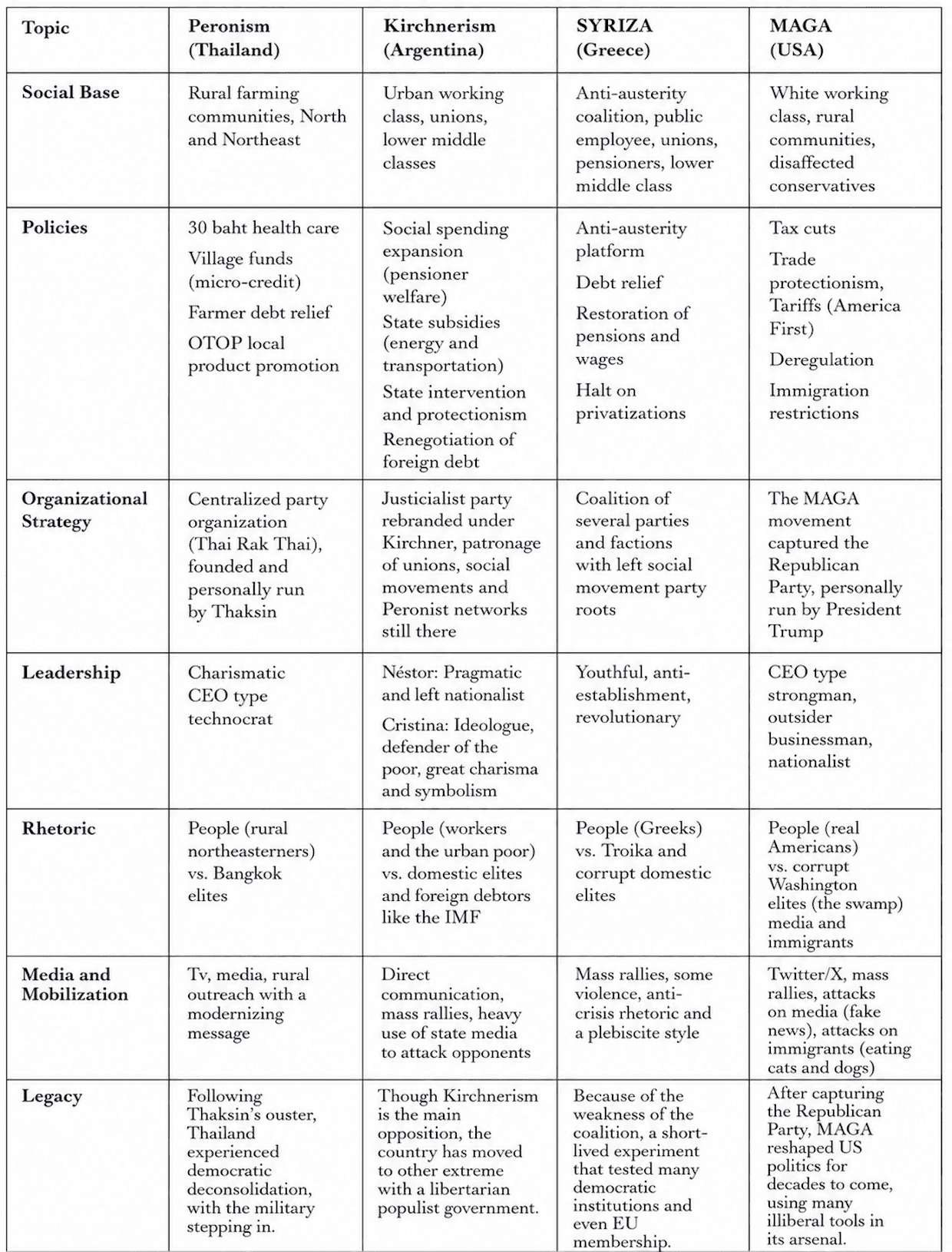
For each of the aforementioned countries, I examined a combination of the base of individuals who have supported a populist leader, their policy populism, their rhetoric, their organizational strategy and leadership style, as well as their mobilization strategy and their legacy (see Table 1 below). The four cases share similarities and differences in how they have implemented populist politics, but the result is the same: the domination of populist politicians over the country's institutional structure. Thailand and the United States chose conservative businessmen with authoritarian/strongman characteristics, while Argentina and Greece chose leftist populist politicians who similarly disavowed the political system.
In all four cases, the political system suffered severe transformations. Polarization increased, clientelism intensified, corruption deepened, and mass rallies were used as a starting point for attacks on national institutions. The international effects and global dislocation of capitalist crises in all four cases gave rise to populist reactions. As a result, democratic institutions suffered in all four countries.
Table 1
References
Alabarces, Pablo. Soccer and the Return of Argentine Politics. Report on Sport and Society 37, no. 5 (March/April 2004).
AP Fact Check: “Trump’s Birther Claims.” Associated Press. September 26, 2016. https://apnews.com/events-united-states-presidential-election-bc9e054698e644e8bc5c05e7f9812291
Baker, Peter & Glasser, Susan (2022). The Divider: Trump in the White House 2017-2021. NY: Doubleday
Bermeo, Nancy. (2016). “On Democratic Backsliding” Journal of Democracy, Vol 27, Number 1, pp. 5-19.
Bernanke, Ben. (2012). “The Economic Recovery and Economic Policy.” Speech, November 20, 2012. Board of Governors of the Federal Reserve System. https://www.federalreserve.gov/newsevents/speech/bernanke20121120a.htm.
Bluestein, Paul. (2005). And the Money Kept Rolling In (and Out). New York: Public Affairs, 2005.
Bunce, Valerie & Wolchik, Sharon. (2011). Defeating Authoritarian Leaders in Post-Communist Countries. Cambridge: Cambridge University Press.
Brinks, Daniel; Leiras, Marcelo and Mainwaring, Scott. (eds.) (2014). Reflections on Uneven Democracies: The Legacy of Guillermo O’Donnell. Baltimore: Johns Hopkins University Press.
Chachavalpongpun, Pavin, (ed.) (2020). Coup, King, Crisis: A Critical Interregnum in Thailand. New Haven: Yale Southeast Asia Studies.
———, (ed.) (2020). Routledge Handbook of Contemporary Thailand. New York: Routledge, 2020.
Connors, Michael & Pathmanand (eds.). (2021). Thai Politics in Translation: Monarchy, Democracy and the Supra-Constitution. Copenhagen: Nordic Institute of Asian Studies.
Davies, William. (2025). “Repeal the 20th Century.” London Review of Books 47, no. 17.
Dendrinou, Victoria and Varvitsioti, Eleni (2019). The Last Bluff: How Greece Came Face to Face with Financial Catastrophe and the Secret Plan for Its Euro Exit. Athens: Papadopoulos Publishing.
De la Torre, Carlos. (2018). Populisms: A Quick Immersion. Lexington, KY: Quick Immersions.
Desai, Padma. (2003). Financial Crisis, Contagion and Containment: From Asia to Argentina. Princeton: Princeton University Press.
Diamond, Larry; Plattner, Marc and Brun, Diego Abente (eds.) (2008). Latin America’s Struggle for Democracy.Baltimore: Johns Hopkins University Press.
Dornbusch, Rüdiger and Edwards, Sebastian. (1991) “The Macroeconomics of Populism.” In: The Macroeconomics of Populism in Latin America, edited by Rüdiger Dornbusch and Sebastian Edwards, 7–13. Chicago: University of Chicago Press.
Faulder, Dominic. (2018). Anand Panyarachun and the Making of Modern Thailand. Singapore: Editions Didier Millet.
Ferrara, Federico. (2015). The Political Development of Modern Thailand. Cambridge: Cambridge University Press.
Foa, Roberto Stefan and Mounk, Yascha. (2017). “The Signs of Deconsolidation.” Journal of Democracy, 28, no.1: 5-65.
Frank, Thomas. (2016). Listen, Liberal: Or, What Ever Happened to the Party of the People? New York: Metropolitan Books.
Gibson, James and Sutherland, Joseph. (2023). “Keeping Your Mouth Shut: Spiraling Self-Censorship in the United States.” Political Science Quarterly 138, no. 3: 361–76.
Goodwin, Lawrence. (1978). The Populist Moment: A Short History of the Agrarian Revolt in America. Oxford: Oxford University Press.
Gurr, Ted. (1970). Why Men Rebel. Princeton, NJ: Princeton University Press.
Hayward, Jack (ed.) (1996). Elitism, Populism, and European Politics. Oxford: Oxford University Press.
Hedges, Jill. (2015) Argentina: A Modern History. London: I.B. Tauris.
Hofstadter, Richard. (1962). Anti-Intellectualism in American Life. New York: Vintage.
———. (2008). The Paranoid Style in American Politics. New York: Vintage.
Judis, John. (2016). The Populist Explosion: How the Great Recession Transformed American and European Politics.New York: Columbia Global Reports.
International Monetary Fund. (2009). World Economic Outlook, April 2009: Crisis and Recovery. Washington, DC: IMF.
Kahler, Miles and Lake, David A. (2013). Politics in the New Hard Times: The Great Recession in Comparative Perspective. Ithaca: Cornell University Press.
Kalyvas, Stathis. (2015). Greece: What Everyone Needs to Know. Oxford: Oxford University Press.
Labrianidis, Lois and Pratsinakis, Manolis. (2017). “Crisis Brain Drain: Short-Term Pain/Long-Term Gain?” In: Greece in Crisis: The Cultural Politics of Austerity, edited by Dimitris Tziovas, 215–36. London: I.B. Tauris, 2017.
Levitsky, Steven and Roberts, Kenneth. (2011). “Latin America’s ‘Left Turn’: A Framework of Analysis.” In: The Resurgence of the Latin American Left, edited by Steven Levitsky and Kenneth Roberts, 1–28. Baltimore: Johns Hopkins University Press.
Levitsky, Steven and Murillo, María Victoria. (2008). “Argentina: From Kirchner to Kirchner.” Journal of Democracy 19, no. 2: 16–30.
———, (eds.) (2005). Argentine Democracy: The Politics of Institutional Weakness. University Park: Pennsylvania State University Press.
Levitsky, Steven. (2005). “Crisis and Renovation: Institutional Weakness and the Transformation of Argentine Peronism, 1983–2003.” In: Argentine Democracy: The Politics of Institutional Weakness, edited by Steven Levitsky and María Victoria Murillo, 193–216. University Park: Pennsylvania State University Press.
MercoPress. (2025). “CFK Lambasts Milei for Deal with IMF.” March 10, 2025. https://en.mercopress.com/2025/03/10/cfk-lambasts-milei-for-deal-with-imf.
Marshall, Andrew MacGregor. (2014). A Kingdom in Crisis: Thailand’s Struggle for Democracy in the Twentieth Century.London: Zed Books, 2014.
Micklethwait, John and Wooldridge, Adrian. (2004). The Right Nation: Conservative Power in America. New York: Penguin Press.
Moffitt, Benjamin. (2016). The Global Rise of Populism: Performance, Political Style and Representation. Stanford: Stanford University Press, 2016.
Moffitt, Benjamin. (2020). Populism. Cambridge: Polity.
Mudde, Cass and Rovira Kaltwasser, Cristóbal. (2017). Populism: A Very Short Introduction. Oxford: Oxford University Press.
Müller, Jan-Werner. (2016). What Is Populism? Philadelphia: University of Pennsylvania Press.
O’Donnell, Guillermo. (1994). “Delegative Democracy.” Journal of Democracy 5, no. 1: 55–69.
Palacios, Irene. (2025). “How Democratic Backsliding and Populism affect trust in democratic institutions.” Democratization, 32:8, 1827-1850.
Palaiologos, Yannis. (2014). The 13th Labour of Hercules: Inside the Greek Crisis. London: Portobello Books.
Paul, Rand. (2011). The Tea Party Goes to Washington. NY: Hatchett Book Group.
Palmer, Tom G. (2019). “The Terrifying Rise of Authoritarian Populism.” CATO Institute Commentary.
Plate, Tom. (2011). From Exile to Deliverance: Thailand’s Populist Tycoon Tells His Story. Singapore: Marshall Cavendish Editions.
Papaconstantinou, George. (2016). Game Over: The Inside Story of the Greek Crisis. Athens: Papadopoulos Publishing.
Παππάς, Τάκης. (2014). Λαϊκισμός και Κρίση στην Ελλάδα. Αθήνα: Ίκαρος.
Pappas, Takis. (2019). Populism and Liberal Democracy: A Comparative and Theoretical Approach. Oxford: OxfordUniversity Press.
Παππάς, Τάκης. (2024). Παράδοξη Χώρα: Γιατί η Ελλάδα υστερεί σε σχέση με την Ιρλανδία και την Πορτογαλία και τι μπορούμε να μάθουμε από αυτές. Αθήνα: Εκδόσεις Πατάκη.
Phongpaichit, Pasuk and Baker, Chris. (2000). Thailand’s Crisis. Singapore: Institute of South Asian Studies.
Phongpaichit, Pasuk and Baker, Chris. (2004). Thaksin: The Business of Politics in Thailand. Chiang Mai: Silkworm Books.
Phongpaichit, Pasuk and Baker, Chris. (2009). A History of Thailand. 2nd ed. Cambridge: Cambridge University Press.
Rowland, Robert. (2021). The Rhetoric of Donald Trump: Nationalist Populism and American Democracy. Lawrence: University of Kansas Press.
Rucker, Philip and Leonning, Carol. (2020). A Very Stable Genius: Donald J. Trump’s Testing of America. New York: Penguin Press.
Ruth, Richard. (2021). A Brief History of Thailand: Monarchy, War and Resilience. Tokyo: Tuttle Publishing.
Schedler, Andreas. (2013). The Politics of Uncertainty: Sustaining and Subverting Electoral Authoritarianism. Oxford: Oxford University Press, 2013.
Skocpol, Theda and Williamson, Vanessa. (2012). The Tea Party and the Remaking of Republican Conservatism. New York: Oxford University Press.
The Economist. (2025). “Argentina’s Finances Got Even More Surreal.” The Economist, September 25, 2025.
The Guardian. (2026). “Five EU Governments found to ‘consistently’ dismantle rule of law.” The Guardian, March 30, 2026.
Tanzi, Vito. (2007). Argentina: An Economic Chronicle. New York: Jorge Pinto Books.
Tziovas, Dimitris, (ed.) (2017). Greece in Crisis: The Cultural Politics of Austerity. London: I.B. Tauris, 2017.
US Congress. (01/07/2025). https://www.congress.gov/bill/119th-congress/senate-bill/23/text/is
Weyland, Kurt. (2001). “Populism as a Political Strategy.” Comparative Politics 31, no. 4: 1–22.
Williamson, Vanessa; Skocpol, Theda and Coggin, John. (2011). “The Tea Party and the Remaking of Republican Conservatism.” Perspectives on Politics 9, no. 1 (March 2011): 25–43.
White House Archives (January 20, 2017). The Inaugural Address. https://trumpwhitehouse.archives.gov/briefings-statements/the-inaugural-address/
From Economic Crisis to Democratic Backsliding: Evidence from Thailand, Argentina, the United States, and Greece
Akis Kalaitzidis
Do economic crises necessarily lead to democratic backsliding? My argument in this paper is that it does. Economic crises lead to increased populism, which ultimately erodes public confidence in the political system and degrades not only democratic regimes (Levitsky & Murillo, 2008) but also authoritarian ones (O’Donnell, 1999; Schedler, 2013). Bunce and Wolchik (2011) argued that the exclusionary populist politics of Slobodan Milosevic destroyed the multicultural authoritarian regime in Yugoslavia. Others have argued it is not necessarily the economic crises that produce populism but the conflict between the “winners and losers” of said economic crisis, which increases the feeling of loss among the many, something in conflict studies we call the Relative Deprivation thesis (Gurr, 1970). Others argue that it is race and status that are responsible for the increasing populism worldwide (Palmer, 2019). Finally, some blame global migratory patterns for being zero-sum, arguing that every newcomer is a net negative for the country that receives them (Palmer, 2019).
Populist regimes are, par excellence, illiberal, argues Pappas (2019). In this sense, democracies decline step by step, embracing new institutional structures that undermine the preceding democratic ones and replace them with illiberal ones. Often personalistic, these new regimes create institutions closer to authoritarianism than to actual democracy and dominate their countries for a long time, for example, Hungary, Turkey, Argentina, etc.
In this paper, I will examine four cases, in the order of the economic crises that affected them: Thailand in 1997, Argentina in 2001, the US in 2008, and Greece in 2015. It is my argument that economic crises arising from global economic dislocations and contagion (Desai, 2003) produce populist regimes that wreak havoc on established institutions and lead countries to political backsliding (Foa & Mounk, 2017). I will explain how populism works in light of severe financial crises, addressing the key elements such as a) its social base, b) the policies associated with the regime, c) its rhetoric, d) the organizational strategy of the regime, e) its leadership style, f) the mobilization associated with regime change, and finally, g) the legacy of each regime.
Populism and Its Discontents
What is populism? And how does it affect different countries? Before I analyze my case studies, it is important to examine how these populist movements form and what they mean. Considering the variation in regimes and political cultures that produce populism, as well as the nebulousness of the concept, it is essential to define it as precisely as possible. Generically, the definition of populism is “a thin center ideology that considers society to be ultimately separated into two homogenous and antagonistic camps, ‘the pure people’ versus the ‘corrupt elite’ and which argues that politics should be an expression of the volonté générale (general will) of the people.” (Mudde & Kaltwasser, 2017). Although Ernesto Laclau (2005) argued that populism does not lead to authoritarianism, my research finds evidence to the contrary. In fact, using populism as an intermediary variable, one can see that economic crisis can lead to political backsliding that takes the form of authoritarianism (Thailand, the USA) or not (Argentina and Greece), depending on political culture. I agree with Laclau that populism is a form of politics, not an ideology, but unlike Laclau, I view populism as a challenge to democracy and argue it should be viewed as such.
Benjamin Moffit describes the various approaches to defining the concept through the years with a) the ideational approach, b) the strategic approach, and c) the discussive performative approach (Moffit, 2020). The Ideational approach argues that populism is a worldview and an ideology. Populism, sure enough, increasingly appeals to even the younger generation and has made inroads in even the strongest liberal democracies. Roberto Stefan Foa and Yascha Mounk argue that there are signs of the deconsolidation of democracies across the board (Foa & Mounk, 2017). Americans have long been growing dissatisfied with the state of their political system. As survey researchers have chronicled over recent decades, an overwhelming majority of citizens now believe that the US is ‘headed in the wrong direction,” (Foa & Mounk, 2017).
In Europe, the shock of Brexit was felt in the corridors of European capitals, and some decided to work against the established order. Several populist leaders, among them the leaders of Italy, Croatia, Slovakia, Hungary, and Bulgaria, made an extra effort to dismantle liberal justice requirements and regress their country’s democracy (The Guardian, 3.30.2026). It remains to be seen whether the trend of democratic backsliding can be reversed following Viktor Orbán's decisive defeat.
In general, there are two forms of backsliding according to Nancy Bermeo (2016: 6): “Backsliding can take us to different end points at different speeds. Where backsliding involves rapid and radical change across a broad range of institutions, it leads to outright democratic breakdown and to regimes that are unambiguously authoritarian.” In one of my cases, a complete deconsolidation of democracy happened with the end of a populist regime in Thailand. Essentially, the end of the Thaksin experiment was the rise of the Thai military. In the other three cases, the backsliding has been much more gradual, and in those cases, Bermeo argues: “Where backsliding takes the form of gradual changes across a broad range of institutions, it is less likely to lead to all-out regime change and more likely to yield political systems that are ambiguously democratic or hybrid” (Bermeo 2016: 6). In other words, illiberal democracies.
The last three cases here, Argentina, the US, and Greece, experienced a decline in democratic values, with the US doing the heavy lifting under the Trump Administration. Yet, even in the mild cases of Greece and Argentina, we have seen a serious weakening of democratic institutions, thus “Democratic backsliding can thus constitute democratic breakdown or simply the serious weakening of existing democratic institutions for undefined ends. When backsliding yields situations that are fluid and ill-defined, taking action to defend democracy becomes particularly difficult,” (Bermeo, 2016:6). So as Palacios (2025: 1832) notes, “a large body of studies has found that populism ‘in the real world’ also has detrimental effects on the quality of democracy. Due to their ambiguous relationship with democracy, once in power, many populist forces adopt an agenda of institutional change that seeks to better approximate their illiberal democratic ideals to the practice.”
What I argue in this paper is that populism transforms economic woes into political and, especially, moral conundrums, pitting parts of society against one another for the benefit of the leadership. The result of populism's divisiveness is frequent democratic backsliding, as seen in Thailand, where it led to a coup d’ etat against Thaksin and renewed authoritarianism. In Greece, the collapse of the party system and increased violence among people, and in the US, the establishment of an authoritarian pronged leadership. Only in Argentina have the populists from the left been replaced by the populists of the right, with no discernible end to their economic woes.
Four Test Cases of Populism That Led to Democratic Backsliding
Seeking an answer to what constitutes a global problem, I have identified four distinct yet successive cases of economic crises that have led to the rise of populist regimes worldwide. First, following the 1997 collapse of the Thai baht, a global crisis brought numerous countries to their knees. Following contagion and mismanagement, Argentina experienced a tremendous decline and has yet to recover. Similarly, during what has been termed the Great Recession in the United States, a significant decline in economic indicators brought increased scrutiny to Europe, which pushed Greece, among other countries, pejoratively labeled PIGS (Portugal, Ireland, Greece, and Spain), into an economic tailspin with predictable results. In all four cases, the results of such financial crises were populism as a response to the decline of traditional political parties and the loosening of established norms and institutions. In addition, in all cases, the legacy of populism was the destruction of the previously established political order. The results of each country only vary due to the political culture of each country, with Thailand returning to authoritarian rule, Argentina to significant reorganization of the state, the US to semi-authoritarianism, and Greece to the collapse of the political order.
Thailand
On July 2, 1997, the Thai government, under international pressure and due to a lack of foreign reserves, floated the Thai Baht, which had been pegged to the US dollar. It is the beginning of a long economic crisis known in Thailand as the Tom Yum Kung (a nickname for the famous soup, meaning "boiled and mixed"). The collapse of the Thai Baht started a contagion process that is today known as the Asian Financial Crisis of 1997 (Phongpaichit & Baker, 2000).
What followed was an election in 2001 led by popular businessman Thaksin Shinawatra and his Thai Rak Thai party, which he founded right after the 1998 crisis. Thaksin was not new to politics, having served as Foreign Minister in the previous government in 1994 and, in 1996, left the party in power to form Thai Rak Thai. In 2001, he won a historic victory, which made him Prime Minister, the only one to serve a full term, I might add, until today. In a country where coups d’état is frequent and palace intrigue permeates all politics, the achievements of the Thaksin government are not negligible (Ferrara, 2015; McGregor, 2015). According to Phongpaichit and Baker (2000), “He won the country’s biggest ever election victory under a new constitution hailed as the most democratic in the country’s history. Then his government controlled the media, harassed civil society, and used violence in ways that recalled Thailand’s past military dictators. … He prioritizes a ‘war on poverty’ while his family business delivers an annual profit equivalent to the total income of a moderate Thai provincial city.” Clearly, his impact on the country was complex, but it also underscored similarities to other populists in our four cases, as I will highlight further.
Thaksin’s social base was the poor, especially in the north and northeast, but also middle-class shopkeepers wary of past government actions and corruption, the Chinese formerly royalist business elite, small business owners, and, of course, the people affected by the “IMF-imposed austerity measures” (McGregor, 2015: 155). He also established and apparently financed the crown prince’s lifestyle, which infuriated the late King (MacGregor, 2015: 157). He implemented several programs for the rural poor, including the 30-baht healthcare program, which was very popular.
For Plate (2011), “His healthcare and economic development policies not only were vote getters but also attention getters. They became his trademark political philosophy.” Thaksin established microcredit village funds, which promoted growth in rural areas and strengthened his political base. In what came to be known as Thaksinomics, he handed approximately twenty-five thousand dollars to each of Thailand’s seventy thousand villages. He established a rural bank to manage the fund, which would lend additional funds to farmers at 4%, below the market borrowing rate, to augment the growth of rural Thailand. As Plate (2011: 42) observes, “Thaksin’s approach was radically different (from Buddhism and Royal grants). Instead of visiting rural areas with the gesture of (in effect) passing out loaves and fishes to sate hunger temporarily and show royal caring, his policies proposed to train poorer Thais to start up their own bread-making and fish-packaging business to develop sustainable enterprises.” He advocated the One Tambon (region), One Product policy, which would supposedly revitalize the poorer region of Thailand which were disorganized and marginalized.
Thaksin used the newly formed Thai Rak Thai party to promote his agenda. Good populists need a political vehicle and an organizational strategy by which to coalesce the largest possible coalition to form a government. In his first “political statement he identified three main problems: first, too many politicians treated politics as a career, as a way to make money. … Second, the Thai bureaucracy was too powerful, too torpid, and too ignorant of the business world. … Third, both politicians and bureaucrats were simply ‘not modern’” (Phongpaichit & Baker, 2004: 172). For Faulder (2018: 410), “Thaksin excelled at addressing and motivating target groups, particularly at political rallies. Many of his campaign techniques were borrowed from abroad with scant acknowledgment. However, in the Thai context, they came across as fresh, dynamic, and modern. Critics would later chide him for pandering to anything that seemed ‘new’ and suspiciously progressive.”
Thaksin went on to sweep 248 out of 500 elected members of the lower house and subsumed the New Aspirations Party of former Prime Minister Chavalit Yongchaiyudh, getting a comfortable majority (Faulder, 2018: 411). His communication strategy, though brilliant for Thai standards, smacks of Western populism. In his own words, “I will stay another five years [in total], as there will not be any challenge left for me. I will go and teach. There will be no poverty, no ‘mafia,’ no societal ills,” (Speech, 21 August 2003 / Phongpaichit & Baker 2004: 239).
Thaksin’s legacy is complex as befit a visionary populist leader in a very conservative country. He conveniently made huge sums of money from his political dealings and created a family dynasty with his sister and daughter that still dominates Thai politics. He refused to accept limits on power and repeatedly broke with the state's norms. He antagonized the military. He failed to control a public insurgency in the south, which may ultimately have cost him his position. Most importantly, he created fertile ground for the rise in political violence between the red shirts and the yellow shirts (Ruth, 2021). Thai politics has been dominated by the Thaksin clan to the present. In his words, “We are a very disciplined family,” (Plate, 2011: 63).
Argentina
On September 22nd, 2025, 15 minutes before Argentina’s foreign-exchange markets opened, America’s government intervened. ‘Argentina is a systemically important U.S. ally,’ Scott Bessent, America’s treasury secretary, wrote on X, a social network. He added that the United States stands ready to do what is needed and that ‘all options for stabilization are on the table.’ “Argentina will be Great Again.” (The Economist, Sep 22nd 2025). Even the casual observer would ask themselves what is going on with Argentina by now. Why can’t they recover from financial pressures after all? There have been so many in the past thirty years; is it endemic in Argentina? What is wrong with the country?
On September 22, 2025, 15 minutes before Argentina's foreign exchange markets opened, the United States government intervened. "Argentina is a systemically important U.S. ally," Scott Bessent, the U.S. Treasury Secretary, wrote on X, the social media platform. He added that the United States stood ready to do what was needed and that "all options for stabilization are on the table." "Argentina will be Great Again" (The Economist, September 22, 2025). Even a casual observer might ask: What is going on with Argentina? Why can't the country recover from its recurring financial pressures? It has experienced so many crises over the past thirty years. Is this endemic to Argentina? What is wrong with the country?
As economist Vito Tanzi explains, there was an increasing cycle of borrowing from the Argentine government: “Export as a share of the GDP had risen from about 6 percent in 1992 to 9 percent in 2000. The foreign debt was soon several times the size of Argentina’s annual export, raising the question of whether it could be repaid,” (Tanzi 2007: 129). It all came to a head in December of 2001. Pablo Alabarces (2004: 33) remembers, “I listened as President Fernando De La Rua addressed the country. He declared a state of siege, an emergency measure limiting the constitutional rights of assembly and other civil liberties.” Thousands of people rushed the streets chanting “All of them must go! (Que se vayan todos!),” and several were shot, and one died on the scene. The crisis had claimed lives, with the total tally rising to thirty-nine. Finance Minister Domingo Cavallo implemented the Corralito to halt the run on the banks, which essentially froze bank accounts, preventing people from withdrawing their money (Bluestein, 2005: 175).
What followed the Argentinazo was the abdication of two presidents within ten days, followed by the election of Nestor Kirchner as president. He was the leader of the little-known Judicialist Party, which is on the Peronist side. Kirchner proceeded to stabilize the economy with the help of Roberto Lavagna as his finance minister, and after that handed the reins of the country to his wife, Cristina Fernández de Kirchner, who, in subsequent elections, won 45 percent and 54 percent, respectively. Her policies were populist par excellence.
A true firebrand, she used her political speeches to rouse the public against the evils of the international lenders and the IMF. Aided by the successful policies of her late husband, she was able to generate much support among the public (Levitsky & Murillo, 2008: 17). She was able to raise real wages and extend the power of her base with the working classes (Levitsky & Murillo, 2008: 17) She extended welfare benefits and was able to benefit electorally from this massive public expenditure (Levitsky & Murillo, 2008: 17). She used the extensive Peronist party machine to mobilize the voters. She packed the courts (Levitsky & Murillo 2008: 18). The State intervened in the economy, she fired the personnel of the national statistical office, and instituted protectionist policies. She attacked the IMF as the enemy of the Argentinian people and has kept up her pressure to this day (MacroPress, March 10th 2025).
Her organizational strategy benefited from the Judicialist Party’s institutional weakness, which made it easy to rebrand as Kirchnerism. Levitsky and Murillo (2005:183) argues, “when organizational rules are ambiguous, contested, or constantly changing, actors cannot form stable expectations. Consequently, time horizons tend to be shorter, mutual trust is lower, and cooperation is more difficult to sustain. In such a context, actors must invest substantial time and energy into resolving internal conflicts, settling procedural disputes, coordinating activities, and monitoring others’ behavior. The result is often inefficiency, disorder, and even chaos.” So, Cristina Fernandez Kirchner was the beneficiary of such weakness, which dominated her political party and, by extension, the country (Levitsky; 2025: 184). In fact, the Argentinian super-presidency was her vehicle for dominating Argentinian politics for a long while.
As the Latin American countries started veering left from the right-wing populist regimes that dominated them, left nationalism and appeals to the poor versus the elite became a common occurrence (Levitsky & Roberts, 2011: 6). The claims and accusations were amplified but the dominance of state media was used to attack the detractors of President Kirchner, including the largest media conglomerate, the Clarin. From Berlusconi to Thaksin, most populist leaders tend to dominate the media space and give no quarter to their opponents. In Argentina, this was nothing new, having been trained by the Peron regime in the 1940’s and the hagiographies of Evita Peron, and the media has always been used in favor of the president. Cultural critic Beatriz Sarlo, quoted in Carlos De La Torre’s book, Populisms: A Quick Immersion, states, “politics in the mass media is subordinated to the laws that regulate audiovisual flow: high impact, large quantities of undifferentiated visual information, and arbitrary syntax that is better suited to a matinee melodrama than to the political arena” (De La Torre, 2018).
The legacy of the Kirchners is that of a populist mega-dynasty that has kept Argentina at odds with global economic institutions and led to the return of reactionary politics in the form of the right-wing President Milei. Cristina Fernández Kirchner has been sentenced to six years for corruption and permanently banned from holding office. Yet at seventy-two, she remains a formidable force in Argentine politics, and Peronism is likely to rise again.
Greece
In 2009, Greece began facing a sovereign debt crisis, characterized by an inability to meet its international debt obligations. The crisis was a long time coming and was anticipated by the conservative government of Kostas Karamanlis, who did little to prevent it, and was handed over to the Socialist party leadership like an explosive device. George Provopoulos, the leader of the Bank of Greece, had informed both leaders that it was coming, and yet the Socialist leaders decided it would be wise to ignore it (Papakostantinou, 2016: 25). Famously, George Papandreou argued, in campaign speeches, that “there is money.” Predictably, he won the 2009 election. His economics minister, George Papakonstantinou, proceeded to negotiate an economic memorandum of understanding with the Troika, the Eurogroup, the IMF, and the European Central Bank (Papakostantinou, 2016). The memorandum, a fiscal austerity document, became the most hated in Greece and sparked an angry public reaction.
The Greek crisis had many causes, some internal and some external: a) government profligacy could be the main cause, b) cooking the stats was another, and c) the Great Recession in the US and its effect would be the main external one. Predictably, the results of the crisis were the collapse of the Socialist party of Greece, which was the government that negotiated the first austerity memorandum, instability in the following governments with several Prime Ministers taking the helm in a very short time, social unrest and violence that claimed lives (Παππας, 2014: 20). As a result, Greece politics grew more polarized and witnessed the rise of the coalition of the left political parties which would take over and nearly lead to Grexit, and the rise of the extreme rightwing and Nazi parties in Greece. The economic results were catastrophic to say the least, with high unemployment, an economic depression, and a massive exodus of skilled labor (Labrianidis & Pratsinakis, 2017). Populism thrives in such conditions.
The rise of Syriza, the leftist coalition that ruled Greece from 2015 to 2019, was rapid and a result of Greece's economic conditions. According to Judis (2016: 115), “In the 2012 elections, SYRIZA did best among young voters, the unemployed, and the urban employed in both public and private sectors. It did the worst among housewives, senior citizens, and rural voters. While the party had its roots in the Eurocommunist left, SYRIZA shifted in 2012 to making a populist appeal.” In the next election, during the worst of the Greek economic depression, SYRIZA would be in government, assisted by a right-wing populist party, ANEL. Led by a young charismatic leader reminiscent of the great populist leader of PASOK, Andreas Papandreou, who ruled Greece in the 1980s and 1990s before his death, named Alexis Tsipras.
The policy populism SYRIZA followed was predictable in the sense that the first thing they denied was that anyone in Greece would have to pay for the ballooning national debt. Their platform was an anti-austerity platform. Other minor movements also spawned, titled “Δεν Πληρώνω (I’m not paying). People went around refusing to pay road tolls and filming themselves doing it. The public was angry, to say the least (Παππας, 2014:178). “The people” became a constant reference in the SYRIZA vocabulary. Tsipras is quoted as saying a week before the 2012 election, “Sunday is not just about a simple confrontation between SYRIZA and the political establishment of the Memorandum… It is about people's encounters with their lives. An encounter of the people with their fate… Between the Greece of the oligarchy and the Greece of Democracy,” (Judis, 2016: 116). Naturally, the party was for restoring the then-reduced pensions and halting privatizations. The biggest promise was of political resistance to the Troika demands, with a threat to collapse the European, if not global, economic system, arguing that a “Grexit” would lead to global catastrophe.
The rhetoric of SYRIZA reached its crescendo with an anti-German and anti-Euro stance. Kalyvas (2015:186) writes, “In the end, the dominant narrative about the crisis informed the rhetorical tropes of the populist ideology that had triumphed during the 1980’s. The old anti-American and anti-imperialist discourses were easily recycled into an anti-capitalist and anti-German narrative. Media analysis became suffused with ‘charlatan economicc’ and conspiracy theories that mixed extreme nationalism with simplistic Marxism.” Yiannis Varoufakis who became the finance minister and chief negotiator for SYRIZA, accused the conservatives that were “acting like a model prisoner, obeying the Troika instructions, while, on the side pleading for a rationalization of the imposed policies, terms and conditions” (Judis, 2016: 116).
The organizational strategy of SYRIZA was that of a loose coalition of activists, many of whom had no experience in parliamentary procedure, and of social movements that were either newly founded or loosely associated with the broad left, now coalescing with SYRIZA. Alexis Tsipras’ youthful appearance and firebrand politics appealed to the public in that particular moment. He became, in fact, the face of the political system's deterioration. While the parliament heatedly discussed the memorandum in May of 2010, banks were burned in parts of the country, killing three people.
By 2015, SYRIZA had peaked in its dominance of the Greek political scene. As part of his strategy, Alexis Tsipras demanded the people's solidarity so he could negotiate a better deal for the country. The strategy was that of a referendum, announced on June 17, 2015. It was the first referendum since 1974 and one on fiscal matters. The referendum question was complicated and asked people to choose whether the memorandum with the Troika was acceptable, yes or no. “The situation was also tense in Brussels that Monday morning Jean-Claude Junker had decided to make a heartfelt appeal to the Greek voters, asking them to vote yes in the upcoming referendum and ignore the governments guidance,” (Dendrinou & Varvitsioti, 2019: 236). He referred to Greece being in the EU as “playing in the first division, he did not want to see Plato in the Second Division,” he argued, a soccer analogy that would maybe persuade the Greeks (Dendrinou & Varvitsioti, 2019). Predictably, the public again chose NO, with nearly 62% of the vote, and Grexit was a real possibility at this point.
The legacy of SYRIZA in leading Greece was one of failing to achieve a better deal for the country. Alexis Tsipras chose not to weaponize his threats, and Greece remained in the Eurozone, albeit with a worse agreement than before. The results of his risky strategy were that he retired from politics, his finance minister resigned and went on to create a pan-European party despite the irony, and SYRIZA fell in the polls.
USA
American populism is not new, nor is it unique. Despite all the claims of American exceptionalism, the country has had a great many populist movements going back at least to the nineteenth century (Goodwin, 1978; Micklethwait & Wooldridge, 2004; Davies, 2025). It is, though, true that it has been able to produce a rather vibrant, if not the most potent, conservative movement to become government in the Western world (Micklethwait &Wooldridge, 2004: 11). In what was supposed to be a country championing free speech, “the percentage of American people not feeling free to express their view has tripled,” (Gibson & Sutherland, 2023). Nonetheless, I argue that the current populist era in America is a result of the 2008 economic crisis and will eventually lead to political catastrophe, as it did in the previous three cases.
Over the 18 months between the end of 2007 and 2009, a massive economic crisis rocked the United States and, indeed, the rest of the world. It was fueled by the subprime mortgage crisis, in which house prices began to fall, and owners abandoned their homes and mortgages. The consequence of such an economic downturn was the collapse of giant Wall Street banks, such as Lehman Brothers and Bear Stearns (IMF, 2009). The effects of the crisis were widely felt, including high unemployment, bank runs, credit restrictions, and reduced consumer spending (Bernanke, 2012). The result was the creation of the Troubled Asset Relief Program (TARP) by President Bush, a program designed to recover toxic assets in the US economy. The state’s direct intervention in the economy to recapitalize banks led to a populist anti-Wall Street movement, Occupy Wall Street, which objected to the bailout of banks while people were losing their homes. The movement fizzled out rather quickly after the election of President Obama, giving way to a conservative movement that began with Senator Rand Paul's presidential campaign, known as the Tea Party movement (Paul, 2011; Braunstein; 2015, Williamson et al., 2011).
The most visible person critiquing the Obama administration during the Tea Party days of rage was Donald J. Trump, who claimed the president was born in Kenya, and demanded to see his birth certificate, giving birth to the conspiracy movement known as ‘Birtherism’ (AP, 2016). With name recognition beyond question, Trump built a social base for his candidacy based on white working and middle-class voters disaffected by the Great Recession, opposing Obama’s Affordable Care Act (ACA), and the economic bailouts of banks. According to Rucker and Leoning (2020: 2), “Tens of millions of Americans were angry, feeling forgotten by bureaucrats in Washington, derided by liberal elites, and humiliated by a global economy that had sped ahead of their skills and consigned their children to be the first American generation to fare less well than their parents.”
President Trump also coined the “Make America Great Again” (MAGA) slogan, which has since become the name of his movement. The policies associated with that movement were outlined in the President’s first inaugural address titled “American Carnage,” where he said, “From this day forward, a new vision will govern our land. From this moment on, it’s going to be America First. Every decision on trade, taxes, immigration, and foreign affairs will be made to benefit American workers and American families. We must protect our borders from the ravages of other countries making our products, stealing our companies, and destroying our jobs. Protection will lead to great prosperity and strength,” (White House Archives, 2017). Policy populism is nothing new, and in America, it has a long history, yet it has never been such a pugilistic affair involving the President himself. Because of his pugilism, this President has been called “The Divider”(Baker & Glasser, 2022).
His rhetorical acumen is well known, and according to Robert Rowland (2021), it belongs to the nationalist/authoritarian/strongman persona type. Rowland argues, “Nationalist populism is similar to progressive populism in its biting tone and attack on the elites, but the remaining content of the message is quite different. Rather than focusing on policy change to address elite domination, nationalist populism is an affective genre that responds to a sense that some kind of outside group threatens American identity,” (Rowland, 2021: 11). Trump famously promised to “drain the swamp” and was introduced in the US Congress with that name by Senator Joni Ernst of Iowa (191st US Congress 2025). His MAGA movement has completely taken over the Republican Party.
His leadership style is also that of an authoritarian/strongman/outsider. In his speeches, the President said, “We are liberating towns and cities. We are liberating – people are screaming from their windows, thank you to the border patrol. … We are destroying the bloodthirsty criminal gangs. … We don’t want radical Islamic terrorists in our country. We’ve seen the total devastation of Europe,” (Rowland, 2021: 89). Famously, he justified a violent white supremacist rally in Charlottesville, Virginia, saying there were “very fine people on both sides” (Rowland 2021: 90). He rallies his base on X and Truth Social, constantly attacking the news media by calling them fake news and the enemy of the people. He continually criticizes people based on their TV ratings. For Rowland (2021: 94), “his persona shifted from outsider to strongman, a message he enacted by making claims of incredible accomplishments, often about trends that preexisted his presidency or about events that had not happened.” In addition, meritocracy was out; this was a family business, and for that matter, family and close allies came first (Rucker & Leonning, 2002).
The legacy of Trumpism in the short term is the reshaping of US politics, especially the Republican Party. After the Biden interlude, he has returned with even more power and is constantly attacking and destroying institutions he claims are part of the corrupt Democratic “deep state.” He has attacked his detractors and sent the Department of Justice after them. He went as far as to suggest that the US military train in US cities.
Conclusion
Although my point of departure for this work has been the book Politics in the New Hard Times by Kahler and Lake (2013), I treat successive economic crises as exogenous shocks that affect people's political fortunes and prompt them to shape policy through populist politics. In this paper, I examine the politics of Thailand after the 1997 crisis, Argentina after the 2001 crisis, and the US and Greece after the Great Recession.
For each of the aforementioned countries, I examined a combination of the base of individuals who have supported a populist leader, their policy populism, their rhetoric, their organizational strategy and leadership style, as well as their mobilization strategy and their legacy (see Table 1 below). The four cases share similarities and differences in how they have implemented populist politics, but the result is the same: the domination of populist politicians over the country's institutional structure. Thailand and the United States chose conservative businessmen with authoritarian/strongman characteristics, while Argentina and Greece chose leftist populist politicians who similarly disavowed the political system.
In all four cases, the political system suffered severe transformations. Polarization increased, clientelism intensified, corruption deepened, and mass rallies were used as a starting point for attacks on national institutions. The international effects and global dislocation of capitalist crises in all four cases gave rise to populist reactions. As a result, democratic institutions suffered in all four countries.
Table 1
References
Alabarces, Pablo. Soccer and the Return of Argentine Politics. Report on Sport and Society 37, no. 5 (March/April 2004).
AP Fact Check: “Trump’s Birther Claims.” Associated Press. September 26, 2016. https://apnews.com/events-united-states-presidential-election-bc9e054698e644e8bc5c05e7f9812291
Baker, Peter & Glasser, Susan (2022). The Divider: Trump in the White House 2017-2021. NY: Doubleday
Bermeo, Nancy. (2016). “On Democratic Backsliding” Journal of Democracy, Vol 27, Number 1, pp. 5-19.
Bernanke, Ben. (2012). “The Economic Recovery and Economic Policy.” Speech, November 20, 2012. Board of Governors of the Federal Reserve System. https://www.federalreserve.gov/newsevents/speech/bernanke20121120a.htm.
Bluestein, Paul. (2005). And the Money Kept Rolling In (and Out). New York: Public Affairs, 2005.
Bunce, Valerie & Wolchik, Sharon. (2011). Defeating Authoritarian Leaders in Post-Communist Countries. Cambridge: Cambridge University Press.
Brinks, Daniel; Leiras, Marcelo and Mainwaring, Scott. (eds.) (2014). Reflections on Uneven Democracies: The Legacy of Guillermo O’Donnell. Baltimore: Johns Hopkins University Press.
Chachavalpongpun, Pavin, (ed.) (2020). Coup, King, Crisis: A Critical Interregnum in Thailand. New Haven: Yale Southeast Asia Studies.
———, (ed.) (2020). Routledge Handbook of Contemporary Thailand. New York: Routledge, 2020.
Connors, Michael & Pathmanand (eds.). (2021). Thai Politics in Translation: Monarchy, Democracy and the Supra-Constitution. Copenhagen: Nordic Institute of Asian Studies.
Davies, William. (2025). “Repeal the 20th Century.” London Review of Books 47, no. 17.
Dendrinou, Victoria and Varvitsioti, Eleni (2019). The Last Bluff: How Greece Came Face to Face with Financial Catastrophe and the Secret Plan for Its Euro Exit. Athens: Papadopoulos Publishing.
De la Torre, Carlos. (2018). Populisms: A Quick Immersion. Lexington, KY: Quick Immersions.
Desai, Padma. (2003). Financial Crisis, Contagion and Containment: From Asia to Argentina. Princeton: Princeton University Press.
Diamond, Larry; Plattner, Marc and Brun, Diego Abente (eds.) (2008). Latin America’s Struggle for Democracy.Baltimore: Johns Hopkins University Press.
Dornbusch, Rüdiger and Edwards, Sebastian. (1991) “The Macroeconomics of Populism.” In: The Macroeconomics of Populism in Latin America, edited by Rüdiger Dornbusch and Sebastian Edwards, 7–13. Chicago: University of Chicago Press.
Faulder, Dominic. (2018). Anand Panyarachun and the Making of Modern Thailand. Singapore: Editions Didier Millet.
Ferrara, Federico. (2015). The Political Development of Modern Thailand. Cambridge: Cambridge University Press.
Foa, Roberto Stefan and Mounk, Yascha. (2017). “The Signs of Deconsolidation.” Journal of Democracy, 28, no.1: 5-65.
Frank, Thomas. (2016). Listen, Liberal: Or, What Ever Happened to the Party of the People? New York: Metropolitan Books.
Gibson, James and Sutherland, Joseph. (2023). “Keeping Your Mouth Shut: Spiraling Self-Censorship in the United States.” Political Science Quarterly 138, no. 3: 361–76.
Goodwin, Lawrence. (1978). The Populist Moment: A Short History of the Agrarian Revolt in America. Oxford: Oxford University Press.
Gurr, Ted. (1970). Why Men Rebel. Princeton, NJ: Princeton University Press.
Hayward, Jack (ed.) (1996). Elitism, Populism, and European Politics. Oxford: Oxford University Press.
Hedges, Jill. (2015) Argentina: A Modern History. London: I.B. Tauris.
Hofstadter, Richard. (1962). Anti-Intellectualism in American Life. New York: Vintage.
———. (2008). The Paranoid Style in American Politics. New York: Vintage.
Judis, John. (2016). The Populist Explosion: How the Great Recession Transformed American and European Politics.New York: Columbia Global Reports.
International Monetary Fund. (2009). World Economic Outlook, April 2009: Crisis and Recovery. Washington, DC: IMF.
Kahler, Miles and Lake, David A. (2013). Politics in the New Hard Times: The Great Recession in Comparative Perspective. Ithaca: Cornell University Press.
Kalyvas, Stathis. (2015). Greece: What Everyone Needs to Know. Oxford: Oxford University Press.
Labrianidis, Lois and Pratsinakis, Manolis. (2017). “Crisis Brain Drain: Short-Term Pain/Long-Term Gain?” In: Greece in Crisis: The Cultural Politics of Austerity, edited by Dimitris Tziovas, 215–36. London: I.B. Tauris, 2017.
Levitsky, Steven and Roberts, Kenneth. (2011). “Latin America’s ‘Left Turn’: A Framework of Analysis.” In: The Resurgence of the Latin American Left, edited by Steven Levitsky and Kenneth Roberts, 1–28. Baltimore: Johns Hopkins University Press.
Levitsky, Steven and Murillo, María Victoria. (2008). “Argentina: From Kirchner to Kirchner.” Journal of Democracy 19, no. 2: 16–30.
———, (eds.) (2005). Argentine Democracy: The Politics of Institutional Weakness. University Park: Pennsylvania State University Press.
Levitsky, Steven. (2005). “Crisis and Renovation: Institutional Weakness and the Transformation of Argentine Peronism, 1983–2003.” In: Argentine Democracy: The Politics of Institutional Weakness, edited by Steven Levitsky and María Victoria Murillo, 193–216. University Park: Pennsylvania State University Press.
MercoPress. (2025). “CFK Lambasts Milei for Deal with IMF.” March 10, 2025. https://en.mercopress.com/2025/03/10/cfk-lambasts-milei-for-deal-with-imf.
Marshall, Andrew MacGregor. (2014). A Kingdom in Crisis: Thailand’s Struggle for Democracy in the Twentieth Century.London: Zed Books, 2014.
Micklethwait, John and Wooldridge, Adrian. (2004). The Right Nation: Conservative Power in America. New York: Penguin Press.
Moffitt, Benjamin. (2016). The Global Rise of Populism: Performance, Political Style and Representation. Stanford: Stanford University Press, 2016.
Moffitt, Benjamin. (2020). Populism. Cambridge: Polity.
Mudde, Cass and Rovira Kaltwasser, Cristóbal. (2017). Populism: A Very Short Introduction. Oxford: Oxford University Press.
Müller, Jan-Werner. (2016). What Is Populism? Philadelphia: University of Pennsylvania Press.
O’Donnell, Guillermo. (1994). “Delegative Democracy.” Journal of Democracy 5, no. 1: 55–69.
Palacios, Irene. (2025). “How Democratic Backsliding and Populism affect trust in democratic institutions.” Democratization, 32:8, 1827-1850.
Palaiologos, Yannis. (2014). The 13th Labour of Hercules: Inside the Greek Crisis. London: Portobello Books.
Paul, Rand. (2011). The Tea Party Goes to Washington. NY: Hatchett Book Group.
Palmer, Tom G. (2019). “The Terrifying Rise of Authoritarian Populism.” CATO Institute Commentary.
Plate, Tom. (2011). From Exile to Deliverance: Thailand’s Populist Tycoon Tells His Story. Singapore: Marshall Cavendish Editions.
Papaconstantinou, George. (2016). Game Over: The Inside Story of the Greek Crisis. Athens: Papadopoulos Publishing.
Παππάς, Τάκης. (2014). Λαϊκισμός και Κρίση στην Ελλάδα. Αθήνα: Ίκαρος.
Pappas, Takis. (2019). Populism and Liberal Democracy: A Comparative and Theoretical Approach. Oxford: OxfordUniversity Press.
Παππάς, Τάκης. (2024). Παράδοξη Χώρα: Γιατί η Ελλάδα υστερεί σε σχέση με την Ιρλανδία και την Πορτογαλία και τι μπορούμε να μάθουμε από αυτές. Αθήνα: Εκδόσεις Πατάκη.
Phongpaichit, Pasuk and Baker, Chris. (2000). Thailand’s Crisis. Singapore: Institute of South Asian Studies.
Phongpaichit, Pasuk and Baker, Chris. (2004). Thaksin: The Business of Politics in Thailand. Chiang Mai: Silkworm Books.
Phongpaichit, Pasuk and Baker, Chris. (2009). A History of Thailand. 2nd ed. Cambridge: Cambridge University Press.
Rowland, Robert. (2021). The Rhetoric of Donald Trump: Nationalist Populism and American Democracy. Lawrence: University of Kansas Press.
Rucker, Philip and Leonning, Carol. (2020). A Very Stable Genius: Donald J. Trump’s Testing of America. New York: Penguin Press.
Ruth, Richard. (2021). A Brief History of Thailand: Monarchy, War and Resilience. Tokyo: Tuttle Publishing.
Schedler, Andreas. (2013). The Politics of Uncertainty: Sustaining and Subverting Electoral Authoritarianism. Oxford: Oxford University Press, 2013.
Skocpol, Theda and Williamson, Vanessa. (2012). The Tea Party and the Remaking of Republican Conservatism. New York: Oxford University Press.
The Economist. (2025). “Argentina’s Finances Got Even More Surreal.” The Economist, September 25, 2025.
The Guardian. (2026). “Five EU Governments found to ‘consistently’ dismantle rule of law.” The Guardian, March 30, 2026.
Tanzi, Vito. (2007). Argentina: An Economic Chronicle. New York: Jorge Pinto Books.
Tziovas, Dimitris, (ed.) (2017). Greece in Crisis: The Cultural Politics of Austerity. London: I.B. Tauris, 2017.
US Congress. (01/07/2025). https://www.congress.gov/bill/119th-congress/senate-bill/23/text/is
Weyland, Kurt. (2001). “Populism as a Political Strategy.” Comparative Politics 31, no. 4: 1–22.
Williamson, Vanessa; Skocpol, Theda and Coggin, John. (2011). “The Tea Party and the Remaking of Republican Conservatism.” Perspectives on Politics 9, no. 1 (March 2011): 25–43.
White House Archives (January 20, 2017). The Inaugural Address. https://trumpwhitehouse.archives.gov/briefings-statements/the-inaugural-address/