
Mandate Inflation: How Populists Claim Authority to Challenge Global Constraints
Muhammad Faizan Aslam*
Introduction
Populist leaders rarely challenge international order by saying only that a treaty, court or organization is inefficient. They often say something stronger. They argue that constraints on government action stand between the people and democratic control (Dijkstra & Ghassim, 2025). Trade agreements become “bad deals” made by globalist elites (Finbow, 2023). Courts become “foreign” or “unelected bodies.” Migration rules become “imposed commands.” Expert advice becomes “technocratic obstruction.” The point is not only policy disagreement. The point is authority (Wajner et al., 2024).
This creates a puzzle for international relations as populist leaders do not respond to global constraint in a single way. Some withdraw from agreements. Some seek better terms. Some stay inside institutions while blocking decisions. Some comply with parts of a regime while attacking other parts. Some use defiant language even when policy change is limited. Recent research on global populism has made this variation clear (Pacciardi et al., 2024; Wajner & Giurlando, 2024). It has also shown that populist foreign policy is now a serious research programme rather than a side question for domestic politics (Ozdamar & Yanik, 2024; Wajner & Giurlando, 2024). What remains underdeveloped is the democratic authorization mechanism that makes such varied strategies appear legitimate to supporters.
This article calls that process of turning a vote into a broader political claim “mandate inflation.” Mandate inflation is the process through which a populist leader recasts an election or referendum from a limited permission to govern into a wider claim of authority to challenge, override or rewrite constraints in the name of the people. The concept is deliberately narrow. It is not a synonym for nationalism, anti-globalism, sovereignty talk or ordinary treaty renegotiation. It is present when four claims appear together: a complex vote is condensed into one clear mandate; that mandate is attached to “the real people”; international or EU-level constraints are described as illegitimate barriers to that people; and the leader claims authority to act against those constraints. Mandate inflation is therefore observed in actors' claims; whether those claims generate public acceptance or independently cause policy outcomes is a separate empirical question.
The argument matters because global constraints are not self-explanatory objects, and their political effects depend on observable factors such as legal form, institutional location, economic impact and domestic visibility. They can be legal commitments, institutional procedures, market pressures, treaty obligations, policy standards, rights regimes or expert rules. Many have been voluntarily accepted by elected governments. Some are popular because they provide security, market access, rights protection or credibility. Others are weakly accountable, socially unequal or politically remote. Populist leaders exploit this mixed character. They do not need to prove that a constraint is legally invalid. They need to make it look democratically suspect (Ecker-Ehrhardt et al., 2025; Tallberg & Zürn, 2019).
This is why the argument avoids a simple defense of global governance. It does not assume that international institutions are always democratically healthy or that popular control is a false problem. Many voters experience international commitments through job loss, austerity, migration pressure, border disputes, legal complexity or distant expert language (Bellodi et al., 2024; Scheiring et al., 2024a). The issue is not whether these concerns should be dismissed. The issue is how a leader turns them into an exclusive claim to speak for the people against constraints that may also have democratic authorization of their own.
This article compares three cases: Trump's “America First” politics, Brexit's “take back control” discourse and Viktor Orbán's confrontation with EU constraints. The cases are not treated as identical. Trump shows presidential mandate inflation in a great power setting, with exit, renegotiation and symbolic defiance. Brexit shows how a referendum can be converted into a mandate to leave a regional legal order. Orbán shows that mandate inflation can also work from inside an institution through obstruction, selective compliance and public defiance. The cases vary by mandate source, institutional location and strategy toward constraint. This variation is useful because the argument does not predict one outcome. It explains how different strategies are justified through a similar claim about the people. The relevant actors are the Trump administration, the Leave-to-government coalition centered on the May government, and the Orbán government; campaign rhetoric, official government claims, legal acts and institutional responses are treated as distinct forms of evidence.
The article makes three contributions. First, it adds a mechanism to recent work on populism and international affairs. Existing scholarship shows that populist governments affect foreign policy, international institutions, trade, migration, security and world order visions in uneven ways (Brusenbauch Meislova & Chryssogelos, 2024; Destradi & Plagemann, 2024; Wajner & Giurlando, 2024). Mandate inflation explains how this unevenness can still share a common democratic grammar. Second, it connects populism research to work on international institutions and unilateral challenges. Institutions face not only legal non-compliance, but also domestic struggles over whether their constraints count as legitimate democratic commitments (Walter & Plotke-Scherly, 2025). Third, it separates voter-side causes from leader-side authorization. Economic insecurity, status grievance, territorial loss and backlash against globalization may help explain why populist appeals resonate(Carter & Pop-Eleches, 2025; Koenig & Mendelberg, 2026; Scheiring et al., 2024b). They do not by themselves explain how leaders turn a vote into authority to contest courts, treaties or international organizations.
The article proceeds in five steps. It first places the argument in recent literature on global populism, foreign policy and international institutions. It then defines “mandate inflation” and its boundary conditions. The empirical sections trace the mechanism in the United States, the United Kingdom and Hungary. The comparative discussion explains why the same authorizing logic supports different strategies toward constraint. The conclusion draws implications for scholars and policy practitioners who face populist challenges to global governance.
Populism, Mandate and Global Constraint
The current literature no longer treats populism as a purely domestic problem. A large recent body of work asks how populism changes foreign policy, institutional behavior, trade politics, migration, security and the legitimacy of global governance. It builds on that debate but shifts the focus from populist impact to populist authorization.
The first relevant stream is literature on populist foreign policy. Recent mapping work describes a developing research programme that studies populism as a force in international relations, not only as an ideology or electoral style (Wajner & Giurlando, 2024). Scholars now examine how populist leaders personalize foreign policy, politicize foreign ministries, escalate or avoid disputes, revise trade discourse, securitize migration and imagine alternative world orders. This research is important because it rejects a simple domestic-foreign divide. Populists govern, bargain, appoint officials, enter negotiations and make institutional choices (Wajner, 2022).
The same literature also shows why a new mechanism is needed. Populist foreign policy does not have one stable content. Right-wing and left-wing populists do not approach international order in the same way. Even right-wing populists vary across trade, migration, security, health, climate and regional institutions. The 2024 International Affairs debate on global populism is especially useful here. It shows that populist impact is real but uneven. Populist leaders may weaken international institutions, but they may also remain inside them, use them selectively or adapt foreign policy institutions rather than destroy them (Farias et al., 2024; Pacciardi et al., 2024; Wajner et al., 2024). The key question is therefore not whether populists are simply anti-international. It is how they claim authority for different ways of contesting constraint.
A second stream studies international institutions, global governance and unilateral challenges. Work on unilateral challenges shows that states can withdraw, block, renegotiate or violate institutional commitments, and that institutions respond in different ways depending on design, membership and issue area (Walter & Plotke-Scherly, 2025). Other works show that global governance depends on information, expertise, public support, nonstate participation and institutional legitimacy (Carnegie, Clark, & Kaya, 2024; Carnegie, Clark, & Zucker, 2024; Ecker-Ehrhardt et al., 2025; Pinto et al., 2025). These studies prevent a crude view of international constraints as either always democratic or always anti-democratic. Institutions can be voluntarily created and publicly useful, yet still become vulnerable when they seem remote, unequal or unresponsive (Ecker-Ehrhardt et al., 2025; Tallberg & Zürn, 2019).
Populist leaders operate in that vulnerability. They often turn a legal or policy dispute into a democratic dispute. A trade agreement is not only costly; it is a betrayal (Brusenbauch Meislova & Chryssogelos, 2024; Finbow, 2023). A climate accord is not only burdensome; it serves outsiders (Trump, 2017). A regional court is not only intrusive; it blocks the people's will (Voeten, 2020). An expert body is not only mistaken; it belongs to an elite system (Bellodi et al., 2024). Mandate inflation names the process through which constraints are recast in this way.
A third stream explains why populist claims resonate. Recent work links populist support to globalization backlash, economic insecurity, social status, territorial loss, bureaucracy, performance and political resentment (Bellodi et al., 2024; Carter & Pop-Eleches, 2025; Koenig & Mendelberg, 2026; Scheiring et al., 2024b). These explanations are necessary. Populist mandate claims do not float above social life. They gain force from real grievances, unequal gains from integration, distrust in institutions and perceived loss of control. Yet demand-side explanations leave one step underexplained. They tell us why people may be receptive to anti-constraint politics. They do not fully explain how leaders translate that support into authority over international commitments (Cortijos-Bernabeu et al., 2026).
Older foundational work remains useful, although it does not carry the writing's main explanatory burden. Populism is understood here as a politics that opposes a “real people” to “corrupt elites” and claims that politics should express the people's general will. Nationalism is related but distinct. It supplies language of nation, belonging and loss, while populism supplies the claim that the real people have been blocked by elites and that their voice should decide politics. Earlier work on backlash against international courts also showed that populist leaders can make international authority a target of domestic politics (Voeten, 2020). These works provide conceptual anchors. The main debate, however, is the recent IR debate on how populism affects global governance in practice.
The gap is therefore precise. Scholars have shown that populist governments affect foreign policy and global institutions. They have shown that populist impact varies. They have shown that grievances and institutional features matter. What remains less specified is the mandate mechanism through which a vote is turned into authority over concrete constraints such as trade agreements, climate commitments, regional courts, migration rules, funding conditions and expert bodies. Mandate inflation fills that gap.
Mandate inflation differs from nearby concepts in its focus and required evidence. Anti-pluralism is the claim that only one leader or movement represents the people. Populist constitutionalism concerns changes to constitutional rules. Sovereignty claims concern who has the right to decide, while attacks on institutions question whether courts or international organizations deserve authority. Mandate inflation requires a clear election or referendum and a connected sequence: the result is reduced to one message, attached to “the real people,” directed against a rule or institution, and used to justify action. It can overlap with these concepts, but it is not the same as any one of them.
The Argument: Mandate Inflation
Mandate inflation begins from an ordinary democratic fact. Elections and referendums authorize governments to act. They do not, however, speak in one voice without interpretation. Elections contain many reasons for support. Referendums answer a formal question but rarely settle every future policy choice. Winning a mandate gives leaders authority to pursue a programme, but it does not remove courts, legislatures, opposition, administrative rules, treaty obligations, federal or regional balances, future elections or public contestation.
Populist leaders often change that baseline. They treat the mandate not as temporary and mediated permission, but as a direct expression of “the real people.” The people are not only all citizens or all voters. They become the real, forgotten, ordinary, patriotic, national or sovereign people. Those who question the leader's interpretation can then be described as elites, globalists, judges, bureaucrats, foreigners, experts or traitors. This does not abolish institutions on its own. It changes the public meaning of institutional constraint (Destradi & Plagemann, 2019; Wajner & Giurlando, 2024).
Global constraints are limits on domestic political discretion that arise from international commitments, cross-border interdependence, regional integration, legal obligations, economic pressures or expert governance. Constraints may include treaties, trade agreements, courts, climate commitments, migration and asylum rules, human rights regimes, market rules, international organizations, regional legal orders, funding conditions and technical standards (Farrell & Newman, 2019; Pacciardi et al., 2024; Voeten, 2020; Walter & Plotke-Scherly, 2025).
The term is analytical, not normative. It does not mean that such limits are illegitimate. They therefore structure what governments can do while affecting voters through jobs, prices, mobility, rights, administrative decisions or expert standards (Pinto et al., 2025; Scheiring et al., 2024b). For comparison, these constraints are grouped into four simple types: laws and EU rules; institutional procedures; economic and cross-border pressures; and expert or technical standards. Different types encourage different responses. Legal rules often produce court battles, procedures encourage obstruction, economic pressures encourage renegotiation, and expert rules are often attacked as elite interference (Pacciardi et al., 2024; Walter & Plotke-Scherly, 2025).
Mandate inflation has four observable moves. The first is mandate condensation. A complex election or referendum is presented as one clear mandate. Ambiguity is reduced. Coalition support is treated as unity. The leader speaks as if the mandate has a single meaning. Here, condensation means simplification of the vote's meaning; the subsequent extension of that simplified mandate across issues and institutions produces the inflation.
The second move is construction of “real people.” The mandate is attached to “real people,” not simply to a numerical majority. The people may be described as forgotten workers, ordinary citizens, patriots, the sovereign nation or a religious or national community, such as a Christian national community. This gives the mandate moral weight and makes opposition look less legitimate.
The third move is constraint reframing. A rule or institution is described as an illegitimate barrier to popular rule. The target may be a treaty, court, trade regime, migration rule, funding condition, expert body or international organization. The important point is not that the leader criticizes the rule. Criticism of rules is often found in democratic governments, but the populist move is to present the rule as anti-democratic and anti-patriotic because it blocks “the real people.”
The fourth move is strategy justification: the claim that the leader has special authority. This does not usually mean a formal emergency or a legal state of exception. It means a claim that normal political checks should give way because the people are claimed to have spoken. Exit, renegotiation, obstruction, selective compliance or public defiance can then be presented as taking power back for the people rather than breaking institutional rules. The evidence therefore shows a claim of broader authority, not a new formal mandate from voters.
These moves do not need to appear in one speech. They may be distributed across a campaign, an election, a referendum, policy documents, legal disputes and public confrontation with international bodies. Mandate inflation is strongest when the same sequence links a mandate event to the real people, identifies a constraint as illegitimate and supplies a strategy justification for action against it. Figure 1 summarizes this populist claim sequence and distinguishes it from the strategies that may follow.
Figure 1. The mandate inflation authorization sequence.

The expected evidence is straightforward. If mandate inflation is present, official and semi-official texts should do more than criticize global rules. They should connect policy change to a popular mandate, identify “the real people” whose voice is treated as decisive, and describe the constraint as a barrier to that people's control. If mandate inflation is absent, one should find ordinary bargaining language, legal argument, cost-benefit reasoning or expert criticism without the claim that “the real people” have already settled the matter. The distinction is important because international politics is full of renegotiation. The concept applies only when renegotiation is presented as carrying out a populist mandate.
The concept has clear boundaries. Not every treaty renegotiation is mandate inflation. A government may seek better terms for technical, economic or legal reasons without claiming that only it speaks for the people. Not every sovereignty claim is mandate inflation. States routinely defend their right to decide without constructing “the real people” against “elites.” Not every criticism of international institutions is mandate inflation. Some criticisms concern democracy, law or fairness without being populist. The concept applies only when a mandate claim, “the real people,” a rule presented as illegitimate and a strategy justification are connected.
The concept also has scope conditions. Mandate inflation is more likely when leaders can point to a visible mandate event, such as an election victory or referendum. It is stronger when constraints are easy to name and personalize, such as Brussels, foreign courts, globalist trade deals or expert bodies. It is politically useful when full exit is costly, because the same claim can justify staying inside an institution while obstructing or bargaining. It is also strengthened when domestic opposition can be portrayed as siding with external constraint.
Mandate inflation does not explain everything. Material interests shape which constraints are targeted. Party competition shapes timing and intensity. Institutions shape available strategies. Nationalism shapes the boundaries of the people. Bureaucracies and courts shape implementation. The claim is more limited and, for that reason, more useful. Mandate inflation explains how actions against international constraints are justified through claims of democratic authority.
Cases and Evidence
This article uses a structured comparison of three cases that are familiar enough to matter for the wider IR field and different enough to test the concept across settings. The United States under Trump, Brexit Britain and Hungary under Orbán each involved a strong populist claim about popular control, but they varied in political system, mandate source and relationship to international institutions.
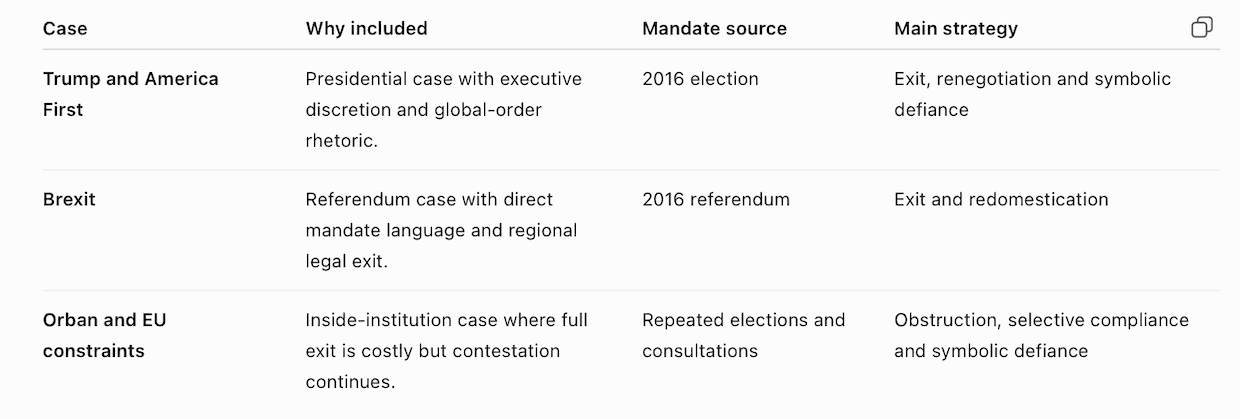
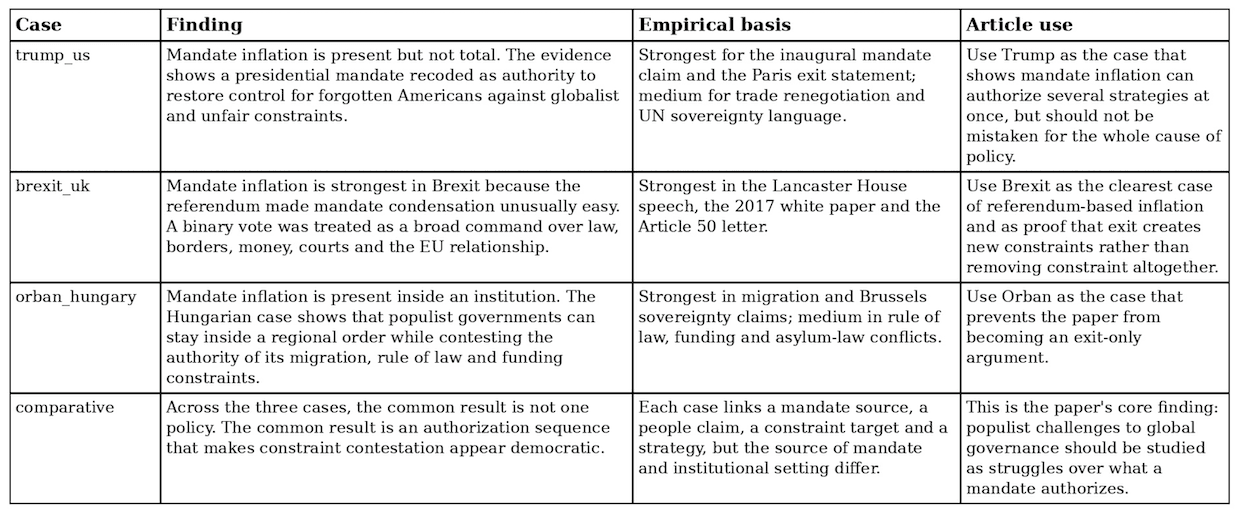
The cases were selected for variation, not because they exhaust populist constraint politics. Trump is a presidential case in which the leader personalized the mandate and used executive authority, trade tools and public rhetoric to challenge international commitments. Brexit is a referendum case in which a single vote was repeatedly interpreted as a broad mandate to recover control from a regional legal order. Orbán is a parliamentary and party-dominant case in which a government has remained inside the EU while contesting migration, rule of law, funding and sovereignty constraints. Table 1 summarizes the controlled variation that structures the comparison.
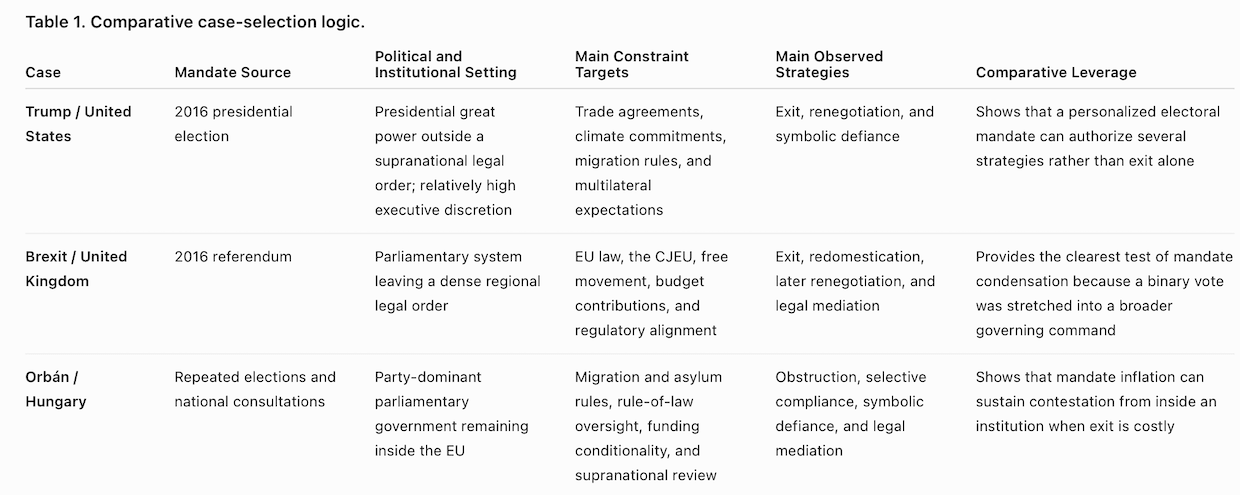
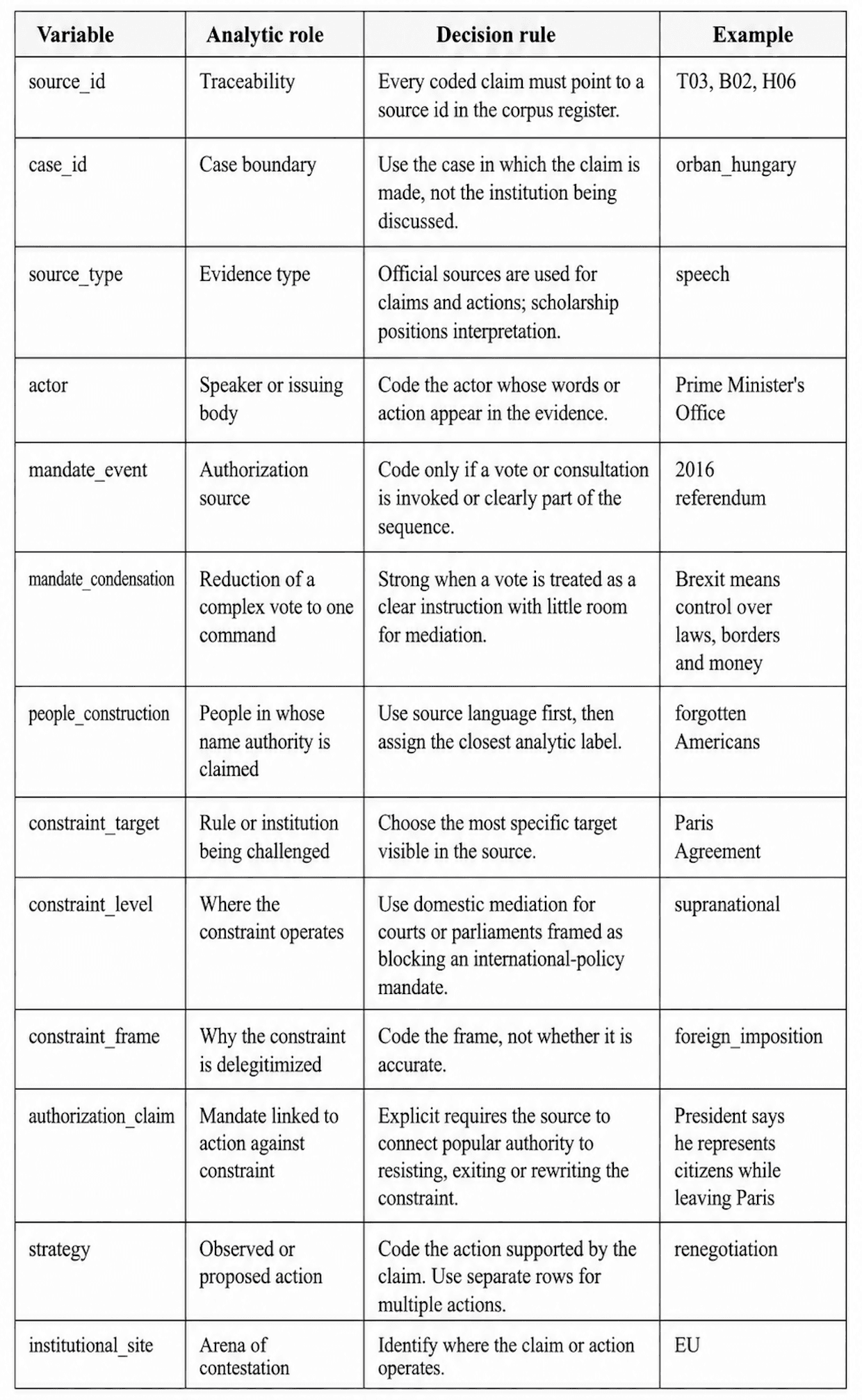
The evidence consists of official speeches, policy documents, legal and institutional records, and recent scholarship. The analysis looks for claim sequences rather than isolated phrases. A passage counts as strong evidence of mandate inflation when it links three elements: a mandate or popular claim, a claim about “the real people,” and a constraint described as illegitimate obstruction. Policy action is then traced to the strategy it supports: exit, renegotiation, obstruction, selective compliance or symbolic defiance. The unit of analysis is a claim episode: a limited period in which an identifiable actor links an election or referendum, the people invoked by the leader, an external constraint and a proposed strategy. Individual passages are coded observations within that episode, not separate cases.
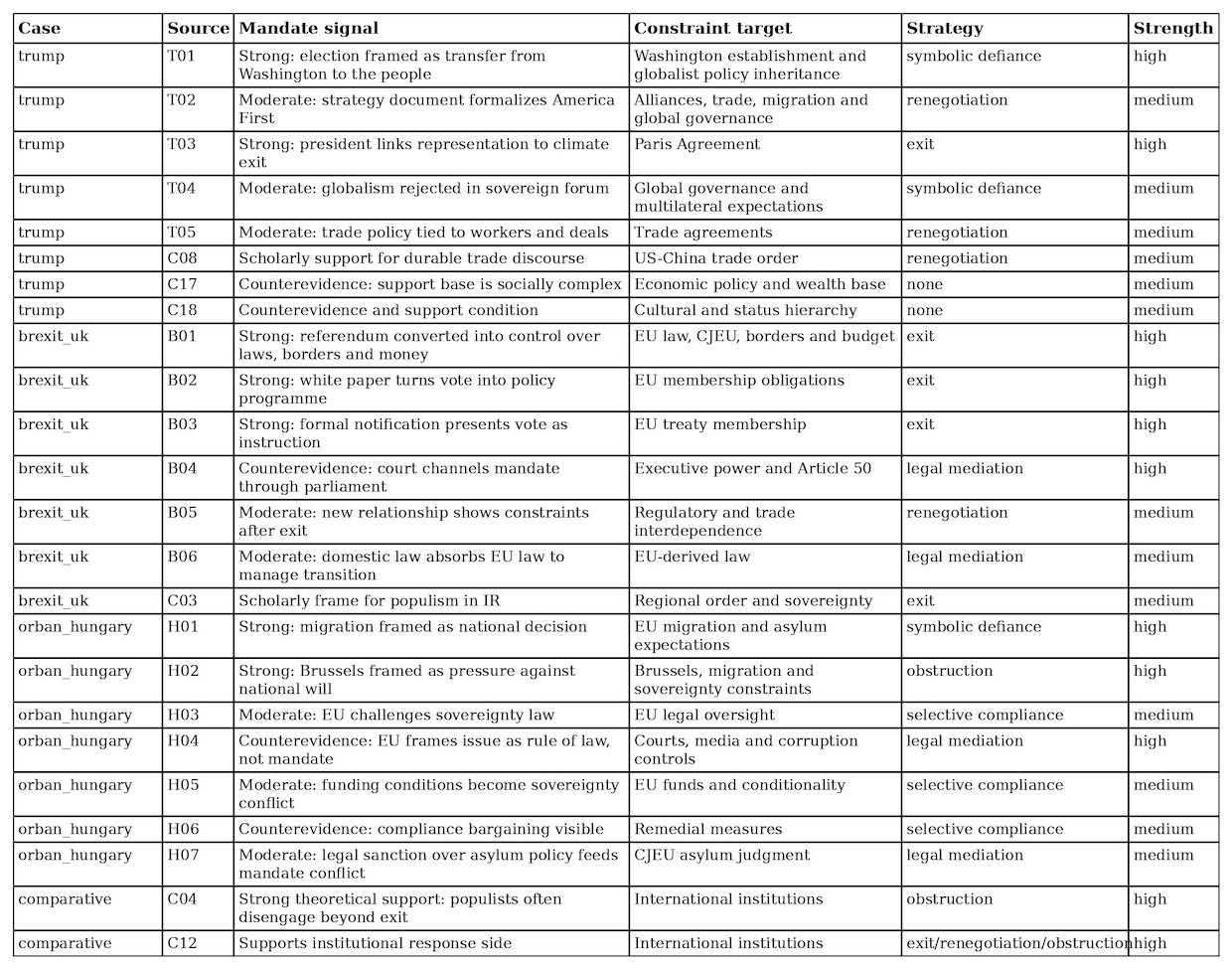
The same evidence rules are used to look for negative cases inside the positive cases. A court judgment, Commission report or government white paper may show ordinary legal mediation rather than mandate inflation. A policy document may support withdrawal for administrative reasons rather than populist reasons. These entries are not discarded. They are used to limit the claim and to show where the mechanism stops. This is especially important in Brexit, where formal legal withdrawal and populist mandate rhetoric moved together but were not identical. The mechanism would be weakened where actors acknowledge the mandate's limits, defend a policy without a “real people” claim, accept parliamentary and legal checks as legitimate, or challenge a constraint solely through legal, material or expert reasoning.
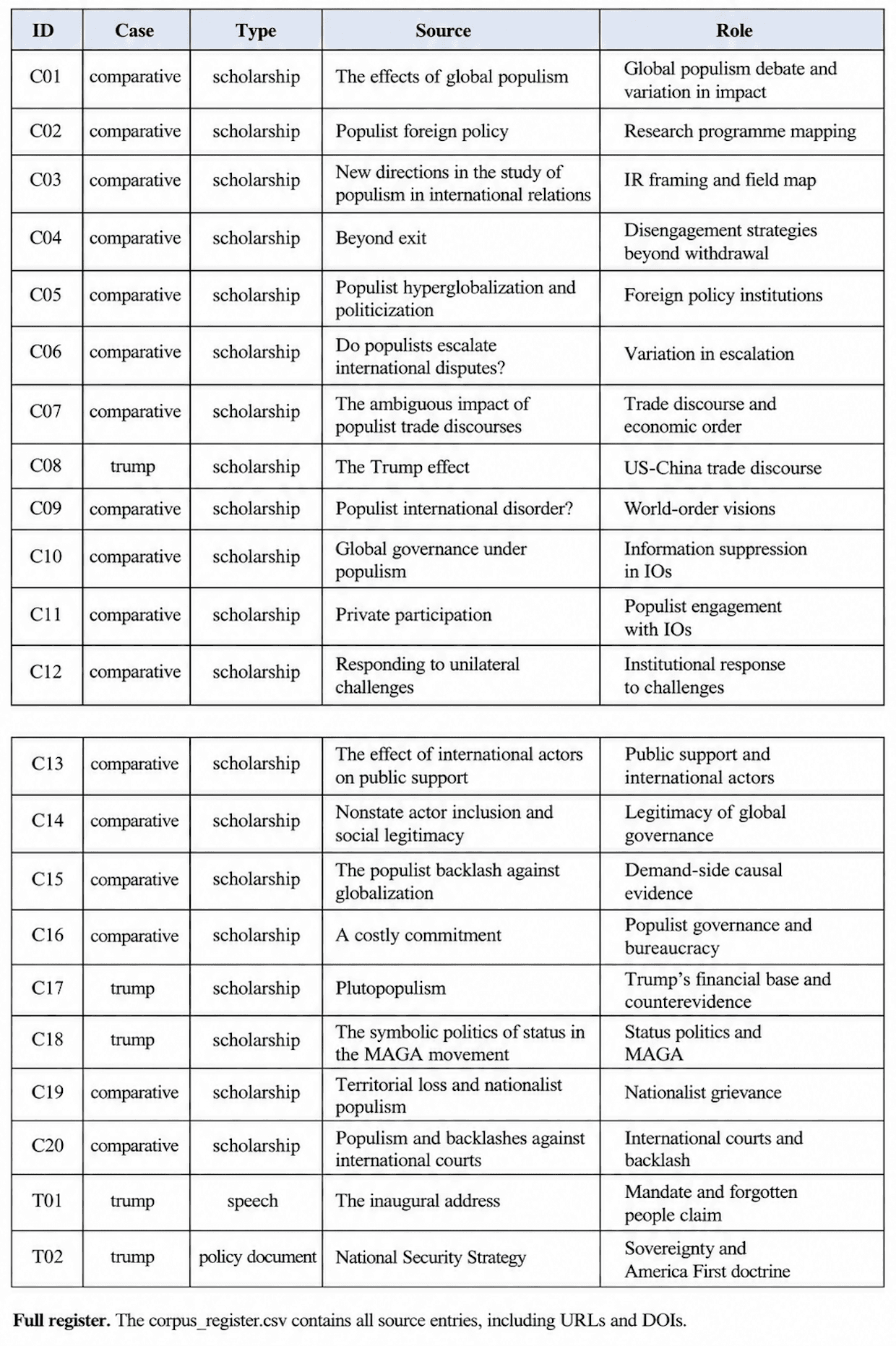
The appendix provides the evidence base for this claim, including the corpus register, coding rules, case evidence matrix, rival explanation checks and strategy map. It does not claim that rhetoric alone caused policy. It makes the narrower claim that mandate language supplied a public justification based on the people's will alongside material, institutional and partisan causes. The appendix provides the complete evidence base; Table 2 reports the corpus and coded observations used in the comparison.
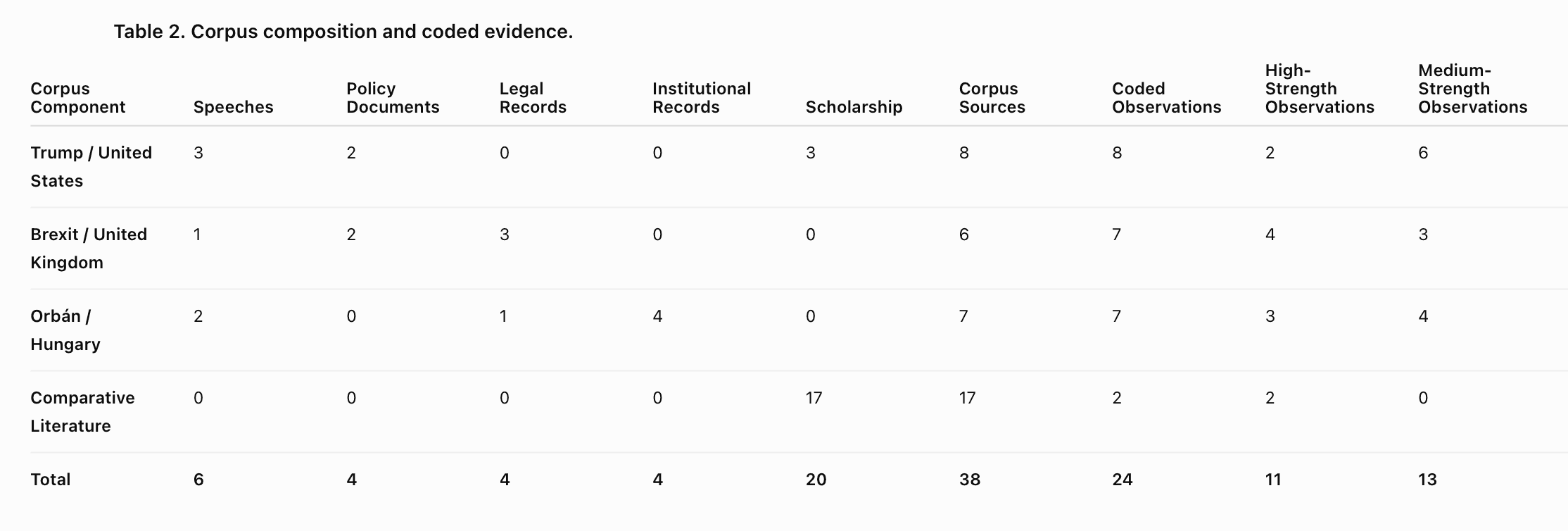
The primary corpus contains 38 sources (18 official and 20 scholarship) and 24 coded observations; contextual scholarship is kept separate from coded primary evidence.
The corpus was assembled from official electoral, executive, parliamentary and judicial repositories, with targeted scholarly searches used for case context. Searches combined actor or episode names with terms including mandate, people, vote, sovereignty, control, treaty, court, Brussels, Paris Agreement, trade, migration and referendum. Sources were included when they established the legal limits of a mandate, contained an actor's claim, documented policy translation or recorded an institutional response. Duplicate versions, unstable commentary and material outside the episode windows were excluded. The author conducted the coding and a second rule-based recoding; no inter-coder reliability statistic is claimed.
Trump and America First
Trump's “America First” politics is the clearest case of presidential mandate inflation. The 2016 election was treated not only as a victory for a party or candidate, but as proof that the forgotten “real people” had taken power back from “corrupt elites” (Lacatus, 2019). This mandate claim was then attached to trade agreements, climate commitments, migration rules, international organizations and foreign policy establishments. The episode covers the period from the November 2016 election to the September 2018 UN General Assembly address and concerns the first Trump administration only.
The inaugural address set the frame. Trump described a transfer of power from Washington to the people and spoke of forgotten citizens who would be forgotten no longer. The speech did not merely announce policy priorities. It cast the election as a democratic recovery from an establishment that had benefited while ordinary Americans lost jobs, factories and security (Trump, 2017). This is mandate condensation and people construction in one sequence.
The target was not international order as a whole. It was a set of constraints presented as unfair, globalist or disconnected from American workers. Trade agreements were described as bad deals (Brusenbauch Meislova & Chryssogelos, 2024; Finbow, 2023). Migration was framed as a loss of control. Climate commitments were treated as burdens placed on American citizens for the benefit of outsiders (Trump, 2017). Multilateral bodies were criticized when they appeared to limit national discretion. The 2017 National Security Strategy made this language official by grounding foreign policy in sovereignty, competition and America First (Weaver, 2018).
The Paris Agreement withdrawal showed how mandate inflation authorized exit. Trump's statement did not only make an economic argument about costs. It connected the decision to electoral representation and national peoplehood, including the claim that he represented American citizens rather than Paris (Bowen et al., 2020; Trump, 2017). The sentence worked because it turned a climate agreement into a choice between domestic democratic duty and external obligation. The legal ability to withdraw mattered, but the public justification was about whom the president represented.
The United Nations speech in 2018 extended the same logic into symbolic defiance. Trump praised sovereignty and rejected globalism (Trump, 2018). This did not mean abandoning all international cooperation. The administration still used alliances, sanctions, trade negotiations and international pressure. The point was that cooperation had to be recast as voluntary action by a sovereign people rather than submission to global rules.
Trade politics followed the same pattern. The withdrawal from the Trans-Pacific Partnership, pressure on NAFTA and negotiation of the United States-Mexico-Canada Agreement were not framed only as technical corrections. They were presented as recovery from deals that had betrayed American workers. Recent work on Trumpian trade discourse shows that this language continued beyond individual decisions and helped reshape the vocabulary of US-China trade politics (Skonieczny & Sherel, 2024). In mandate inflation terms, trade agreements became constraints imposed by elites and global competitors, while renegotiation became obedience to the people.
This pattern also shows why the concept should be located at the level of authorization rather than at the level of policy content. Tariffs, renegotiation and industrial rhetoric can be justified by many arguments, including distributional fairness, strategic competition and bargaining leverage. What made “the America First” version distinctive was the claim that previous international commitments had separated government from its proper people. The policy could therefore be sold as repair of representation, not only as economic adjustment (Thierbach-McLean, 2019).
The case also has counterevidence, which matters. The Trump administration's trade and climate decisions were not caused only by populist mandate claims. They reflected party ideology, business interests, fossil fuel politics, bureaucratic conflict, legal opportunity and strategic competition. Research on Trump's support base also complicates any simple image of a uniformly working class people (Kates et al., 2026; Koenig & Mendelberg, 2026). These facts do not weaken the concept. They clarify its role. Mandate inflation did not supply every motive. It supplied the democratic language through which varied motives could be tied to a claim of popular recovery.
Trump also faced constraints. Courts blocked or revised migration measures (Supreme Court of the United States, 2017; Trump v. Hawaii, 585 U.S. 667 (2018), 2018). Congress shaped trade and spending (Office of the United States Trade Representative, 2017; United States Congress, 2018). Markets, allies and agencies limited implementation (Amiti et al., 2019; Corsini & Ongaro, 2025; Fajgelbaum et al., 2020). International dependence did not disappear (Chishti et al., 2019). This matters because mandate inflation is not a theory of unlimited leader success. It is a theory of how leaders make constraints appear illegitimate when they resist the leader's mandate. For example, continued participation in NATO, the United Nations and the World Trade Organization shows that the rhetoric did not translate into general withdrawal from international institutions.
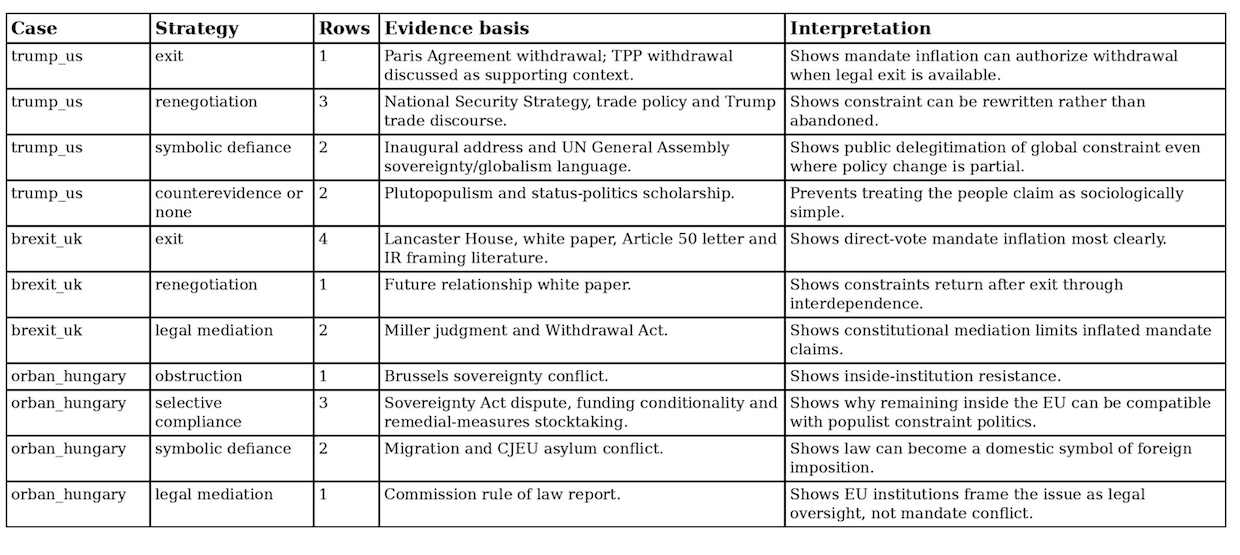
The Trump case, therefore, shows three strategies. Exit appeared in the Paris withdrawal and TPP withdrawal. Renegotiation appeared in trade. Symbolic defiance appeared in attacks on globalism and multilateral constraint. The common thread was not policy content alone. It was the claim that these moves restored authority to the people who had spoken in 2016.
Brexit and ‘Take Back Control’
Brexit is the strongest case of referendum-based mandate inflation. The referendum asked whether the United Kingdom should remain in or leave the European Union (UK Electoral Commission, 2016). It did not specify the future trade relationship, the status of regulatory alignment, the Northern Ireland border, the role of courts, the timing of exit or the balance between parliamentary and executive authority (Department for Exiting the European Union, 2017; Keating, 2022; UK Electoral Commission, 2016; UK Supreme Court, 2017). Yet after the vote, the result was repeatedly condensed into a broad command to take back control. The episode covers the period from the June 2016 referendum to the July 2018 future-relationship white paper.
This condensation was politically powerful because referendums appear direct. A general election can be interpreted as support for many things. A referendum produces a single result. That result made it easier to describe Brexit as the will of the people, even though voters supported leave for different reasons and with different expectations. The mandate was clear enough to authorize exit, but far less clear about the form of exit.
Theresa May's Lancaster House speech translated the referendum into a governing programme. The speech identified control over laws, borders and money as central to Brexit and rejected arrangements that would leave the United Kingdom half in and half out (Prime Minister’s Office, 2017b). The important point is not that May's government was populist in the same style as Trump or Orban. It is that the referendum mandate was interpreted through a populist grammar already established by the campaign: the people had voted, and institutions had to implement that command.
The 2017 white paper and Article 50 letter made the conversion institutional. The white paper organized the future relationship around recovering control, while the Article 50 letter formally notified the EU that the UK would leave (Prime Minister’s Office, 2017a). The referendum moved from a political result to a legal process. This is why Brexit is so useful for the concept. It shows how mandate inflation can take a democratic vote that is real and legally significant, then stretch it into authority for a long sequence of constitutional and international reordering.
The constraint targets were clear. EU law, the Court of Justice of the European Union, freedom of movement, budget contributions and regulatory alignment were presented as barriers to self-government. The phrase “take back control” worked because it placed multiple issues under one democratic story (Department for Exiting the European Union, 2017; Keating, 2022; UK Supreme Court, 2017). Control over borders, courts, money and law became parts of a single mandate rather than separate policy choices.
Domestic institutions also became part of the story. Parliamentary debate, litigation and judicial review were often portrayed by hard Brexit actors as attempts to frustrate the people's decision. The Miller litigation, which required parliamentary authorization before Article 50 notification, did not stop Brexit (UK Supreme Court, 2017). But it became part of a wider political conflict over whether ordinary constitutional mediation was legitimate after a referendum. This is a central feature of mandate inflation: institutions that normally interpret and channel democratic authority are redescribed as obstacles to it.
This was not a marginal rhetorical dispute. It shaped what counted as loyalty to the mandate. A softer exit, prolonged parliamentary scrutiny, court involvement or a negotiated compromise could be attacked not only as bad policy but as refusal to obey the people. That move mattered because the referendum itself had not answered the detailed questions that later divided Parliament and the public. Mandate inflation filled that gap by treating one answer as if it contained a complete governing instruction.
Brexit also shows why the concept should not be inflated beyond its own evidence. Leaving the EU was a legally available choice. Many voters had democratic reasons for wanting withdrawal. EU governance has real accountability problems. The UK had long-standing party, sovereignty and constitutional conflicts over European integration (Kyriazi, 2025). Mandate inflation does not mean the referendum was false or that all Brexit arguments were populist. It means that key actors converted a narrow formal decision into a broad authority claim against constraints whose details had not been settled by the vote.
The policy outcome was not pure liberation from constraint. Brexit replaced one form of constraint with others. Trade frictions, border arrangements, regulatory choices, security cooperation and Northern Ireland all produced new forms of interdependence. The 2018 white paper on the future relationship showed the difficulty of combining sovereignty claims with economic and regulatory dependence (Dhingra et al., 2017; HM Government, 2018; Sampson, 2017). Later implementation confirmed that exit does not remove constraint. It changes where constraint appears and how it is negotiated.
The Brexit case therefore shows mandate inflation through exit and the promise to bring power back home. The referendum was condensed into a command. The people were presented as sovereign and blocked by EU and domestic institutions. EU legal and institutional constraints were presented as a loss of control. Exit was presented as “taking back democratic control,” even as new constraints emerged.
Orbán and Contestation from within the EU
The Orbán case shows that mandate inflation does not require exit. Hungary has remained inside the European Union while repeatedly contesting EU constraints. This makes the case essential. Populist challenges to global governance often happen from within institutions, not only through withdrawal from them. For direct comparison, the main research covers the period from the EU migrant-relocation decision in September 2015 to the Court of Justice judgment in September 2017; the later rule-of-law and funding disputes are treated only as contextual illustrations, not additional coded episodes.
By the time of the coded episode, Orbán's government had governed through multiple election cycles, giving it an established institutional base. Its mandate claims rested on repeated elections, referendums and national consultations. These instruments are used to present the government as the voice of the Hungarian people against Brussels, liberal elites, migration advocates, foreign-funded organizations and EU-level pressure. The people are presented as a national, Christian and sovereign community under threat from outside forces. This is not only normal democratic representation. It is a claim that the government carries a truer democratic voice than the institutions that constrain it (Batory, 2016; Government of Hungary, 2015, 2017; Hungarian National Election Office, 2016).
Migration made the pattern visible. During and after the 2015 migration crisis, EU relocation schemes, asylum rules and border debates were framed as external attempts to force unwanted policies on Hungary (Council of the European Union, 2015; Court of Justice of the European Union, 2017; Government of Hungary, 2015). Orban's speeches connected migration to national survival, Christian Europe and the right of Hungarians to decide who may live with them. The EU constraint was not only a legal disagreement over asylum and burden sharing. It was presented as a challenge to the democratic right of the Hungarian people to decide their future.
National consultations reinforced the same sequence. Here, 'between elections' refers to the periods between national parliamentary election cycles; the exercises allowed the government to claim repeated public authorization. These exercises have been criticized for framing and fairness, but their political function is clear (Batory, 2016; Government of Hungary, 2015, 2017). They turn government positions into evidence that the people have spoken. When directed at Brussels, migration, sanctions or sovereignty, they renew the mandate claim and keep constraint politics alive between electoral cycles.
Rule of law conflicts created another site of mandate inflation. EU procedures concerning courts, media, corruption, civil society and academic freedom were often presented by the Hungarian government as political punishment rather than legitimate oversight (Batory, 2016). The European Commission's 2024 action against Hungary's Defense of Sovereignty Act (European Commission, 2024b), and its 2024 Rule of Law Report on Hungary (European Commission, 2024a), show the institutional side of this conflict. From the government's side, such constraints are framed as Brussels interference in national democracy. From the EU side, they are legal and institutional safeguards attached to membership (European Commission, 2024c).
Funding conditionality shows why exit is not the only strategy. EU membership gives Hungary market access, funds and bargaining power (Council of the European Union, 2022). Full exit would be costly. Selective compliance and obstruction are therefore more useful than withdrawal. Hungary can contest conditions, make partial changes, bargain over funds and present conflict with EU institutions as defense of national sovereignty. The Council and Commission decisions on conditionality and funds made these constraints material, not only rhetorical.
This inside-institution setting is analytically important. If populist politics were only an exit impulse, Hungary would be a poor fit. Instead, it shows a different logic. The government can benefit from membership while questioning the authority of EU institutions to define rule of law, migration and sovereignty. Mandate inflation helps make this position coherent for domestic audiences. The government is not presented as rejecting Europe altogether. It is presented as defending the Hungarian people inside Europe against an elite version of Europe.
The Court of Justice's 2024 penalty against Hungary over asylum policy added a further example of legal constraint becoming political conflict (Court of Justice of the European Union, 2024). The ruling concerned compliance with EU law. The political reception in Hungary fit the wider pattern in which supranational judgment is treated as an attempt to force migration policy on the country. Again, the issue is not whether Hungary had no legal obligations. It is how those obligations are framed domestically when they collide with the government's mandate claim.
Orbán's strategy combines obstruction, selective compliance and symbolic defiance. Hungary has used veto threats and blocking tactics inside EU decision-making, including over migration, budget matters, sanctions and Ukraine-related decisions. These choices cannot be explained by populism alone. They also reflect bargaining for funds, party politics, geopolitical calculation and domestic coalition maintenance (Batory, 2016; Council of the European Union, 2022; Pacciardi et al., 2024). Mandate inflation explains how they are justified to domestic audiences: resistance becomes democracy because Brussels is said to be blocking the Hungarian people.
The Orbán case also shows the limits of mandate inflation. EU law can constrain the government through binding court judgments; funding conditions can tie access to EU resources to remedial steps; and courts, markets and other member states can raise the costs of non-compliance (Council of the European Union, 2022; Court of Justice of the European Union, 2024). The government has sometimes adjusted policies or negotiated compromises (Council of the European Union, 2022; Nguyen, 2025). Constraint has not disappeared. But its meaning has changed. Compliance can be narrated as forced concession, while obstruction can be narrated as democratic defense.
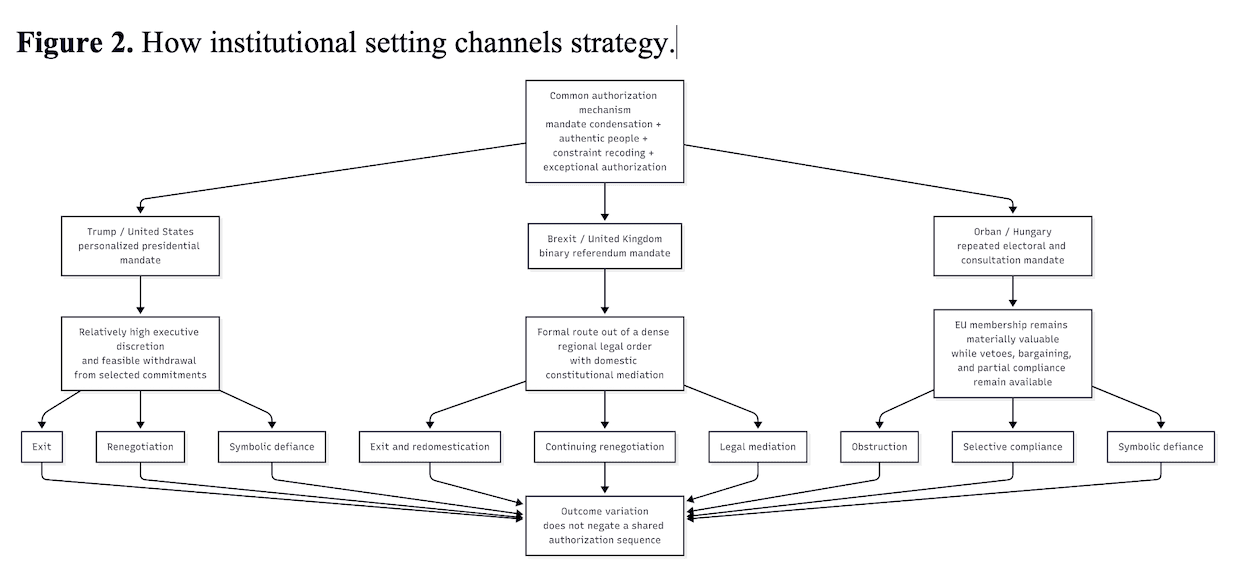
This case completes the comparison. Trump shows mandate inflation through a personalized presidential mandate. Brexit shows it through a referendum mandate. Orbán shows it through repeated electoral and consultation claims inside a dense regional order. The outcome varies, but the authorization-oriented claim sequence is similar.
Comparative Discussion
The three cases show that mandate inflation is not a single policy outcome. It is a way of justifying action against constraints through a claim of popular authority. Trump, Brexit and Orbán vary in mandate source, institutional setting and strategy, yet each links a mandate claim to “the real people,” presents constraints as illegitimate and resistance as taking power back for the people.
The first comparison concerns mandate source. Trump's mandate came from a presidential election and was personalized through the leader. Brexit's mandate came from a referendum and was therefore easier to present as a direct command. Orbán's mandate comes from repeated parliamentary victories and consultations, which allow the government to renew the claim over time. This matters because different mandates enable different forms of inflation. Elections are flexible but ambiguous. Referendums are direct but narrow. Repeated consultations are politically useful but institutionally weaker as evidence of consent.
The second comparison concerns the construction of the people. Trump invoked forgotten Americans and patriotic workers betrayed by Washington and globalism. Brexit invoked the sovereign people who had chosen control over EU rule. Orbán invokes the Hungarian nation against Brussels, migration advocates and liberal elites. In none of these cases is the people merely a statistical majority. The people are presented as a real community whose mandate should outweigh ordinary political checks.
The third comparison concerns constraint targets. Trump targeted trade agreements, climate commitments, migration rules and globalist foreign policy. Brexit targeted EU law, courts, free movement, budget contributions and regulatory alignment. Orbán targeted EU migration rules, rule of law procedures, funding conditions and EU-level oversight. These targets differ, but they play the same role in the claim structure. They become barriers between the people and control.
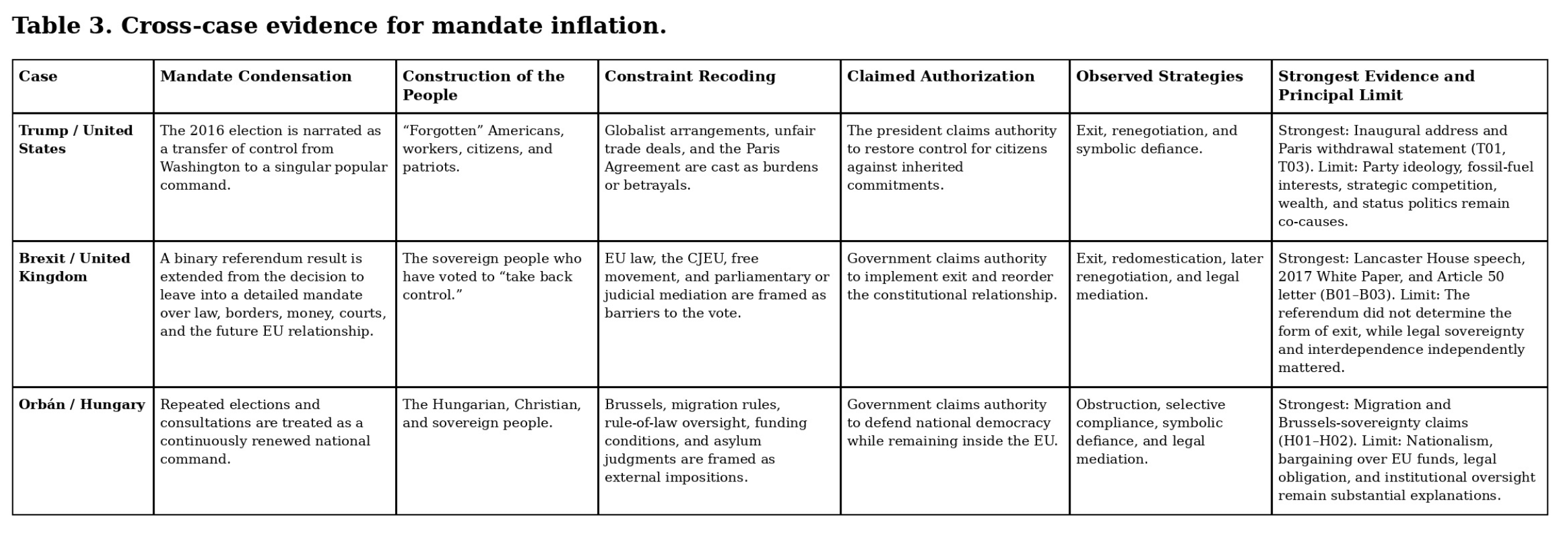
The fourth comparison concerns strategy. Trump used exit, renegotiation and symbolic defiance. Brexit centered on exit and bringing authority back home. Orbán uses obstruction, selective compliance and symbolic defiance from inside the EU. This is the main reason the concept is needed. If scholars look only for withdrawal, they will miss much of populist constraint politics. Many populists want the benefits of international institutions without accepting the full authority of their constraints. Table 3 brings the four observable moves and resulting strategies together across the cases.
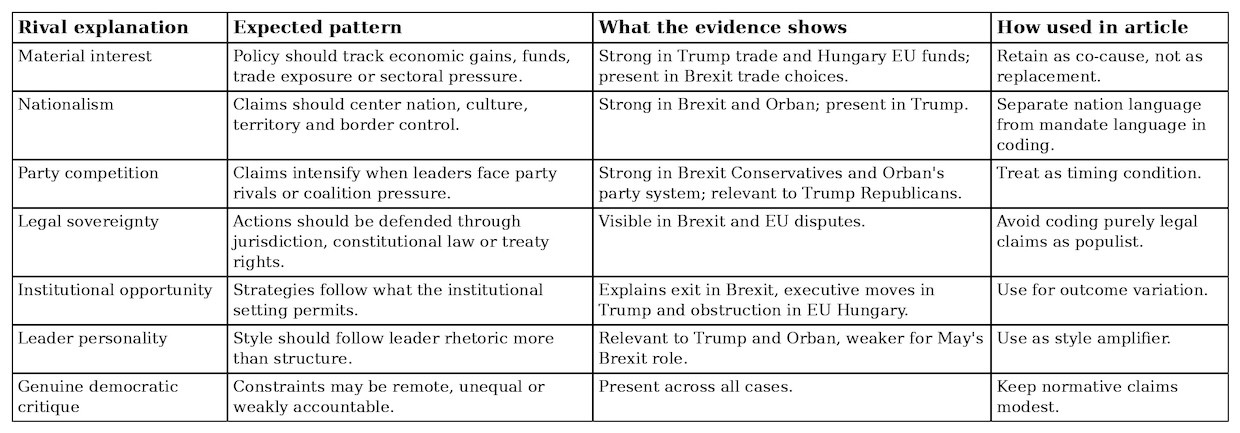
The rival explanations are strong and should be taken seriously. Material interest explains why trade, funds, migration and climate costs become attractive targets. Party competition explains why leaders intensify mandate claims at particular moments. Nationalism explains why the people is often imagined through borders, culture and history. Institutional design explains why some leaders can exit while others obstruct. Leader personality explains part of the style and intensity of confrontation. None of these explanations is wrong. They answer different questions.
Mandate inflation answers a specific question: how are actions against international constraints presented as the people's democratic choice? Material interest does not explain why a climate agreement is described as betrayal of citizens. Nationalism does not by itself explain why a referendum is stretched into authority over courts and parliament. Institutional design does not explain why compliance is described as submission to elites. Mandate inflation shows how these factors are tied to the claimed authority of the people. The study does not test whether audiences accepted that presentation or whether it independently caused the subsequent strategy.
This has practical implications. International institutions facing populist governments should not assume that the threat is simply exit. The more common challenge may be contestation from within: blocking, selective compliance, rhetorical delegitimization, information withholding, budget bargaining and attempts to politicize institutional oversight. Recent research on international organizations under populism makes this point in different ways, including through studies of private participation and information suppression (Carnegie, Clark, & Kaya, 2024; Carnegie, Clark, & Zucker, 2024). Mandate inflation adds the domestic authorization side of the problem.
Institutions also should not answer every mandate claim only with legal language. Legal authority matters, but populist contestation often begins before a legal dispute reaches court. It begins when a leader convinces supporters that a rule is not merely binding but democratically suspect. A response that ignores democratic legitimacy may strengthen the populist claim. This does not mean institutions should concede rule of law or rights protections. It means they need public explanations of why constraints exist, who authorized them, how they can be changed and how citizens benefit from them (Ecker-Ehrhardt et al., 2025; Pinto et al., 2025; Tallberg & Zürn, 2019).
This point has consequences for institutional design. If rules are too opaque, if adjustment costs are ignored, or if domestic publics see only discipline and not voice, mandate inflation becomes easier. Institutions cannot prevent populist leaders from making anti-constraint claims, but they can reduce the plausibility of those claims by making authorization, review and contestation more visible (Carnegie, Clark, & Zucker, 2024; Ecker-Ehrhardt et al., 2025; Pinto et al., 2025; Tallberg & Zürn, 2019). The lesson is not to politicize every technical decision. It is to recognize that technocratic insulation has political costs when leaders are ready to describe it as rule against the people.
The comparison also warns against idealism in the opposite direction. Global constraints are not automatically democratic because they are multilateral or legal. Some are distant, unequal or highly technical. Populist leaders gain traction partly because international commitments can feel remote from ordinary political control. The democratic problem is real. The populist move is to answer that problem by claiming that one leader, party or mandate alone speaks for the people.
Conclusion
Populist challenges to global constraints are often described as nationalism, anti-globalism or backlash against international order. Those descriptions capture important parts of the story, but they miss the mandate mechanism. Populist leaders often claim that an election or referendum gives them authority not only to govern, but to challenge constraints in the name of the people.
This article calls that process mandate inflation. It occurs when a complex vote is condensed into a clear mandate, attached to “the real people,” directed against rules presented as illegitimate and used to justify exit, renegotiation, obstruction, selective compliance or symbolic defiance. The concept explains why populist challenges to international order vary without becoming random.
The comparison of Trump, Brexit and Orbán shows the mechanism across three settings. Trump used “America First” to connect electoral victory with withdrawal, trade renegotiation and public defiance of globalism. Brexit turned a referendum into authority to leave a regional legal order and recover control from EU institutions. Orbán uses repeated mandate claims to resist EU migration, rule of law, funding and sovereignty constraints from within the Union. The cases differ sharply, but each shows mandate claims doing political work against global constraints.
The argument is limited by design. It does not explain why voters choose populists, why every policy decision occurs or why institutions succeed or fail in response. It shows how populist leaders use a vote to claim authority for strategies toward international constraints; whether people accept these claims and whether they cause policy changes remain questions for further research. That link matters because international institutions depend not only on legal commitments, but also on what citizens see as rightful authority.
Future research can test mandate inflation in populist left cases, Global South sovereignty politics and non-Western settings where anti-imperial claims interact with populist representation. It can also examine when institutions contain mandate inflation and when they unintentionally strengthen it. The central point is that struggles over global governance are also struggles over what a democratic mandate means.
***
(*) Muhammad Faizan Aslam is a Scholar, Department of International Relations, Faculty of Contemporary Studies, National Defence University, Islamabad. ORCID: 0009-0008-8837-3755 Email: Immakee00@gmail.com
Acknowledgements
The author used OpenAI ChatGPT, based on GPT-5, accessed through OpenAI’s ChatGPT interface at https://chatgpt.com, during May and June 2026. It was used to assist with language revision, paragraph restructuring, consistency checks, formatting guidance, and the reconsideration of draft wording for selected parts of the manuscript. The author reviewed, revised and approved all AI-assisted text before submission and remains solely responsible for the argument, interpretation, accuracy of citations, source verification and final manuscript. Furthermore, the author also used Grammarly during May and June 2026 for spelling, grammar and readability checks.
Please cite as:
Aslam, Muhammad Faizan. (2026). “Mandate Inflation: How Populists Claim Authority to Challenge Global Constraints.” Journal of Populism Studies (JPS). August 24, 2026. https://doi.org/10.55271/JPS000130
Online Appendix: Inflating the Mandate
Purpose. This appendix records what was coded, how cases were compared, how rival explanations were handled and which files should be kept with a journal submission.
Appendix A. Evidence Design
The article treats mandate inflation as an authorizing sequence, not as a total cause of policy. A source is strongest when it links a mandate or popular command, an authentic people claim, a constraint target and a strategy toward that constraint. The comparison therefore codes claims and actions together rather than counting populist words in isolation.
Appendix B. Mechanism Figure

Appendix C. Codebook
The full codebook is saved as codebook_mandate_inflation.csv. The table below gives the variables most likely to matter for peer review.
Appendix D. Corpus Register
The corpus combines recent Q1 scholarship, official speeches, policy documents and legal or institutional records. Official sources are used to identify claims and actions. Scholarship is used to place interpretation, identify rival explanations and avoid repeating existing work.
Appendix E. Case Evidence Matrix
The matrix records how each piece of evidence supports, qualifies or limits the mechanism. It is deliberately mixed: positive evidence and counterevidence are kept in the same file so the paper does not depend on selective confirmation.
Appendix F. Analysis Results
This section states the result of the coding. The codebook does not produce a numerical score that automatically proves the argument. It produces a structured qualitative finding: mandate inflation is strongest where a mandate source, people claim, constraint frame and strategy appear together, and weaker where legal, material or administrative explanations dominate.
Appendix G. Strategy Distribution
The distribution below is not offered as statistical proof. It is a transparency device that shows how the coded evidence supports the article's central claim that mandate inflation authorizes a repertoire of strategies rather than a single exit outcome.
Appendix H. Rival Explanation Checks
The article does not claim that mandate inflation replaces material, institutional or nationalist explanations. The table below states how each rival explanation is handled in the analysis.
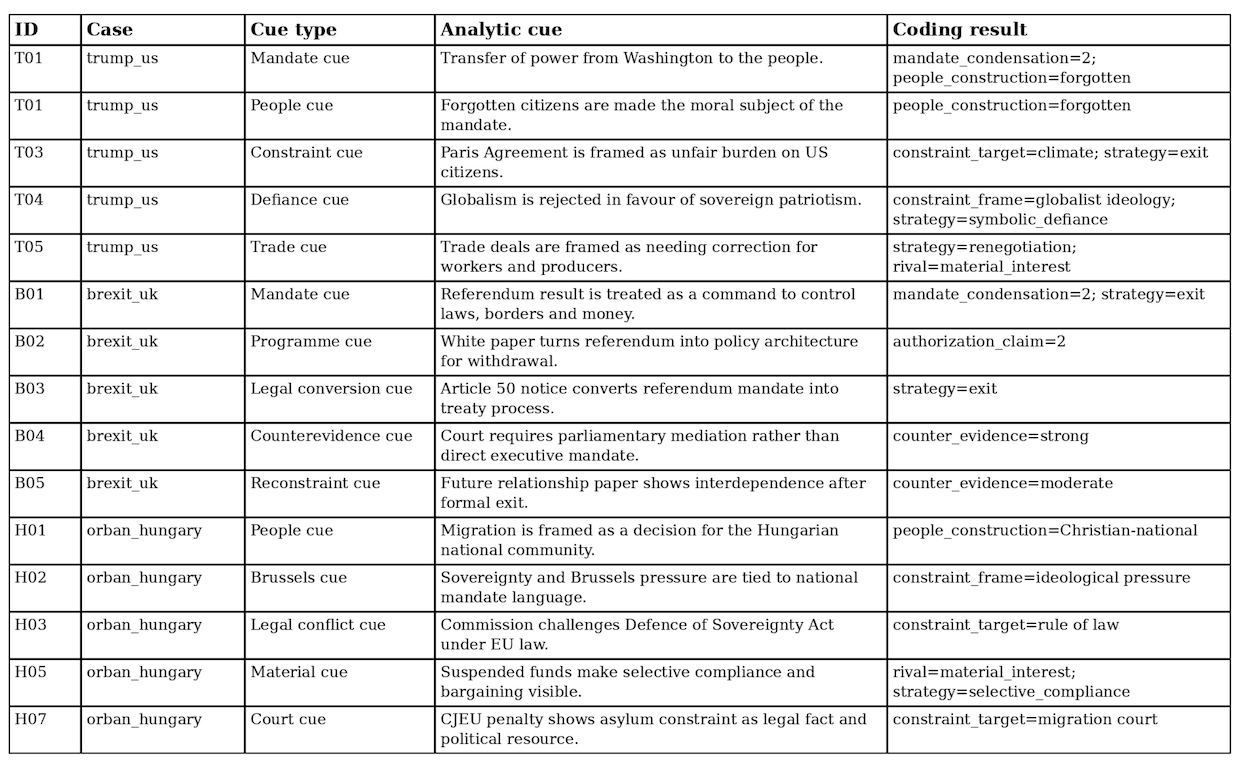
Appendix I. Source Evidence Ledger
The ledger records the analytic cues used in the case sections. It avoids long quotation and uses paraphrase or very short source cues so the main text can remain readable.
References
Amiti, M., Redding, S. J., & Weinstein, D. E. (2019). The Impact of the 2018 Tariffs on Prices and Welfare. Journal of Economic Perspectives, 33(4), 187–210. https://doi.org/10.1257/jep.33.4.187
Batory, A. (2016). Populists in Government? Hungary’s System of National Cooperation. Democratization, 23(2), 283–303. https://doi.org/10.1080/13510347.2015.1076214
Bellodi, L., Morelli, M., & Vannoni, M. (2024). A Costly Commitment: Populism, Economic Performance, and the Quality of Bureaucracy. American Journal of Political Science, 68(1), 193–209. https://doi.org/10.1111/ajps.12782
Bowen, A., Burke, M., Donovan, C., Gillingham, K., Moore, F. C., Stavins, R., Wagner, G., & Ward, B. (2020). The Economic Case for the United States to Remain in the Paris Agreement on Climate Change [Policy Brief]. Grantham Research Institute on Climate Change and the Environment, London School of Economics and Political Science and Grantham Institute – Climate Change and the Environment, Imperial College London. https://www.lse.ac.uk/granthaminstitute/wp-content/uploads/2020/08/GRI_The-economic-case-for-the-United-States-to-remain-in-the-Paris-Agreement-on-climate-change.pdf
Brusenbauch Meislova, M., & Chryssogelos, A. (2024). The Ambiguous Impact of Populist Trade Discourses on the International Economic Order. International Affairs, 100(5). https://doi.org/10.1093/ia/iiad296
Carnegie, A., Clark, R., & Kaya, A. (2024). Private Participation: How Populists Engage with International Organizations. The Journal of Politics, 86(3), 877–891. https://doi.org/10.1086/727595
Carnegie, A., Clark, R., & Zucker, N. (2024). Global Governance under Populism: The Challenge of Information Suppression. World Politics, 76(4), 639–666.
Carter, P. J., & Pop-Eleches, G. (2025). Territorial Loss and Nationalist Populism. Comparative Political Studies, 58(11), 2508–2553. https://doi.org/10.1177/00104140241302753
Chishti, M., Pierce, S., & O’Connor, A. (2019). Despite Flurry of Actions, Trump Administration Faces Constraints in Achieving Its Immigration Agenda. Policy Beat. https://www.migrationpolicy.org/journal/policy-beat/despite-flurry-actions-trump-administration-faces-constraints-achieving-its
Corsini, H., & Ongaro, E. (2025). Bureaucratic Responses to Populist Government: Explaining Foreign Policy (Non-)Change. Journal of Common Market Studies, 64(1), 24–47. https://doi.org/10.1111/jcms.13748
Cortijos-Bernabeu, A., Cavallaro, M., & Staerklé, C. (2026). Left Wanting and Left Unheard: A Dual Grievance Model of Populism Across Six European Countries. European Journal of Social Psychology, 56(5), 811–828. https://doi.org/10.1002/ejsp.70073
Council of the European Union. (2015). Council Decision (EU) 2015/1601 of 22 September 2015. https://eur-lex.europa.eu/eli/dec/2015/1601/oj/eng
Council of the European Union. (2022). Council Implementing Decision (EU) 2022/2506 of 15 December 2022 on Measures for the Protection of the Union Budget against Breaches of the Principles of the Rule of Law in Hungary. https://eur-lex.europa.eu/eli/dec_impl/2022/2506/oj/eng
Court of Justice of the European Union. (2017). Slovakia and Hungary v Council, Joined Cases C-643/15 and C-647/15.
Court of Justice of the European Union. (2024). Asylum Policy: Hungary Is Ordered to Pay a Lump Sum of 200 Million Euros and a Penalty Payment of 1 Million Euros per Day of Delay for Failure to Comply with a Judgment of the Court of Justice (Press Release No. 99/24). Court of Justice of the European Union.
Department for Exiting the European Union. (2017). The United Kingdom’s Exit from, and New Partnership with, the European Union (White Paper Cm. 9417). HM Government. https://www.gov.uk/government/publications/the-united-kingdoms-exit-from-and-new-partnership-with-the-european-union-white-paper
Destradi, S., & Plagemann, J. (2019). Populism and International Relations: Unpredictability, Personalisation, and the Reinforcement of Existing Trends in World Politics. Review of International Studies. https://doi.org/10.1017/S0260210519000184
Destradi, S., & Plagemann, J. (2024). Do Populists Escalate International Disputes? International Affairs, 100(5). https://doi.org/10.1093/ia/iiae172
Dhingra, S., Ottaviano, G. I. P., Sampson, T., & Van Reenen, J. (2017). The Costs and Benefits of Leaving the EU: Trade Effects. Economic Policy, 32(92), 651–705. https://doi.org/10.1093/epolic/eix015
Dijkstra, H., & Ghassim, F. (2025). Are authoritative international organizations challenged more? A recurrent event analysis of member state criticisms and withdrawals. The Review of International Organizations, 20(4), 907–935. https://doi.org/10.1007/s11558-024-09557-0
Ecker-Ehrhardt, M., Verhaegen, S., & Quack, S. (2025). Nonstate Actor Inclusion and the Social Legitimacy of Global Governance Institutions. International Studies Quarterly, 69(2), sqaf040. https://doi.org/10.1093/isq/sqaf040
European Commission. (2024a). 2024 Rule of Law Report: Country Chapter on the Rule of Law Situation in Hungary. https://commission.europa.eu/publications/2024-rule-law-report-communication-and-country-chapters_en
European Commission. (2024b). The Commission Decides to Refer Hungary to the Court of Justice concerning Its National Law on the Defence of Sovereignty. https://ec.europa.eu/commission/presscorner/detail/en/ip_24_4865
European Commission. (2024c, October 3). The Commission decides to refer HUNGARY to the Court of Justice of the European Union considering its national law on the Defence of Sovereignty to be in breach of EU law. European Commission. https://ec.europa.eu/commission/presscorner/detail/en/ip_24_4865
Fajgelbaum, P. D., Goldberg, P. K., Kennedy, P. J., & Khandelwal, A. K. (2020). The Return to Protectionism. Quarterly Journal of Economics, 135(1), 1–55. https://doi.org/10.1093/qje/qjz036
Farias, D. B. L., Casarões, G., & WAJNER, D. F. (2024). Populist international (dis)order? Lessons from world-order visions in Latin American populism. International Affairs, 100(5), 2003–2024. https://doi.org/10.1093/ia/iiae179
Farrell, H., & Newman, A. L. (2019). Weaponized Interdependence: How Global Economic Networks Shape State Coercion. International Security, 44(1), 42–79. https://doi.org/10.1162/isec_a_00351
Finbow, R. G. (2023). Populist Backlash and Trade Agreements in North America: The Prospects for Progressive Trade. Politics and Governance, 11(1), 237–248. https://doi.org/10.17645/pag.v11i1.6078
Government of Hungary. (2015). Prime Minister Viktor Orbán’s Presentation at the 26th Bálványos Summer Open University and Student Camp. https://2015-2019.kormany.hu/en/the-prime-minister/the-prime-minister-s-speeches/prime-minister-viktor-orban-s-presentation-at-the-26th-balvanyos-summer-open-university-and-student-camp
Government of Hungary. (2017). Let’s Stop Brussels! National Consultation: Questionnaire and Results.
HM Government. (2018). The Future Relationship between the United Kingdom and the European Union. https://www.gov.uk/government/publications/the-future-relationship-between-the-united-kingdom-and-the-european-union
Hungarian National Election Office. (2016). National Referendum, October 2, 2016: Result Details. https://web.archive.org/web/20161005065048/http://valasztas.hu/dyn/onepsz201610/szavossz/en/eredm_e.html
Kates, S., Manning, E., Mendelberg, T., & Wasow, O. (2026). Plutopopulism: Wealth and Trump’s Financial Base. American Political Science Review, 120(1), 92–109. https://doi.org/10.1017/S0003055425000061
Keating, M. (2022). Taking back control? Brexit and the territorial constitution of the United Kingdom. Journal of European Public Policy, 29(4), 491–509. https://doi.org/10.1080/13501763.2021.1876156
Koenig, B., & Mendelberg, T. (2026). The Symbolic Politics of Status in the MAGA Movement. Perspectives on Politics, 24(1), 238–255. https://doi.org/10.1017/S1537592725102090
Kyriazi, A. (2025). Political competition, personal ambition, and the fragility of EU membership: A comparison of Brexit and the rule of law crisis. Journal of European Public Policy, 0(0), 1–25. https://doi.org/10.1080/13501763.2025.2596128
Lacatus, C. (2019). Populism and the 2016 American Election: Evidence from Official Press Releases and Twitter. PS: Political Science & Politics, 52(2), 223–228. Cambridge Core. https://doi.org/10.1017/S104909651800183X
Nguyen, T. (2025). What the EU Should Do About Viktor Orbán [Policy Position]. Jacques Delors Centre. https://www.delorscentre.eu/en/publications/detail/publication/what-the-eu-should-do-about-viktor-orban
Office of the United States Trade Representative. (2017). The President’s 2017 Trade Policy Agenda. Office of the United States Trade Representative.
Ozdamar, O., & Yanik, L. K. (2024). Populist Hyperpersonalization and Politicization of Foreign Policy Institutions. International Affairs, 100(5). https://doi.org/10.1093/ia/iiae181
Pacciardi, A., Spandler, K., & Soderbaum, F. (2024). Beyond Exit: How Populist Governments Disengage From International Institutions. International Affairs, 100(5). https://doi.org/10.1093/ia/iiae185
Pinto, P. M., Rickard, S. J., & Vreeland, J. R. (2025). The Effect of International Actors on Public Support for Government Spending Decisions. International Studies Quarterly, 69(1), sqae150. https://doi.org/10.1093/isq/sqae150
Prime Minister’s Office. (2017a). Prime Minister’s Letter to Donald Tusk Triggering Article 50. https://www.gov.uk/government/publications/prime-ministers-letter-to-donald-tusk-triggering-article-50
Prime Minister’s Office. (2017b). The Government’s Negotiating Objectives for Exiting the EU: PM Speech. https://www.gov.uk/government/speeches/the-governments-negotiating-objectives-for-exiting-the-eu-pm-speech
Sampson, T. (2017). Brexit: The Economics of International Disintegration. Journal of Economic Perspectives, 31(4), 163–184. https://doi.org/10.1257/jep.31.4.163
Scheiring, G., Serrano-Alarcón, M., Moise, A., McNamara, C., & Stuckler, D. (2024a). The Populist Backlash Against Globalization: A Meta-Analysis of the Causal Evidence. British Journal of Political Science, 54(3), 892–916. https://doi.org/10.1017/S0007123424000024
Scheiring, G., Serrano-Alarcón, M., Moise, A., McNamara, C., & Stuckler, D. (2024b). The Populist Backlash Against Globalization: A Meta-Analysis of the Causal Evidence. British Journal of Political Science, 54(3), 892–916. https://doi.org/10.1017/S0007123424000024
Skonieczny, C., & Sherel, R. (2024). The Trump Effect: The Perpetuation of Populism in US-China Trade. International Affairs, 100(5). https://doi.org/10.1093/ia/iiae183
Supreme Court of the United States. (2017). Trump v. International Refugee Assistance Project, 582 U.S. 571 (2017).
Tallberg, J., & Zürn, M. (2019). The Legitimacy and Legitimation of International Organizations: Introduction and Framework. Review of International Organizations, 14(4), 581–606. https://doi.org/10.1007/s11558-018-9330-7
Thierbach-McLean, O. (2019). Between Globalism and America First: The Ambiguous Resonance of Individualist Values in Current U.S. Foreign Policy. The Journal of International Relations, Peace Studies, and Development, 5(1), Article 3.
Trump, D. J. (2017, June). Statement by President Trump on the Paris Climate Accord. The White House. https://trumpwhitehouse.archives.gov/briefings-statements/statement-president-trump-paris-climate-accord/
Trump v. Hawaii, 585 U.S. 667 (2018). (2018).
Trump White House Archives. (2017). The Inaugural Address. https://trumpwhitehouse.archives.gov/briefings-statements/the-inaugural-address/
Trump White House Archives. (2018). Remarks by President Trump to the 73rd Session of the United Nations General Assembly. https://trumpwhitehouse.archives.gov/briefings-statements/remarks-president-trump-73rd-session-united-nations-general-assembly-new-york-ny/
UK Electoral Commission. (2016). The 2016 EU Referendum.
UK Supreme Court. (2017). R (Miller) v Secretary of State for Exiting the European Union [2017] UKSC 5. https://www.supremecourt.uk/cases/uksc-2016-0196.html
United States Congress. (2018). Consolidated Appropriations Act, 2018, Pub. L. No. 115-141, 132 Stat. 3. https://www.congress.gov/115/plaws/publ141/PLAW-115publ141.pdf
Voeten, E. (2020). Populism and Backlashes against International Courts. Perspectives on Politics, 18(2), 407–422. Cambridge Core. https://doi.org/10.1017/S1537592719000975
Wajner, D. F. (2022). The populist way out: Why contemporary populist leaders seek transnational legitimation. The British Journal of Politics and International Relations, 24(3), 416–436. https://doi.org/10.1177/13691481211069345
Wajner, D. F., Destradi, S., & Zurn, M. (2024). The Effects of Global Populism: Assessing the Populist Impact on International Affairs. International Affairs, 100(5). https://doi.org/10.1093/ia/iiae217
Wajner, D. F., & Giurlando, P. (2024). Populist Foreign Policy: Mapping the Developing Research Program on Populism in International Relations. International Studies Review. https://doi.org/10.1093/isr/viae012
Walter, S., & Plotke-Scherly, J. (2025). Responding to Unilateral Challenges to International Institutions. International Studies Quarterly. https://doi.org/10.1093/isq/sqaf022
Weaver, J. (2018). The 2017 National Security Strategy of the United States. Journal of Strategic Security, 11(1). https://doi.org/10.5038/1944-0472.11.1.1655
Mandate Inflation: How Populists Claim Authority to Challenge Global Constraints
Muhammad Faizan Aslam*
Introduction
Populist leaders rarely challenge international order by saying only that a treaty, court or organization is inefficient. They often say something stronger. They argue that constraints on government action stand between the people and democratic control (Dijkstra & Ghassim, 2025). Trade agreements become “bad deals” made by globalist elites (Finbow, 2023). Courts become “foreign” or “unelected bodies.” Migration rules become “imposed commands.” Expert advice becomes “technocratic obstruction.” The point is not only policy disagreement. The point is authority (Wajner et al., 2024).
This creates a puzzle for international relations as populist leaders do not respond to global constraint in a single way. Some withdraw from agreements. Some seek better terms. Some stay inside institutions while blocking decisions. Some comply with parts of a regime while attacking other parts. Some use defiant language even when policy change is limited. Recent research on global populism has made this variation clear (Pacciardi et al., 2024; Wajner & Giurlando, 2024). It has also shown that populist foreign policy is now a serious research programme rather than a side question for domestic politics (Ozdamar & Yanik, 2024; Wajner & Giurlando, 2024). What remains underdeveloped is the democratic authorization mechanism that makes such varied strategies appear legitimate to supporters.
This article calls that process of turning a vote into a broader political claim “mandate inflation.” Mandate inflation is the process through which a populist leader recasts an election or referendum from a limited permission to govern into a wider claim of authority to challenge, override or rewrite constraints in the name of the people. The concept is deliberately narrow. It is not a synonym for nationalism, anti-globalism, sovereignty talk or ordinary treaty renegotiation. It is present when four claims appear together: a complex vote is condensed into one clear mandate; that mandate is attached to “the real people”; international or EU-level constraints are described as illegitimate barriers to that people; and the leader claims authority to act against those constraints. Mandate inflation is therefore observed in actors' claims; whether those claims generate public acceptance or independently cause policy outcomes is a separate empirical question.
The argument matters because global constraints are not self-explanatory objects, and their political effects depend on observable factors such as legal form, institutional location, economic impact and domestic visibility. They can be legal commitments, institutional procedures, market pressures, treaty obligations, policy standards, rights regimes or expert rules. Many have been voluntarily accepted by elected governments. Some are popular because they provide security, market access, rights protection or credibility. Others are weakly accountable, socially unequal or politically remote. Populist leaders exploit this mixed character. They do not need to prove that a constraint is legally invalid. They need to make it look democratically suspect (Ecker-Ehrhardt et al., 2025; Tallberg & Zürn, 2019).
This is why the argument avoids a simple defense of global governance. It does not assume that international institutions are always democratically healthy or that popular control is a false problem. Many voters experience international commitments through job loss, austerity, migration pressure, border disputes, legal complexity or distant expert language (Bellodi et al., 2024; Scheiring et al., 2024a). The issue is not whether these concerns should be dismissed. The issue is how a leader turns them into an exclusive claim to speak for the people against constraints that may also have democratic authorization of their own.
This article compares three cases: Trump's “America First” politics, Brexit's “take back control” discourse and Viktor Orbán's confrontation with EU constraints. The cases are not treated as identical. Trump shows presidential mandate inflation in a great power setting, with exit, renegotiation and symbolic defiance. Brexit shows how a referendum can be converted into a mandate to leave a regional legal order. Orbán shows that mandate inflation can also work from inside an institution through obstruction, selective compliance and public defiance. The cases vary by mandate source, institutional location and strategy toward constraint. This variation is useful because the argument does not predict one outcome. It explains how different strategies are justified through a similar claim about the people. The relevant actors are the Trump administration, the Leave-to-government coalition centered on the May government, and the Orbán government; campaign rhetoric, official government claims, legal acts and institutional responses are treated as distinct forms of evidence.
The article makes three contributions. First, it adds a mechanism to recent work on populism and international affairs. Existing scholarship shows that populist governments affect foreign policy, international institutions, trade, migration, security and world order visions in uneven ways (Brusenbauch Meislova & Chryssogelos, 2024; Destradi & Plagemann, 2024; Wajner & Giurlando, 2024). Mandate inflation explains how this unevenness can still share a common democratic grammar. Second, it connects populism research to work on international institutions and unilateral challenges. Institutions face not only legal non-compliance, but also domestic struggles over whether their constraints count as legitimate democratic commitments (Walter & Plotke-Scherly, 2025). Third, it separates voter-side causes from leader-side authorization. Economic insecurity, status grievance, territorial loss and backlash against globalization may help explain why populist appeals resonate(Carter & Pop-Eleches, 2025; Koenig & Mendelberg, 2026; Scheiring et al., 2024b). They do not by themselves explain how leaders turn a vote into authority to contest courts, treaties or international organizations.
The article proceeds in five steps. It first places the argument in recent literature on global populism, foreign policy and international institutions. It then defines “mandate inflation” and its boundary conditions. The empirical sections trace the mechanism in the United States, the United Kingdom and Hungary. The comparative discussion explains why the same authorizing logic supports different strategies toward constraint. The conclusion draws implications for scholars and policy practitioners who face populist challenges to global governance.
Populism, Mandate and Global Constraint
The current literature no longer treats populism as a purely domestic problem. A large recent body of work asks how populism changes foreign policy, institutional behavior, trade politics, migration, security and the legitimacy of global governance. It builds on that debate but shifts the focus from populist impact to populist authorization.
The first relevant stream is literature on populist foreign policy. Recent mapping work describes a developing research programme that studies populism as a force in international relations, not only as an ideology or electoral style (Wajner & Giurlando, 2024). Scholars now examine how populist leaders personalize foreign policy, politicize foreign ministries, escalate or avoid disputes, revise trade discourse, securitize migration and imagine alternative world orders. This research is important because it rejects a simple domestic-foreign divide. Populists govern, bargain, appoint officials, enter negotiations and make institutional choices (Wajner, 2022).
The same literature also shows why a new mechanism is needed. Populist foreign policy does not have one stable content. Right-wing and left-wing populists do not approach international order in the same way. Even right-wing populists vary across trade, migration, security, health, climate and regional institutions. The 2024 International Affairs debate on global populism is especially useful here. It shows that populist impact is real but uneven. Populist leaders may weaken international institutions, but they may also remain inside them, use them selectively or adapt foreign policy institutions rather than destroy them (Farias et al., 2024; Pacciardi et al., 2024; Wajner et al., 2024). The key question is therefore not whether populists are simply anti-international. It is how they claim authority for different ways of contesting constraint.
A second stream studies international institutions, global governance and unilateral challenges. Work on unilateral challenges shows that states can withdraw, block, renegotiate or violate institutional commitments, and that institutions respond in different ways depending on design, membership and issue area (Walter & Plotke-Scherly, 2025). Other works show that global governance depends on information, expertise, public support, nonstate participation and institutional legitimacy (Carnegie, Clark, & Kaya, 2024; Carnegie, Clark, & Zucker, 2024; Ecker-Ehrhardt et al., 2025; Pinto et al., 2025). These studies prevent a crude view of international constraints as either always democratic or always anti-democratic. Institutions can be voluntarily created and publicly useful, yet still become vulnerable when they seem remote, unequal or unresponsive (Ecker-Ehrhardt et al., 2025; Tallberg & Zürn, 2019).
Populist leaders operate in that vulnerability. They often turn a legal or policy dispute into a democratic dispute. A trade agreement is not only costly; it is a betrayal (Brusenbauch Meislova & Chryssogelos, 2024; Finbow, 2023). A climate accord is not only burdensome; it serves outsiders (Trump, 2017). A regional court is not only intrusive; it blocks the people's will (Voeten, 2020). An expert body is not only mistaken; it belongs to an elite system (Bellodi et al., 2024). Mandate inflation names the process through which constraints are recast in this way.
A third stream explains why populist claims resonate. Recent work links populist support to globalization backlash, economic insecurity, social status, territorial loss, bureaucracy, performance and political resentment (Bellodi et al., 2024; Carter & Pop-Eleches, 2025; Koenig & Mendelberg, 2026; Scheiring et al., 2024b). These explanations are necessary. Populist mandate claims do not float above social life. They gain force from real grievances, unequal gains from integration, distrust in institutions and perceived loss of control. Yet demand-side explanations leave one step underexplained. They tell us why people may be receptive to anti-constraint politics. They do not fully explain how leaders translate that support into authority over international commitments (Cortijos-Bernabeu et al., 2026).
Older foundational work remains useful, although it does not carry the writing's main explanatory burden. Populism is understood here as a politics that opposes a “real people” to “corrupt elites” and claims that politics should express the people's general will. Nationalism is related but distinct. It supplies language of nation, belonging and loss, while populism supplies the claim that the real people have been blocked by elites and that their voice should decide politics. Earlier work on backlash against international courts also showed that populist leaders can make international authority a target of domestic politics (Voeten, 2020). These works provide conceptual anchors. The main debate, however, is the recent IR debate on how populism affects global governance in practice.
The gap is therefore precise. Scholars have shown that populist governments affect foreign policy and global institutions. They have shown that populist impact varies. They have shown that grievances and institutional features matter. What remains less specified is the mandate mechanism through which a vote is turned into authority over concrete constraints such as trade agreements, climate commitments, regional courts, migration rules, funding conditions and expert bodies. Mandate inflation fills that gap.
Mandate inflation differs from nearby concepts in its focus and required evidence. Anti-pluralism is the claim that only one leader or movement represents the people. Populist constitutionalism concerns changes to constitutional rules. Sovereignty claims concern who has the right to decide, while attacks on institutions question whether courts or international organizations deserve authority. Mandate inflation requires a clear election or referendum and a connected sequence: the result is reduced to one message, attached to “the real people,” directed against a rule or institution, and used to justify action. It can overlap with these concepts, but it is not the same as any one of them.
The Argument: Mandate Inflation
Mandate inflation begins from an ordinary democratic fact. Elections and referendums authorize governments to act. They do not, however, speak in one voice without interpretation. Elections contain many reasons for support. Referendums answer a formal question but rarely settle every future policy choice. Winning a mandate gives leaders authority to pursue a programme, but it does not remove courts, legislatures, opposition, administrative rules, treaty obligations, federal or regional balances, future elections or public contestation.
Populist leaders often change that baseline. They treat the mandate not as temporary and mediated permission, but as a direct expression of “the real people.” The people are not only all citizens or all voters. They become the real, forgotten, ordinary, patriotic, national or sovereign people. Those who question the leader's interpretation can then be described as elites, globalists, judges, bureaucrats, foreigners, experts or traitors. This does not abolish institutions on its own. It changes the public meaning of institutional constraint (Destradi & Plagemann, 2019; Wajner & Giurlando, 2024).
Global constraints are limits on domestic political discretion that arise from international commitments, cross-border interdependence, regional integration, legal obligations, economic pressures or expert governance. Constraints may include treaties, trade agreements, courts, climate commitments, migration and asylum rules, human rights regimes, market rules, international organizations, regional legal orders, funding conditions and technical standards (Farrell & Newman, 2019; Pacciardi et al., 2024; Voeten, 2020; Walter & Plotke-Scherly, 2025).
The term is analytical, not normative. It does not mean that such limits are illegitimate. They therefore structure what governments can do while affecting voters through jobs, prices, mobility, rights, administrative decisions or expert standards (Pinto et al., 2025; Scheiring et al., 2024b). For comparison, these constraints are grouped into four simple types: laws and EU rules; institutional procedures; economic and cross-border pressures; and expert or technical standards. Different types encourage different responses. Legal rules often produce court battles, procedures encourage obstruction, economic pressures encourage renegotiation, and expert rules are often attacked as elite interference (Pacciardi et al., 2024; Walter & Plotke-Scherly, 2025).
Mandate inflation has four observable moves. The first is mandate condensation. A complex election or referendum is presented as one clear mandate. Ambiguity is reduced. Coalition support is treated as unity. The leader speaks as if the mandate has a single meaning. Here, condensation means simplification of the vote's meaning; the subsequent extension of that simplified mandate across issues and institutions produces the inflation.
The second move is construction of “real people.” The mandate is attached to “real people,” not simply to a numerical majority. The people may be described as forgotten workers, ordinary citizens, patriots, the sovereign nation or a religious or national community, such as a Christian national community. This gives the mandate moral weight and makes opposition look less legitimate.
The third move is constraint reframing. A rule or institution is described as an illegitimate barrier to popular rule. The target may be a treaty, court, trade regime, migration rule, funding condition, expert body or international organization. The important point is not that the leader criticizes the rule. Criticism of rules is often found in democratic governments, but the populist move is to present the rule as anti-democratic and anti-patriotic because it blocks “the real people.”
The fourth move is strategy justification: the claim that the leader has special authority. This does not usually mean a formal emergency or a legal state of exception. It means a claim that normal political checks should give way because the people are claimed to have spoken. Exit, renegotiation, obstruction, selective compliance or public defiance can then be presented as taking power back for the people rather than breaking institutional rules. The evidence therefore shows a claim of broader authority, not a new formal mandate from voters.
These moves do not need to appear in one speech. They may be distributed across a campaign, an election, a referendum, policy documents, legal disputes and public confrontation with international bodies. Mandate inflation is strongest when the same sequence links a mandate event to the real people, identifies a constraint as illegitimate and supplies a strategy justification for action against it. Figure 1 summarizes this populist claim sequence and distinguishes it from the strategies that may follow.
Figure 1. The mandate inflation authorization sequence.
The expected evidence is straightforward. If mandate inflation is present, official and semi-official texts should do more than criticize global rules. They should connect policy change to a popular mandate, identify “the real people” whose voice is treated as decisive, and describe the constraint as a barrier to that people's control. If mandate inflation is absent, one should find ordinary bargaining language, legal argument, cost-benefit reasoning or expert criticism without the claim that “the real people” have already settled the matter. The distinction is important because international politics is full of renegotiation. The concept applies only when renegotiation is presented as carrying out a populist mandate.
The concept has clear boundaries. Not every treaty renegotiation is mandate inflation. A government may seek better terms for technical, economic or legal reasons without claiming that only it speaks for the people. Not every sovereignty claim is mandate inflation. States routinely defend their right to decide without constructing “the real people” against “elites.” Not every criticism of international institutions is mandate inflation. Some criticisms concern democracy, law or fairness without being populist. The concept applies only when a mandate claim, “the real people,” a rule presented as illegitimate and a strategy justification are connected.
The concept also has scope conditions. Mandate inflation is more likely when leaders can point to a visible mandate event, such as an election victory or referendum. It is stronger when constraints are easy to name and personalize, such as Brussels, foreign courts, globalist trade deals or expert bodies. It is politically useful when full exit is costly, because the same claim can justify staying inside an institution while obstructing or bargaining. It is also strengthened when domestic opposition can be portrayed as siding with external constraint.
Mandate inflation does not explain everything. Material interests shape which constraints are targeted. Party competition shapes timing and intensity. Institutions shape available strategies. Nationalism shapes the boundaries of the people. Bureaucracies and courts shape implementation. The claim is more limited and, for that reason, more useful. Mandate inflation explains how actions against international constraints are justified through claims of democratic authority.
Cases and Evidence
This article uses a structured comparison of three cases that are familiar enough to matter for the wider IR field and different enough to test the concept across settings. The United States under Trump, Brexit Britain and Hungary under Orbán each involved a strong populist claim about popular control, but they varied in political system, mandate source and relationship to international institutions.
The cases were selected for variation, not because they exhaust populist constraint politics. Trump is a presidential case in which the leader personalized the mandate and used executive authority, trade tools and public rhetoric to challenge international commitments. Brexit is a referendum case in which a single vote was repeatedly interpreted as a broad mandate to recover control from a regional legal order. Orbán is a parliamentary and party-dominant case in which a government has remained inside the EU while contesting migration, rule of law, funding and sovereignty constraints. Table 1 summarizes the controlled variation that structures the comparison.
The evidence consists of official speeches, policy documents, legal and institutional records, and recent scholarship. The analysis looks for claim sequences rather than isolated phrases. A passage counts as strong evidence of mandate inflation when it links three elements: a mandate or popular claim, a claim about “the real people,” and a constraint described as illegitimate obstruction. Policy action is then traced to the strategy it supports: exit, renegotiation, obstruction, selective compliance or symbolic defiance. The unit of analysis is a claim episode: a limited period in which an identifiable actor links an election or referendum, the people invoked by the leader, an external constraint and a proposed strategy. Individual passages are coded observations within that episode, not separate cases.
The same evidence rules are used to look for negative cases inside the positive cases. A court judgment, Commission report or government white paper may show ordinary legal mediation rather than mandate inflation. A policy document may support withdrawal for administrative reasons rather than populist reasons. These entries are not discarded. They are used to limit the claim and to show where the mechanism stops. This is especially important in Brexit, where formal legal withdrawal and populist mandate rhetoric moved together but were not identical. The mechanism would be weakened where actors acknowledge the mandate's limits, defend a policy without a “real people” claim, accept parliamentary and legal checks as legitimate, or challenge a constraint solely through legal, material or expert reasoning.
The appendix provides the evidence base for this claim, including the corpus register, coding rules, case evidence matrix, rival explanation checks and strategy map. It does not claim that rhetoric alone caused policy. It makes the narrower claim that mandate language supplied a public justification based on the people's will alongside material, institutional and partisan causes. The appendix provides the complete evidence base; Table 2 reports the corpus and coded observations used in the comparison.
The primary corpus contains 38 sources (18 official and 20 scholarship) and 24 coded observations; contextual scholarship is kept separate from coded primary evidence.
The corpus was assembled from official electoral, executive, parliamentary and judicial repositories, with targeted scholarly searches used for case context. Searches combined actor or episode names with terms including mandate, people, vote, sovereignty, control, treaty, court, Brussels, Paris Agreement, trade, migration and referendum. Sources were included when they established the legal limits of a mandate, contained an actor's claim, documented policy translation or recorded an institutional response. Duplicate versions, unstable commentary and material outside the episode windows were excluded. The author conducted the coding and a second rule-based recoding; no inter-coder reliability statistic is claimed.
Trump and America First
Trump's “America First” politics is the clearest case of presidential mandate inflation. The 2016 election was treated not only as a victory for a party or candidate, but as proof that the forgotten “real people” had taken power back from “corrupt elites” (Lacatus, 2019). This mandate claim was then attached to trade agreements, climate commitments, migration rules, international organizations and foreign policy establishments. The episode covers the period from the November 2016 election to the September 2018 UN General Assembly address and concerns the first Trump administration only.
The inaugural address set the frame. Trump described a transfer of power from Washington to the people and spoke of forgotten citizens who would be forgotten no longer. The speech did not merely announce policy priorities. It cast the election as a democratic recovery from an establishment that had benefited while ordinary Americans lost jobs, factories and security (Trump, 2017). This is mandate condensation and people construction in one sequence.
The target was not international order as a whole. It was a set of constraints presented as unfair, globalist or disconnected from American workers. Trade agreements were described as bad deals (Brusenbauch Meislova & Chryssogelos, 2024; Finbow, 2023). Migration was framed as a loss of control. Climate commitments were treated as burdens placed on American citizens for the benefit of outsiders (Trump, 2017). Multilateral bodies were criticized when they appeared to limit national discretion. The 2017 National Security Strategy made this language official by grounding foreign policy in sovereignty, competition and America First (Weaver, 2018).
The Paris Agreement withdrawal showed how mandate inflation authorized exit. Trump's statement did not only make an economic argument about costs. It connected the decision to electoral representation and national peoplehood, including the claim that he represented American citizens rather than Paris (Bowen et al., 2020; Trump, 2017). The sentence worked because it turned a climate agreement into a choice between domestic democratic duty and external obligation. The legal ability to withdraw mattered, but the public justification was about whom the president represented.
The United Nations speech in 2018 extended the same logic into symbolic defiance. Trump praised sovereignty and rejected globalism (Trump, 2018). This did not mean abandoning all international cooperation. The administration still used alliances, sanctions, trade negotiations and international pressure. The point was that cooperation had to be recast as voluntary action by a sovereign people rather than submission to global rules.
Trade politics followed the same pattern. The withdrawal from the Trans-Pacific Partnership, pressure on NAFTA and negotiation of the United States-Mexico-Canada Agreement were not framed only as technical corrections. They were presented as recovery from deals that had betrayed American workers. Recent work on Trumpian trade discourse shows that this language continued beyond individual decisions and helped reshape the vocabulary of US-China trade politics (Skonieczny & Sherel, 2024). In mandate inflation terms, trade agreements became constraints imposed by elites and global competitors, while renegotiation became obedience to the people.
This pattern also shows why the concept should be located at the level of authorization rather than at the level of policy content. Tariffs, renegotiation and industrial rhetoric can be justified by many arguments, including distributional fairness, strategic competition and bargaining leverage. What made “the America First” version distinctive was the claim that previous international commitments had separated government from its proper people. The policy could therefore be sold as repair of representation, not only as economic adjustment (Thierbach-McLean, 2019).
The case also has counterevidence, which matters. The Trump administration's trade and climate decisions were not caused only by populist mandate claims. They reflected party ideology, business interests, fossil fuel politics, bureaucratic conflict, legal opportunity and strategic competition. Research on Trump's support base also complicates any simple image of a uniformly working class people (Kates et al., 2026; Koenig & Mendelberg, 2026). These facts do not weaken the concept. They clarify its role. Mandate inflation did not supply every motive. It supplied the democratic language through which varied motives could be tied to a claim of popular recovery.
Trump also faced constraints. Courts blocked or revised migration measures (Supreme Court of the United States, 2017; Trump v. Hawaii, 585 U.S. 667 (2018), 2018). Congress shaped trade and spending (Office of the United States Trade Representative, 2017; United States Congress, 2018). Markets, allies and agencies limited implementation (Amiti et al., 2019; Corsini & Ongaro, 2025; Fajgelbaum et al., 2020). International dependence did not disappear (Chishti et al., 2019). This matters because mandate inflation is not a theory of unlimited leader success. It is a theory of how leaders make constraints appear illegitimate when they resist the leader's mandate. For example, continued participation in NATO, the United Nations and the World Trade Organization shows that the rhetoric did not translate into general withdrawal from international institutions.
The Trump case, therefore, shows three strategies. Exit appeared in the Paris withdrawal and TPP withdrawal. Renegotiation appeared in trade. Symbolic defiance appeared in attacks on globalism and multilateral constraint. The common thread was not policy content alone. It was the claim that these moves restored authority to the people who had spoken in 2016.
Brexit and ‘Take Back Control’
Brexit is the strongest case of referendum-based mandate inflation. The referendum asked whether the United Kingdom should remain in or leave the European Union (UK Electoral Commission, 2016). It did not specify the future trade relationship, the status of regulatory alignment, the Northern Ireland border, the role of courts, the timing of exit or the balance between parliamentary and executive authority (Department for Exiting the European Union, 2017; Keating, 2022; UK Electoral Commission, 2016; UK Supreme Court, 2017). Yet after the vote, the result was repeatedly condensed into a broad command to take back control. The episode covers the period from the June 2016 referendum to the July 2018 future-relationship white paper.
This condensation was politically powerful because referendums appear direct. A general election can be interpreted as support for many things. A referendum produces a single result. That result made it easier to describe Brexit as the will of the people, even though voters supported leave for different reasons and with different expectations. The mandate was clear enough to authorize exit, but far less clear about the form of exit.
Theresa May's Lancaster House speech translated the referendum into a governing programme. The speech identified control over laws, borders and money as central to Brexit and rejected arrangements that would leave the United Kingdom half in and half out (Prime Minister’s Office, 2017b). The important point is not that May's government was populist in the same style as Trump or Orban. It is that the referendum mandate was interpreted through a populist grammar already established by the campaign: the people had voted, and institutions had to implement that command.
The 2017 white paper and Article 50 letter made the conversion institutional. The white paper organized the future relationship around recovering control, while the Article 50 letter formally notified the EU that the UK would leave (Prime Minister’s Office, 2017a). The referendum moved from a political result to a legal process. This is why Brexit is so useful for the concept. It shows how mandate inflation can take a democratic vote that is real and legally significant, then stretch it into authority for a long sequence of constitutional and international reordering.
The constraint targets were clear. EU law, the Court of Justice of the European Union, freedom of movement, budget contributions and regulatory alignment were presented as barriers to self-government. The phrase “take back control” worked because it placed multiple issues under one democratic story (Department for Exiting the European Union, 2017; Keating, 2022; UK Supreme Court, 2017). Control over borders, courts, money and law became parts of a single mandate rather than separate policy choices.
Domestic institutions also became part of the story. Parliamentary debate, litigation and judicial review were often portrayed by hard Brexit actors as attempts to frustrate the people's decision. The Miller litigation, which required parliamentary authorization before Article 50 notification, did not stop Brexit (UK Supreme Court, 2017). But it became part of a wider political conflict over whether ordinary constitutional mediation was legitimate after a referendum. This is a central feature of mandate inflation: institutions that normally interpret and channel democratic authority are redescribed as obstacles to it.
This was not a marginal rhetorical dispute. It shaped what counted as loyalty to the mandate. A softer exit, prolonged parliamentary scrutiny, court involvement or a negotiated compromise could be attacked not only as bad policy but as refusal to obey the people. That move mattered because the referendum itself had not answered the detailed questions that later divided Parliament and the public. Mandate inflation filled that gap by treating one answer as if it contained a complete governing instruction.
Brexit also shows why the concept should not be inflated beyond its own evidence. Leaving the EU was a legally available choice. Many voters had democratic reasons for wanting withdrawal. EU governance has real accountability problems. The UK had long-standing party, sovereignty and constitutional conflicts over European integration (Kyriazi, 2025). Mandate inflation does not mean the referendum was false or that all Brexit arguments were populist. It means that key actors converted a narrow formal decision into a broad authority claim against constraints whose details had not been settled by the vote.
The policy outcome was not pure liberation from constraint. Brexit replaced one form of constraint with others. Trade frictions, border arrangements, regulatory choices, security cooperation and Northern Ireland all produced new forms of interdependence. The 2018 white paper on the future relationship showed the difficulty of combining sovereignty claims with economic and regulatory dependence (Dhingra et al., 2017; HM Government, 2018; Sampson, 2017). Later implementation confirmed that exit does not remove constraint. It changes where constraint appears and how it is negotiated.
The Brexit case therefore shows mandate inflation through exit and the promise to bring power back home. The referendum was condensed into a command. The people were presented as sovereign and blocked by EU and domestic institutions. EU legal and institutional constraints were presented as a loss of control. Exit was presented as “taking back democratic control,” even as new constraints emerged.
Orbán and Contestation from within the EU
The Orbán case shows that mandate inflation does not require exit. Hungary has remained inside the European Union while repeatedly contesting EU constraints. This makes the case essential. Populist challenges to global governance often happen from within institutions, not only through withdrawal from them. For direct comparison, the main research covers the period from the EU migrant-relocation decision in September 2015 to the Court of Justice judgment in September 2017; the later rule-of-law and funding disputes are treated only as contextual illustrations, not additional coded episodes.
By the time of the coded episode, Orbán's government had governed through multiple election cycles, giving it an established institutional base. Its mandate claims rested on repeated elections, referendums and national consultations. These instruments are used to present the government as the voice of the Hungarian people against Brussels, liberal elites, migration advocates, foreign-funded organizations and EU-level pressure. The people are presented as a national, Christian and sovereign community under threat from outside forces. This is not only normal democratic representation. It is a claim that the government carries a truer democratic voice than the institutions that constrain it (Batory, 2016; Government of Hungary, 2015, 2017; Hungarian National Election Office, 2016).
Migration made the pattern visible. During and after the 2015 migration crisis, EU relocation schemes, asylum rules and border debates were framed as external attempts to force unwanted policies on Hungary (Council of the European Union, 2015; Court of Justice of the European Union, 2017; Government of Hungary, 2015). Orban's speeches connected migration to national survival, Christian Europe and the right of Hungarians to decide who may live with them. The EU constraint was not only a legal disagreement over asylum and burden sharing. It was presented as a challenge to the democratic right of the Hungarian people to decide their future.
National consultations reinforced the same sequence. Here, 'between elections' refers to the periods between national parliamentary election cycles; the exercises allowed the government to claim repeated public authorization. These exercises have been criticized for framing and fairness, but their political function is clear (Batory, 2016; Government of Hungary, 2015, 2017). They turn government positions into evidence that the people have spoken. When directed at Brussels, migration, sanctions or sovereignty, they renew the mandate claim and keep constraint politics alive between electoral cycles.
Rule of law conflicts created another site of mandate inflation. EU procedures concerning courts, media, corruption, civil society and academic freedom were often presented by the Hungarian government as political punishment rather than legitimate oversight (Batory, 2016). The European Commission's 2024 action against Hungary's Defense of Sovereignty Act (European Commission, 2024b), and its 2024 Rule of Law Report on Hungary (European Commission, 2024a), show the institutional side of this conflict. From the government's side, such constraints are framed as Brussels interference in national democracy. From the EU side, they are legal and institutional safeguards attached to membership (European Commission, 2024c).
Funding conditionality shows why exit is not the only strategy. EU membership gives Hungary market access, funds and bargaining power (Council of the European Union, 2022). Full exit would be costly. Selective compliance and obstruction are therefore more useful than withdrawal. Hungary can contest conditions, make partial changes, bargain over funds and present conflict with EU institutions as defense of national sovereignty. The Council and Commission decisions on conditionality and funds made these constraints material, not only rhetorical.
This inside-institution setting is analytically important. If populist politics were only an exit impulse, Hungary would be a poor fit. Instead, it shows a different logic. The government can benefit from membership while questioning the authority of EU institutions to define rule of law, migration and sovereignty. Mandate inflation helps make this position coherent for domestic audiences. The government is not presented as rejecting Europe altogether. It is presented as defending the Hungarian people inside Europe against an elite version of Europe.
The Court of Justice's 2024 penalty against Hungary over asylum policy added a further example of legal constraint becoming political conflict (Court of Justice of the European Union, 2024). The ruling concerned compliance with EU law. The political reception in Hungary fit the wider pattern in which supranational judgment is treated as an attempt to force migration policy on the country. Again, the issue is not whether Hungary had no legal obligations. It is how those obligations are framed domestically when they collide with the government's mandate claim.
Orbán's strategy combines obstruction, selective compliance and symbolic defiance. Hungary has used veto threats and blocking tactics inside EU decision-making, including over migration, budget matters, sanctions and Ukraine-related decisions. These choices cannot be explained by populism alone. They also reflect bargaining for funds, party politics, geopolitical calculation and domestic coalition maintenance (Batory, 2016; Council of the European Union, 2022; Pacciardi et al., 2024). Mandate inflation explains how they are justified to domestic audiences: resistance becomes democracy because Brussels is said to be blocking the Hungarian people.
The Orbán case also shows the limits of mandate inflation. EU law can constrain the government through binding court judgments; funding conditions can tie access to EU resources to remedial steps; and courts, markets and other member states can raise the costs of non-compliance (Council of the European Union, 2022; Court of Justice of the European Union, 2024). The government has sometimes adjusted policies or negotiated compromises (Council of the European Union, 2022; Nguyen, 2025). Constraint has not disappeared. But its meaning has changed. Compliance can be narrated as forced concession, while obstruction can be narrated as democratic defense.
This case completes the comparison. Trump shows mandate inflation through a personalized presidential mandate. Brexit shows it through a referendum mandate. Orbán shows it through repeated electoral and consultation claims inside a dense regional order. The outcome varies, but the authorization-oriented claim sequence is similar.
Comparative Discussion
The three cases show that mandate inflation is not a single policy outcome. It is a way of justifying action against constraints through a claim of popular authority. Trump, Brexit and Orbán vary in mandate source, institutional setting and strategy, yet each links a mandate claim to “the real people,” presents constraints as illegitimate and resistance as taking power back for the people.
The first comparison concerns mandate source. Trump's mandate came from a presidential election and was personalized through the leader. Brexit's mandate came from a referendum and was therefore easier to present as a direct command. Orbán's mandate comes from repeated parliamentary victories and consultations, which allow the government to renew the claim over time. This matters because different mandates enable different forms of inflation. Elections are flexible but ambiguous. Referendums are direct but narrow. Repeated consultations are politically useful but institutionally weaker as evidence of consent.
The second comparison concerns the construction of the people. Trump invoked forgotten Americans and patriotic workers betrayed by Washington and globalism. Brexit invoked the sovereign people who had chosen control over EU rule. Orbán invokes the Hungarian nation against Brussels, migration advocates and liberal elites. In none of these cases is the people merely a statistical majority. The people are presented as a real community whose mandate should outweigh ordinary political checks.
The third comparison concerns constraint targets. Trump targeted trade agreements, climate commitments, migration rules and globalist foreign policy. Brexit targeted EU law, courts, free movement, budget contributions and regulatory alignment. Orbán targeted EU migration rules, rule of law procedures, funding conditions and EU-level oversight. These targets differ, but they play the same role in the claim structure. They become barriers between the people and control.
The fourth comparison concerns strategy. Trump used exit, renegotiation and symbolic defiance. Brexit centered on exit and bringing authority back home. Orbán uses obstruction, selective compliance and symbolic defiance from inside the EU. This is the main reason the concept is needed. If scholars look only for withdrawal, they will miss much of populist constraint politics. Many populists want the benefits of international institutions without accepting the full authority of their constraints. Table 3 brings the four observable moves and resulting strategies together across the cases.
The rival explanations are strong and should be taken seriously. Material interest explains why trade, funds, migration and climate costs become attractive targets. Party competition explains why leaders intensify mandate claims at particular moments. Nationalism explains why the people is often imagined through borders, culture and history. Institutional design explains why some leaders can exit while others obstruct. Leader personality explains part of the style and intensity of confrontation. None of these explanations is wrong. They answer different questions.
Mandate inflation answers a specific question: how are actions against international constraints presented as the people's democratic choice? Material interest does not explain why a climate agreement is described as betrayal of citizens. Nationalism does not by itself explain why a referendum is stretched into authority over courts and parliament. Institutional design does not explain why compliance is described as submission to elites. Mandate inflation shows how these factors are tied to the claimed authority of the people. The study does not test whether audiences accepted that presentation or whether it independently caused the subsequent strategy.
This has practical implications. International institutions facing populist governments should not assume that the threat is simply exit. The more common challenge may be contestation from within: blocking, selective compliance, rhetorical delegitimization, information withholding, budget bargaining and attempts to politicize institutional oversight. Recent research on international organizations under populism makes this point in different ways, including through studies of private participation and information suppression (Carnegie, Clark, & Kaya, 2024; Carnegie, Clark, & Zucker, 2024). Mandate inflation adds the domestic authorization side of the problem.
Institutions also should not answer every mandate claim only with legal language. Legal authority matters, but populist contestation often begins before a legal dispute reaches court. It begins when a leader convinces supporters that a rule is not merely binding but democratically suspect. A response that ignores democratic legitimacy may strengthen the populist claim. This does not mean institutions should concede rule of law or rights protections. It means they need public explanations of why constraints exist, who authorized them, how they can be changed and how citizens benefit from them (Ecker-Ehrhardt et al., 2025; Pinto et al., 2025; Tallberg & Zürn, 2019).
This point has consequences for institutional design. If rules are too opaque, if adjustment costs are ignored, or if domestic publics see only discipline and not voice, mandate inflation becomes easier. Institutions cannot prevent populist leaders from making anti-constraint claims, but they can reduce the plausibility of those claims by making authorization, review and contestation more visible (Carnegie, Clark, & Zucker, 2024; Ecker-Ehrhardt et al., 2025; Pinto et al., 2025; Tallberg & Zürn, 2019). The lesson is not to politicize every technical decision. It is to recognize that technocratic insulation has political costs when leaders are ready to describe it as rule against the people.
The comparison also warns against idealism in the opposite direction. Global constraints are not automatically democratic because they are multilateral or legal. Some are distant, unequal or highly technical. Populist leaders gain traction partly because international commitments can feel remote from ordinary political control. The democratic problem is real. The populist move is to answer that problem by claiming that one leader, party or mandate alone speaks for the people.
Conclusion
Populist challenges to global constraints are often described as nationalism, anti-globalism or backlash against international order. Those descriptions capture important parts of the story, but they miss the mandate mechanism. Populist leaders often claim that an election or referendum gives them authority not only to govern, but to challenge constraints in the name of the people.
This article calls that process mandate inflation. It occurs when a complex vote is condensed into a clear mandate, attached to “the real people,” directed against rules presented as illegitimate and used to justify exit, renegotiation, obstruction, selective compliance or symbolic defiance. The concept explains why populist challenges to international order vary without becoming random.
The comparison of Trump, Brexit and Orbán shows the mechanism across three settings. Trump used “America First” to connect electoral victory with withdrawal, trade renegotiation and public defiance of globalism. Brexit turned a referendum into authority to leave a regional legal order and recover control from EU institutions. Orbán uses repeated mandate claims to resist EU migration, rule of law, funding and sovereignty constraints from within the Union. The cases differ sharply, but each shows mandate claims doing political work against global constraints.
The argument is limited by design. It does not explain why voters choose populists, why every policy decision occurs or why institutions succeed or fail in response. It shows how populist leaders use a vote to claim authority for strategies toward international constraints; whether people accept these claims and whether they cause policy changes remain questions for further research. That link matters because international institutions depend not only on legal commitments, but also on what citizens see as rightful authority.
Future research can test mandate inflation in populist left cases, Global South sovereignty politics and non-Western settings where anti-imperial claims interact with populist representation. It can also examine when institutions contain mandate inflation and when they unintentionally strengthen it. The central point is that struggles over global governance are also struggles over what a democratic mandate means.
***
(*) Muhammad Faizan Aslam is a Scholar, Department of International Relations, Faculty of Contemporary Studies, National Defence University, Islamabad. ORCID: 0009-0008-8837-3755 Email: Immakee00@gmail.com
Acknowledgements
The author used OpenAI ChatGPT, based on GPT-5, accessed through OpenAI’s ChatGPT interface at https://chatgpt.com, during May and June 2026. It was used to assist with language revision, paragraph restructuring, consistency checks, formatting guidance, and the reconsideration of draft wording for selected parts of the manuscript. The author reviewed, revised and approved all AI-assisted text before submission and remains solely responsible for the argument, interpretation, accuracy of citations, source verification and final manuscript. Furthermore, the author also used Grammarly during May and June 2026 for spelling, grammar and readability checks.
Please cite as:
Aslam, Muhammad Faizan. (2026). “Mandate Inflation: How Populists Claim Authority to Challenge Global Constraints.” Journal of Populism Studies (JPS). August 24, 2026. https://doi.org/10.55271/JPS000130
Online Appendix: Inflating the Mandate
Purpose. This appendix records what was coded, how cases were compared, how rival explanations were handled and which files should be kept with a journal submission.
Appendix A. Evidence Design
The article treats mandate inflation as an authorizing sequence, not as a total cause of policy. A source is strongest when it links a mandate or popular command, an authentic people claim, a constraint target and a strategy toward that constraint. The comparison therefore codes claims and actions together rather than counting populist words in isolation.
Appendix B. Mechanism Figure
Appendix C. Codebook
The full codebook is saved as codebook_mandate_inflation.csv. The table below gives the variables most likely to matter for peer review.
Appendix D. Corpus Register
The corpus combines recent Q1 scholarship, official speeches, policy documents and legal or institutional records. Official sources are used to identify claims and actions. Scholarship is used to place interpretation, identify rival explanations and avoid repeating existing work.
Appendix E. Case Evidence Matrix
The matrix records how each piece of evidence supports, qualifies or limits the mechanism. It is deliberately mixed: positive evidence and counterevidence are kept in the same file so the paper does not depend on selective confirmation.
Appendix F. Analysis Results
This section states the result of the coding. The codebook does not produce a numerical score that automatically proves the argument. It produces a structured qualitative finding: mandate inflation is strongest where a mandate source, people claim, constraint frame and strategy appear together, and weaker where legal, material or administrative explanations dominate.
Appendix G. Strategy Distribution
The distribution below is not offered as statistical proof. It is a transparency device that shows how the coded evidence supports the article's central claim that mandate inflation authorizes a repertoire of strategies rather than a single exit outcome.
Appendix H. Rival Explanation Checks
The article does not claim that mandate inflation replaces material, institutional or nationalist explanations. The table below states how each rival explanation is handled in the analysis.
Appendix I. Source Evidence Ledger
The ledger records the analytic cues used in the case sections. It avoids long quotation and uses paraphrase or very short source cues so the main text can remain readable.
References
Amiti, M., Redding, S. J., & Weinstein, D. E. (2019). The Impact of the 2018 Tariffs on Prices and Welfare. Journal of Economic Perspectives, 33(4), 187–210. https://doi.org/10.1257/jep.33.4.187
Batory, A. (2016). Populists in Government? Hungary’s System of National Cooperation. Democratization, 23(2), 283–303. https://doi.org/10.1080/13510347.2015.1076214
Bellodi, L., Morelli, M., & Vannoni, M. (2024). A Costly Commitment: Populism, Economic Performance, and the Quality of Bureaucracy. American Journal of Political Science, 68(1), 193–209. https://doi.org/10.1111/ajps.12782
Bowen, A., Burke, M., Donovan, C., Gillingham, K., Moore, F. C., Stavins, R., Wagner, G., & Ward, B. (2020). The Economic Case for the United States to Remain in the Paris Agreement on Climate Change [Policy Brief]. Grantham Research Institute on Climate Change and the Environment, London School of Economics and Political Science and Grantham Institute – Climate Change and the Environment, Imperial College London. https://www.lse.ac.uk/granthaminstitute/wp-content/uploads/2020/08/GRI_The-economic-case-for-the-United-States-to-remain-in-the-Paris-Agreement-on-climate-change.pdf
Brusenbauch Meislova, M., & Chryssogelos, A. (2024). The Ambiguous Impact of Populist Trade Discourses on the International Economic Order. International Affairs, 100(5). https://doi.org/10.1093/ia/iiad296
Carnegie, A., Clark, R., & Kaya, A. (2024). Private Participation: How Populists Engage with International Organizations. The Journal of Politics, 86(3), 877–891. https://doi.org/10.1086/727595
Carnegie, A., Clark, R., & Zucker, N. (2024). Global Governance under Populism: The Challenge of Information Suppression. World Politics, 76(4), 639–666.
Carter, P. J., & Pop-Eleches, G. (2025). Territorial Loss and Nationalist Populism. Comparative Political Studies, 58(11), 2508–2553. https://doi.org/10.1177/00104140241302753
Chishti, M., Pierce, S., & O’Connor, A. (2019). Despite Flurry of Actions, Trump Administration Faces Constraints in Achieving Its Immigration Agenda. Policy Beat. https://www.migrationpolicy.org/journal/policy-beat/despite-flurry-actions-trump-administration-faces-constraints-achieving-its
Corsini, H., & Ongaro, E. (2025). Bureaucratic Responses to Populist Government: Explaining Foreign Policy (Non-)Change. Journal of Common Market Studies, 64(1), 24–47. https://doi.org/10.1111/jcms.13748
Cortijos-Bernabeu, A., Cavallaro, M., & Staerklé, C. (2026). Left Wanting and Left Unheard: A Dual Grievance Model of Populism Across Six European Countries. European Journal of Social Psychology, 56(5), 811–828. https://doi.org/10.1002/ejsp.70073
Council of the European Union. (2015). Council Decision (EU) 2015/1601 of 22 September 2015. https://eur-lex.europa.eu/eli/dec/2015/1601/oj/eng
Council of the European Union. (2022). Council Implementing Decision (EU) 2022/2506 of 15 December 2022 on Measures for the Protection of the Union Budget against Breaches of the Principles of the Rule of Law in Hungary. https://eur-lex.europa.eu/eli/dec_impl/2022/2506/oj/eng
Court of Justice of the European Union. (2017). Slovakia and Hungary v Council, Joined Cases C-643/15 and C-647/15.
Court of Justice of the European Union. (2024). Asylum Policy: Hungary Is Ordered to Pay a Lump Sum of 200 Million Euros and a Penalty Payment of 1 Million Euros per Day of Delay for Failure to Comply with a Judgment of the Court of Justice (Press Release No. 99/24). Court of Justice of the European Union.
Department for Exiting the European Union. (2017). The United Kingdom’s Exit from, and New Partnership with, the European Union (White Paper Cm. 9417). HM Government. https://www.gov.uk/government/publications/the-united-kingdoms-exit-from-and-new-partnership-with-the-european-union-white-paper
Destradi, S., & Plagemann, J. (2019). Populism and International Relations: Unpredictability, Personalisation, and the Reinforcement of Existing Trends in World Politics. Review of International Studies. https://doi.org/10.1017/S0260210519000184
Destradi, S., & Plagemann, J. (2024). Do Populists Escalate International Disputes? International Affairs, 100(5). https://doi.org/10.1093/ia/iiae172
Dhingra, S., Ottaviano, G. I. P., Sampson, T., & Van Reenen, J. (2017). The Costs and Benefits of Leaving the EU: Trade Effects. Economic Policy, 32(92), 651–705. https://doi.org/10.1093/epolic/eix015
Dijkstra, H., & Ghassim, F. (2025). Are authoritative international organizations challenged more? A recurrent event analysis of member state criticisms and withdrawals. The Review of International Organizations, 20(4), 907–935. https://doi.org/10.1007/s11558-024-09557-0
Ecker-Ehrhardt, M., Verhaegen, S., & Quack, S. (2025). Nonstate Actor Inclusion and the Social Legitimacy of Global Governance Institutions. International Studies Quarterly, 69(2), sqaf040. https://doi.org/10.1093/isq/sqaf040
European Commission. (2024a). 2024 Rule of Law Report: Country Chapter on the Rule of Law Situation in Hungary. https://commission.europa.eu/publications/2024-rule-law-report-communication-and-country-chapters_en
European Commission. (2024b). The Commission Decides to Refer Hungary to the Court of Justice concerning Its National Law on the Defence of Sovereignty. https://ec.europa.eu/commission/presscorner/detail/en/ip_24_4865
European Commission. (2024c, October 3). The Commission decides to refer HUNGARY to the Court of Justice of the European Union considering its national law on the Defence of Sovereignty to be in breach of EU law. European Commission. https://ec.europa.eu/commission/presscorner/detail/en/ip_24_4865
Fajgelbaum, P. D., Goldberg, P. K., Kennedy, P. J., & Khandelwal, A. K. (2020). The Return to Protectionism. Quarterly Journal of Economics, 135(1), 1–55. https://doi.org/10.1093/qje/qjz036
Farias, D. B. L., Casarões, G., & WAJNER, D. F. (2024). Populist international (dis)order? Lessons from world-order visions in Latin American populism. International Affairs, 100(5), 2003–2024. https://doi.org/10.1093/ia/iiae179
Farrell, H., & Newman, A. L. (2019). Weaponized Interdependence: How Global Economic Networks Shape State Coercion. International Security, 44(1), 42–79. https://doi.org/10.1162/isec_a_00351
Finbow, R. G. (2023). Populist Backlash and Trade Agreements in North America: The Prospects for Progressive Trade. Politics and Governance, 11(1), 237–248. https://doi.org/10.17645/pag.v11i1.6078
Government of Hungary. (2015). Prime Minister Viktor Orbán’s Presentation at the 26th Bálványos Summer Open University and Student Camp. https://2015-2019.kormany.hu/en/the-prime-minister/the-prime-minister-s-speeches/prime-minister-viktor-orban-s-presentation-at-the-26th-balvanyos-summer-open-university-and-student-camp
Government of Hungary. (2017). Let’s Stop Brussels! National Consultation: Questionnaire and Results.
HM Government. (2018). The Future Relationship between the United Kingdom and the European Union. https://www.gov.uk/government/publications/the-future-relationship-between-the-united-kingdom-and-the-european-union
Hungarian National Election Office. (2016). National Referendum, October 2, 2016: Result Details. https://web.archive.org/web/20161005065048/http://valasztas.hu/dyn/onepsz201610/szavossz/en/eredm_e.html
Kates, S., Manning, E., Mendelberg, T., & Wasow, O. (2026). Plutopopulism: Wealth and Trump’s Financial Base. American Political Science Review, 120(1), 92–109. https://doi.org/10.1017/S0003055425000061
Keating, M. (2022). Taking back control? Brexit and the territorial constitution of the United Kingdom. Journal of European Public Policy, 29(4), 491–509. https://doi.org/10.1080/13501763.2021.1876156
Koenig, B., & Mendelberg, T. (2026). The Symbolic Politics of Status in the MAGA Movement. Perspectives on Politics, 24(1), 238–255. https://doi.org/10.1017/S1537592725102090
Kyriazi, A. (2025). Political competition, personal ambition, and the fragility of EU membership: A comparison of Brexit and the rule of law crisis. Journal of European Public Policy, 0(0), 1–25. https://doi.org/10.1080/13501763.2025.2596128
Lacatus, C. (2019). Populism and the 2016 American Election: Evidence from Official Press Releases and Twitter. PS: Political Science & Politics, 52(2), 223–228. Cambridge Core. https://doi.org/10.1017/S104909651800183X
Nguyen, T. (2025). What the EU Should Do About Viktor Orbán [Policy Position]. Jacques Delors Centre. https://www.delorscentre.eu/en/publications/detail/publication/what-the-eu-should-do-about-viktor-orban
Office of the United States Trade Representative. (2017). The President’s 2017 Trade Policy Agenda. Office of the United States Trade Representative.
Ozdamar, O., & Yanik, L. K. (2024). Populist Hyperpersonalization and Politicization of Foreign Policy Institutions. International Affairs, 100(5). https://doi.org/10.1093/ia/iiae181
Pacciardi, A., Spandler, K., & Soderbaum, F. (2024). Beyond Exit: How Populist Governments Disengage From International Institutions. International Affairs, 100(5). https://doi.org/10.1093/ia/iiae185
Pinto, P. M., Rickard, S. J., & Vreeland, J. R. (2025). The Effect of International Actors on Public Support for Government Spending Decisions. International Studies Quarterly, 69(1), sqae150. https://doi.org/10.1093/isq/sqae150
Prime Minister’s Office. (2017a). Prime Minister’s Letter to Donald Tusk Triggering Article 50. https://www.gov.uk/government/publications/prime-ministers-letter-to-donald-tusk-triggering-article-50
Prime Minister’s Office. (2017b). The Government’s Negotiating Objectives for Exiting the EU: PM Speech. https://www.gov.uk/government/speeches/the-governments-negotiating-objectives-for-exiting-the-eu-pm-speech
Sampson, T. (2017). Brexit: The Economics of International Disintegration. Journal of Economic Perspectives, 31(4), 163–184. https://doi.org/10.1257/jep.31.4.163
Scheiring, G., Serrano-Alarcón, M., Moise, A., McNamara, C., & Stuckler, D. (2024a). The Populist Backlash Against Globalization: A Meta-Analysis of the Causal Evidence. British Journal of Political Science, 54(3), 892–916. https://doi.org/10.1017/S0007123424000024
Scheiring, G., Serrano-Alarcón, M., Moise, A., McNamara, C., & Stuckler, D. (2024b). The Populist Backlash Against Globalization: A Meta-Analysis of the Causal Evidence. British Journal of Political Science, 54(3), 892–916. https://doi.org/10.1017/S0007123424000024
Skonieczny, C., & Sherel, R. (2024). The Trump Effect: The Perpetuation of Populism in US-China Trade. International Affairs, 100(5). https://doi.org/10.1093/ia/iiae183
Supreme Court of the United States. (2017). Trump v. International Refugee Assistance Project, 582 U.S. 571 (2017).
Tallberg, J., & Zürn, M. (2019). The Legitimacy and Legitimation of International Organizations: Introduction and Framework. Review of International Organizations, 14(4), 581–606. https://doi.org/10.1007/s11558-018-9330-7
Thierbach-McLean, O. (2019). Between Globalism and America First: The Ambiguous Resonance of Individualist Values in Current U.S. Foreign Policy. The Journal of International Relations, Peace Studies, and Development, 5(1), Article 3.
Trump, D. J. (2017, June). Statement by President Trump on the Paris Climate Accord. The White House. https://trumpwhitehouse.archives.gov/briefings-statements/statement-president-trump-paris-climate-accord/
Trump v. Hawaii, 585 U.S. 667 (2018). (2018).
Trump White House Archives. (2017). The Inaugural Address. https://trumpwhitehouse.archives.gov/briefings-statements/the-inaugural-address/
Trump White House Archives. (2018). Remarks by President Trump to the 73rd Session of the United Nations General Assembly. https://trumpwhitehouse.archives.gov/briefings-statements/remarks-president-trump-73rd-session-united-nations-general-assembly-new-york-ny/
UK Electoral Commission. (2016). The 2016 EU Referendum.
UK Supreme Court. (2017). R (Miller) v Secretary of State for Exiting the European Union [2017] UKSC 5. https://www.supremecourt.uk/cases/uksc-2016-0196.html
United States Congress. (2018). Consolidated Appropriations Act, 2018, Pub. L. No. 115-141, 132 Stat. 3. https://www.congress.gov/115/plaws/publ141/PLAW-115publ141.pdf
Voeten, E. (2020). Populism and Backlashes against International Courts. Perspectives on Politics, 18(2), 407–422. Cambridge Core. https://doi.org/10.1017/S1537592719000975
Wajner, D. F. (2022). The populist way out: Why contemporary populist leaders seek transnational legitimation. The British Journal of Politics and International Relations, 24(3), 416–436. https://doi.org/10.1177/13691481211069345
Wajner, D. F., Destradi, S., & Zurn, M. (2024). The Effects of Global Populism: Assessing the Populist Impact on International Affairs. International Affairs, 100(5). https://doi.org/10.1093/ia/iiae217
Wajner, D. F., & Giurlando, P. (2024). Populist Foreign Policy: Mapping the Developing Research Program on Populism in International Relations. International Studies Review. https://doi.org/10.1093/isr/viae012
Walter, S., & Plotke-Scherly, J. (2025). Responding to Unilateral Challenges to International Institutions. International Studies Quarterly. https://doi.org/10.1093/isq/sqaf022
Weaver, J. (2018). The 2017 National Security Strategy of the United States. Journal of Strategic Security, 11(1). https://doi.org/10.5038/1944-0472.11.1.1655