
Toward a Three-Dimensional Understanding of Populism: Discourse, Ideology, and Democratic Mediation
Rafael Marchesan Tauil
Introduction
The article takes as its starting point a conceptual problem arising from theoretical debates on populism: the diversity of conceptual formulations of the phenomenon has stimulated the construction or mobilization of highly valuable interpretative frameworks but has not yet satisfactorily resolved the problem of identifying a minimal structure capable of recognizing populism across distinct national, historical, and ideological contexts. This article seeks to address this problem through a three-dimensional theoretical-conceptual framework, bringing together the formulations of Ernesto Laclau, Cas Mudde, and Pierre Rosanvallon on populism.[1] The challenge is to preserve the conceptual variability of populist contents and manifestations without allowing the interpretation to become so broad that it is forced to adapt contextually to the different expressions of the same phenomenon.
This is a predominantly theoretical-conceptual study, complemented by an exploratory empirical exercise involving the analysis of four distinct cases. The hypothesis is that the articulation of these three dimensions makes it possible to apprehend the fundamental properties of populism in a coordinated manner, while simultaneously preserving its conceptual unity and contextual variation.
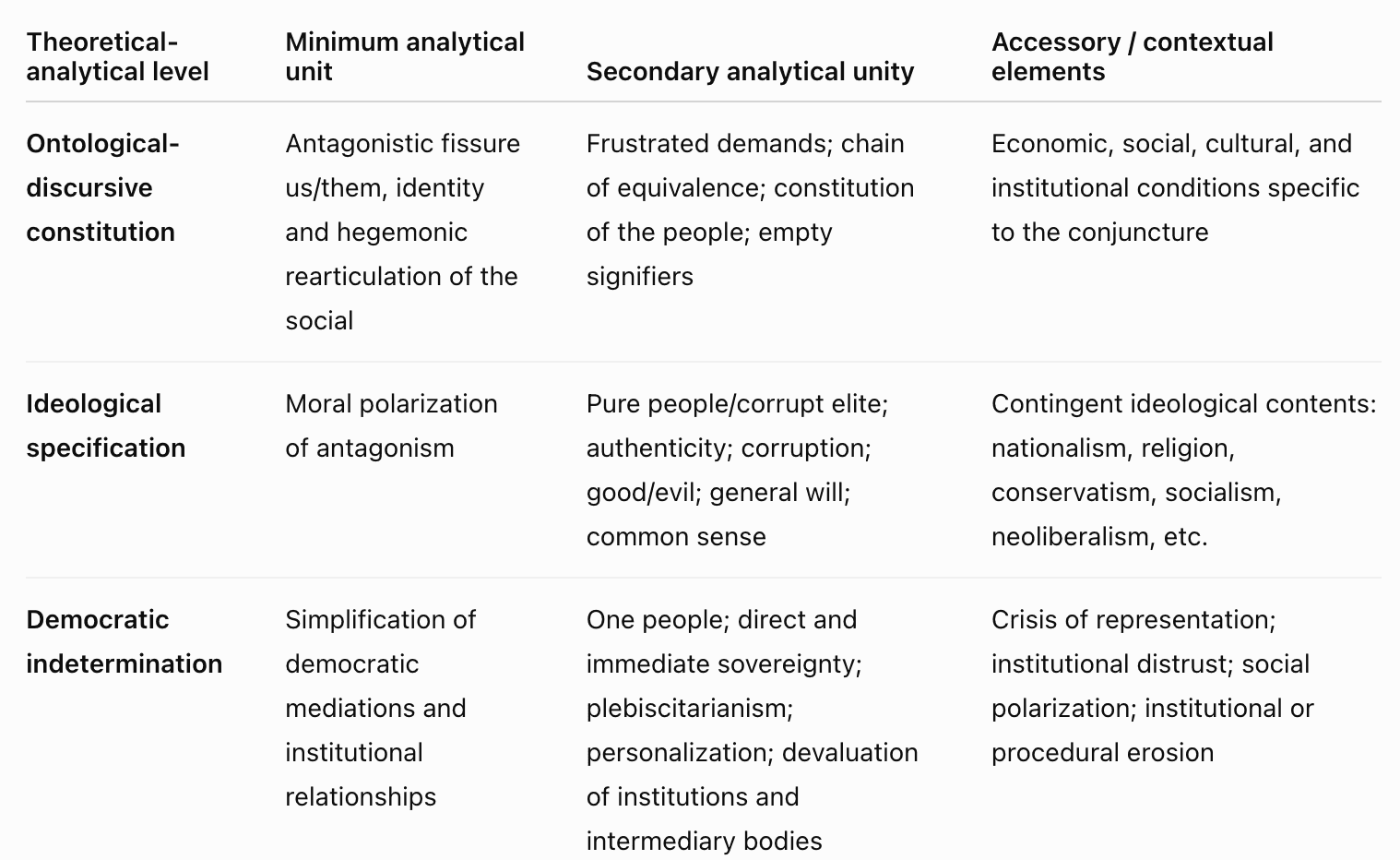
The framework distinguishes three analytical levels that do not correspond to independent phenomena, but rather to constitutive dimensions of the same political dynamic. At the ontological-discursive level, Laclau makes it possible to apprehend the logic through which frustrated social demands, initially particular and heterogeneous, produce an antagonistic fissure within the social sphere and reorganize political positions and identities around an opposition between “we” and “they.” This division thus constitutes the relational structure through which political identities and hegemonic forms are rearticulated in populism.
At the ideological level, Mudde makes it possible to apprehend the specific way in which this antagonistic relationship is organized by populism through moral polarization. Because of its thin-centered character, populist ideology does not substantively determine the constitutive essence of the two poles but structures their relationship through a moral division between the people and the elite. The concrete contents of these poles remain contingent: different actors and groups may occupy the position of the elite or represent the people according to the context. What constitutes the populist dimension is the persistence of the moral polarized form of the relationship, rather than the stability of its contents.
At the democratic level, Rosanvallon makes it possible to apprehend the unfolding of this antagonistic and polarized configuration within democracy itself. The opening of an antagonistic fissure and its ideological organization as moral polarization tend to reduce the plurality of forms of representation and mediation to a conception of direct, immediate, and polarized popular sovereignty. Democratic indetermination thus appears not as a third property simply added to the previous ones, but as the level at which the political consequences of the articulation between antagonism and polarization become manifest. The plebiscitary simplification of democracy therefore constitutes the unfolding of the specific way in which populist conflict organizes the relationship between the people, power, and representation.
The relationship between these levels is therefore constitutive rather than causally linear. At the ontological-discursive level, antagonism structures the political fissure constituted through frustrated demands; at the ideological level, populist ideology organizes this fissure into a moral polarization whose content remains contingent and currently assumes the form of an opposition between the “pure people” and the “corrupt elite”; and, as this configuration is projected onto democracy, it tends to produce its simplification in terms of direct, immediate, and plebiscitary sovereignty.
The framework thus articulates discursive-ontology, ideology, and democratic indetermination as different analytical dimensions of the same process, allowing for the formulation of three distinct but complementary questions through which the cases analyzed here can be empirically examined: 1) does the article identify the presence of an antagonistic fissure that divides the social field between “we” and “they” and produces new political identities through processes of hegemonic rearticulation? 2) does the article identify the organization of this antagonistic division through an ideological form that divides the “pure people” and the “corrupt elite” according to a moral yardstick? 3) does the article identify the simplification of forms of democratic representation, mediation, and sovereignty, expressed through the production of a unitary, direct and/or immediate popular will exercised in a polarized and plebiscitary manner?
The empirical exercise consists of assessing the plausibility of this architecture through the analysis of four scientific articles addressing distinct manifestations of populism, selected for the diversity of their national, historical and ideological contexts. The analysis seeks to identify, in each case, the presence and articulation of the three dimensions, assessing whether the framework is capable of producing a common interpretation of empirically heterogeneous manifestations of populism.
The cases selected for the empirical assessment were chosen according to the criteria of the Global Populism Database (GPD) populist classification. The project aims to identify populist features in the speeches of leaders from different countries and periods. The GPD emerged from a project initiated in 2006 to construct a database on the populist discourse of political leaders, initially focused on Latin America and subsequently expanded to different countries and historical periods. The methodology employed is holistic grading, a technique originally developed to assess latent aspects of texts, such as tone, style, and argumentative quality. In the GPD, trained coders assign speeches a score from 0 to 2 according to a rubric that identifies the presence and intensity of populist elements. For a discourse to be considered populist, it must present some conception of popular will; the mere existence of a Manichean worldview is insufficient. For each term in office, the sample normally includes four speeches: a campaign speech, a domestic/commemorative speech, an international speech, and a speech considered representative or famous of the leader.
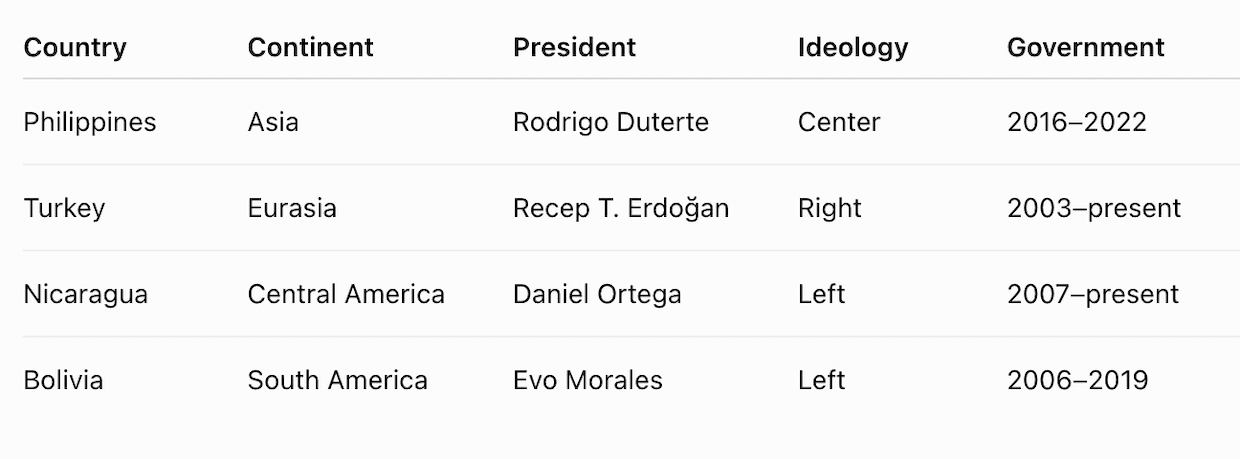
In addition to this classification, the GPD separates cases and selected speeches according to different ideological, temporal, and geographical dimensions. To maintain case diversity in this analysis, populist leaders were selected with the greatest possible diversity across cases, thereby preventing potential methodological bias. Leaders from the Philippines, Turkey, Nicaragua, and Bolivia were considered, classified across the left, center, and right, with GPD scores of 1.375 (Duterte), 1.466 (Erdogan), 1.25 (Ortega), and 1.462 (Morales), and who were in government between 2002 and 2022. This temporal period was defined in order to test the empirical application of the framework to the political context of the twenty-first century.
Multiple Approaches
The concept of populism stands among the most controversial concepts in recent theoretical history. Present in academia, electoral politics, media, and popular vocabulary, it is difficult to find a definition capable of explaining the phenomenon in all its dimensions. This conceptual debate has generated numerous controversies (Retamozo, 2017; Ahedo Rodrigues, 2023; Muller, 2023; Gherghina et al., 2013) and, although several one-dimensional formulations have become established as influential explanatory frameworks (Laclau, 2005; Howarth and Stavrakakis, 2000; Da Silva and Vieira, 2019; De Cleen, 2019; Judis, 2016; Müller, 2016; Moffitt and Tormey, 2014; Canovan, 2002; Mudde, 2004; Freeden, 2017; Rosanvallon, 2021; Levitsky, 2019), they have not been able to answer the following question: how can profoundly different and distinctive populist experiences be classified with theoretical rigor under a single concept capable of accounting for their common and universal aspects while also capturing the particularities and singularities inherent to specific political contexts?
In political disputes, the idea of populism is mobilized by political movements, parties, and incumbent leaders from both positive and negative perspectives (Stavrakakis, 2017; Elmgren, 2018; Dai and Kustov, 2022). While some political actors are classified as populists by their opponents, others embrace the populist label in an attempt to demonstrate that they genuinely govern on behalf of “the people.”
In academic debate, this dichotomy also remains. Merely as an illustration, in some cases populism is understood as a strategic dimension of politics (Weyland, 2024; Ware, 2022; Rueda, 2021), without which its existence would not be possible, while in others, it is defined as a pathological component that weakens democratic functioning and development and, in some cases, condemns democracy itself to extinction (Taggart, 2002; Akkerman, 2003; Zamora, 2022; Hirvonen and Pennane, 2019).
Over the last decade, we have also witnessed a new wave of attempts to characterize political realities through the concept of populism (Noury and Roland, 2020). These characterizations have referred especially to right-wing and far-right governments that have held power in countries such as Hungary, India, the United Kingdom, the United States, Brazil, Turkey, Russia, Italy, Argentina, and the Philippines, among others. Although most analyses focus on far-right movements and governments, others have also considered left-wing experiences, such as those in Venezuela and Mexico.
Different studies have sought to construct a conceptual architecture of populism based on more than one analytical dimension. In addition, the interpretation of populism as a political strategy and style has gained prominence in several studies, including: 1) Bonikowski and Gidron (2016) who propose the articulation of ideological, strategic, and discursive approaches and argue that these perspectives can be understood as complementary dimensions situated at different levels of analysis, rather than as mutually exclusive conceptions; 2) Osuna (2021) who draws on four distinct interpretative traditions for understanding populism — ideological, strategic, discursive, and performative — and argues that they can be understood as complementary spheres situated at different levels of abstraction; and 3) Metz (2026) who compares the ideological, strategic, and discursive-performative dimensions, seeking to demonstrate how each illuminates a different dimension of the relationship between populism and leadership.[2]
Bonikowski and Gidron (2016), Osuna (2021), and Metz (2026) share a common starting point: the difficulty of understanding populism through a single conceptual lens without losing the diversity of its manifestations. The three proposals recognize, albeit in different ways, that ideological, discursive, strategic, and performative approaches need not be treated as mutually exclusive interpretations. The common merit of these formulations therefore lies in shifting the debate away from the choice between competing definitions toward the possibility of integrating contributions from different traditions.
The contribution of Bonikowski and Gidron (2016) is particularly important because it shows that the difference between these traditions does not stem only from disagreements over “what” populism is, but also over “where” it should be located analytically. The ideological perspective apprehends populism as a structure of beliefs; the discursive perspective shifts attention toward the constitution of identities and political boundaries; and the strategic perspective privileges the actions of leaders in mobilizing support and attaining power.
The advantage of this formulation lies in recognizing that each of these perspectives illuminates a real property of the phenomenon and, above all, that one approach does not necessarily have to exclude the others. The problem that remains, however, is that complementarity is established primarily as a relationship between research traditions. This formulation does not yet provide a sufficiently precise explanation of how: what one approach identifies relates constitutively to what another approach identifies.
It is precisely at this point that the three-dimensional proposal differs. Rather than simply placing different perspectives side by side, it establishes a specific analytical relationship between them. The objective is not to argue that populism simultaneously contains discourse, ideology, and democracy, as if these were independent attributes. The hypothesis is that these dimensions correspond to different levels of the same political dynamic: the ontological-discursive dimension makes it possible to understand the constitution of the fissure and the rearticulation of political identities, the ideological dimension makes it possible to understand how this fissure assumes its specifically populist form, and the democratic dimension makes it possible to understand how this configuration is projected onto forms of representation, mediation, and sovereignty.
The difference is small in terms of vocabulary but significant in theoretical terms. From a multidimensional perspective, different attributes may coexist. From a three-dimensional perspective, they are theoretically ordered without constituting a linear causal sequence. Antagonism does not mechanically cause ideology, nor does ideology mechanically cause democratic indetermination. Rather, they are constitutive dimensions of the same process, in which their relationship makes it possible to understand properties that remain partially separated in multidimensional formulations. As formulated in the framework, the ontological-discursive dimension provides the relational structure of the political fissure; the ideological dimension organizes this fissure into moral polarization; and the democratic dimension apprehends the way in which this polarization reorganizes the relationship between the people, power, and representation.
This difference can be seen more clearly in Osuna (2021). His proposal constitutes perhaps the most elaborate attempt to transform the diversity of research traditions into a multidimensional model. The author brings together five dimensions — “depiction of the polity,” “morality,” “construction of society,” “sovereignty,” and “leadership” — and seeks to show that they synthesize elements derived from different conceptions of populism. The main advantage of this formulation lies precisely in its breadth. It prevents the analysis from being restricted to a single property of the phenomenon and makes it possible to capture manifestations in which different attributes appear with varying weights and combinations. His argument is that ideology, discourse, performance, and strategy can be understood as complementary efforts operating at different levels of abstraction.
However, the breadth of Osuna’s approach also produces the problem that the three-dimensional perspective seeks to address. His five dimensions are sufficiently broad to incorporate much of what the literature identifies as populist, but precisely for this reason some of them can be understood as manifestations or consequences of more fundamental operations. “Morality,” “construction of society,” and “sovereignty,” for example, are presented as distinct dimensions, although a closer theoretical relationship can be established between them.
The ontological-discursive dimension makes it possible to understand why “construction of society” need not constitute an independent dimension. The construction of an idealized and homogeneous society presupposes a particular way of constituting “the people” as a political unity. What appears in Osuna as a substantive dimension — the representation of a unified society and a popular collective — can be understood, from the perspective proposed here, as the result of the articulation through which heterogeneous demands are transformed into a collective identity. The advantage of the ontological dimension, therefore, lies not simply in adding discourse to the construction of society, but in explaining how the very image of a populist society becomes possible.
The same applies to the dimension of “morality.” Its presence is fundamental because it prevents every form of political antagonism from being considered populist. However, the three-dimensional perspective provides a more precise theoretical location for this element. Morality constitutes the specific way in which populist ideology organizes the fissure produced at the ontological-discursive level. The opposition between the people and the elite is not merely a political boundary; it is interpreted as an opposition between morally distinct poles. Thus, what appears as an autonomous dimension in Osuna can be reinscribed at the ideological level: ideology does not produce the fissure but gives it its specifically populist form.
This distinction is particularly important because it makes it possible to preserve what is most valuable in Mudde’s ideological approach without turning his conception into a competing definition of the discursive perspective. The thin-centered character of the ideology allows the concrete contents of “the people” and “the elite” to remain variable. What remains is not the substantive identity of the poles, but their polarized relationship. The three-dimensional perspective draws on this property to establish a bridge between Laclau and Mudde that multidimensional approaches tend to leave implicit: the contingency of ideological contents does not contradict the necessity of a populist structure of polarization; rather, it is what allows the same populist form to be filled with historically distinct political contents. It is precisely this preservation of variability without losing conceptual structure that constitutes one of the central objectives of the framework proposed here.
The dimension of sovereignty offers an even more significant distinction. Osuna correctly identifies popular sovereignty as a recurring component of populist manifestations. From the three-dimensional perspective, however, sovereignty is not simply another ideological content of populism. It must be understood in relation to the democratic structure itself. What matters is not merely establishing that populism invokes the will of the people, but understanding what happens to democratic forms of representation and mediation when this will is conceived as immediately identifiable and politically homogeneous.
In this sense, the democratic dimension adds something that is contained neither in the discursive nor in the ideological dimension alone. Antagonism constitutes the fissure, ideology organizes it morally, and it is from this configuration that a particular relationship with emerges in democracy. The promise of restoring popular sovereignty can therefore take a form that simplifies the plurality of democratic mediations into an opposition between an authentic popular will and institutions perceived as obstacles to its realization. Osuna’s “sovereignty” is therefore incorporated but also reinterpreted, it moves from being an independent attribute to becoming a constitutive element of the democratic dimension. What is gained is the possibility of understanding why the claim to sovereignty acquires specific consequences for representation and mediation.
Metz (2026) shifts the discussion to another terrain by articulating ideological, strategic, and discursive-performative perspectives around leadership. His contribution is important because it demonstrates that these approaches do not explain exactly the same thing. The ideological dimension makes it possible to understand the activation of identities and moral oppositions, the strategic dimension focuses on the personalization of power and the exploitation of institutional opportunities, and the discursive-performative dimension addresses the symbolic construction of authority through narratives, performances, and representational practices. The result is a conception in which populist leadership is simultaneously ideologically activated, strategically mobilized, and symbolically constructed.
His contribution is particularly useful because it shows that integrating different approaches can produce a richer explanation than any of them can provide in isolation. At the same time, his proposal highlights the difference from the three-dimensional framework. The center of Metz’s integration is leadership, while the center of the three-dimensional proposal is the constitution of the political relationship between the people, antagonism, ideology, and democracy. Consequently, elements from different perspectives can be repositioned within a single structure. Ideological activation corresponds to the moral form through which the fissure is organized, symbolic construction corresponds to the discursive operations through which popular identity is produced, and the strategic dimension can be understood as the political use of this already constituted relationship.
This difference becomes particularly important when considering the relationship between leadership and representation. In Metz’s approach, leadership constitutes the space in which the different dimensions of populism converge: the leader activates identities, personalizes power, and produces symbolic authority. From the three-dimensional perspective, however, this convergence can be explained through a broader dynamic. Leadership is capable of condensing different demands because a prior operation of articulation makes it possible to represent them as part of the same collectivity. The leader is not merely the actor who mobilizes an already existing popular identity, his or her capacity for representation is itself related to the symbolic constitution of that unity.
It is at this point that the strategic perspective should be considered more carefully. Its contribution should not be dismissed. On the contrary, it draws attention to something that ontological and ideological perspectives, when taken in isolation, may leave in the background: populism is also a practice of political struggle for power. Leaders make choices, exploit opportunities, seek to circumvent institutional intermediaries, personalize political ties, and mobilize followers. Metz shows, moreover, that the strategic approach is particularly important for understanding the personalization of power and the exploitation of institutional vulnerabilities.
The question, however, is whether this requires strategy to be elevated to the same analytical status as the ontological, ideological, and democratic dimensions. The answer proposed here is negative. Strategy adds an important instrumental dimension of political action, but not necessarily a new constitutive dimension of populism.
This is because the discursive constitution of the people already involves a political operation. The production of equivalences among frustrated demands, the construction of an antagonistic fissure, and the symbolic condensation of this plurality around signifiers capable of representing a popular unity are not politically neutral operations. They produce a relationship between leadership and collectivity that can be mobilized to attain and exercise power. In this sense, the symbolic sphere mobilized by the leader through the articulation of empty signifiers already has a strategic dimension: it organizes demands, produces identities, defines adversaries, and creates the conditions for political mobilization.
The difference from the strategic approach is therefore one of explanatory depth. The strategic perspective asks how a leader uses a political relationship to attain power; the ontological-discursive perspective asks how this relationship between the leader and the people becomes constituted as a political relationship in the first place. The former identifies the strategic use of mobilization, while the latter explains the possibility of mobilization itself. This does not mean denying the leader’s strategic agency but rather showing that such agency operates upon a symbolic structure that must itself be produced.
This formulation also makes it possible to address one of the limitations recognized in the strategic literature: the tendency to privilege the leader excessively and reduce political action to rational calculation, leaving the emotional and symbolic components of the populist relationship in the background. Metz shows that criticisms of this kind point precisely to the need to understand leadership as a relational process, in which the leader’s claims encounter followers’ dispositions and institutional conditions. The ontological-discursive perspective provides a way of incorporating this relational dimension without abandoning agency, showing the leader acts strategically, but this action is inseparable from the symbolic construction of the identity he or she seeks to represent.
The advantage of the three-dimensional perspective ultimately lies in the fact that it does not simply add a fourth dimension to the three already existing ones. Rather, it seeks to explain why the elements identified by different approaches appear together. The ontological-discursive perspective provides the level of the constitution of the fissure and political identity; the ideological perspective provides the level of moral polarization that gives this fissure its specifically populist character; and the democratic perspective provides the level at which this configuration reorganizes the relationship between sovereignty, representation, and mediation. Strategy remains important, but as a transversal mode of political action operating upon a relationship whose constitution has already been explained.
Thus, Bonikowski and Gidron (2016) provide the grounds for understanding different traditions as complementary, Osuna (2021) demonstrates the analytical richness of a multidimensional architecture, and Metz (2026) shows how different perspectives can be integrated to explain populist leadership. The three-dimensional perspective builds on these contributions but proposes a distinct theoretical operation: not merely to bring together the different dimensions of populism, but to determine the analytical place each occupies and the constitutive relationship it establishes with the others.
Debating Ontology, Ideology and Democracy
As is well known, Laclau’s conception of populism seeks to explain how the phenomenon is constituted through specific social and political relations within the discursive field. Discourse, according to his formulation, is not merely an interlocutory or speech act, but any relation established among individuals, ideologies, institutions, and other dimensions that constitute the social as a totality and can be symbolically represented. Drawing inspiration from post-structuralism, his theory understands populism as emerging through an antagonistic fissure. This fissure emerges when political power fails to satisfactorily address social demands and the social sphere becomes symbolically divided between “we” and “they.” The resulting fissure destabilizes the existing social arrangement and opens the possibility for the rearticulation of new political identities through hegemonic processes capable of giving symbolic unity to otherwise heterogeneous demands and conflicts.
For Laclau, populism is not an element external to politics, but rather a fundamental part of its very constitution. It should not be understood as a strategy mobilized by specific political actors, nor as an ideology or a deformation of the democratic system, but as an element of politics’ own ontological structure. The populist phenomenon manifests itself through a discursive relationship materialized through language and identity, which represents political disputes through hegemonic narratives among different actors, with rulers and ruled occupying center stage.
From this perspective, populism emerges when social demands are not met by those in power and begin to form a chain of equivalence. What makes these demands equivalent is not the content of the aspirations that constitute their core — healthcare, education, security, and so forth — but rather the fact that they have all been frustrated. This is what might be called a negative equivalence: a chain of demands united by frustration.
The populist leader is the one capable of formulating, in one or a few words — through an empty signifier — a discursive response capable of encompassing the greatest possible number of demands within a single symbolic solution. For Laclau, the populist leader therefore possesses the capacity to provide a hegemonic discursive articulation to diverse political issues.
According to Laclau, the populist phenomenon emerges when political leadership becomes capable of incorporating the hegemonic singularity produced by this chain of equivalence through an empty signifier. This incorporation makes possible a direct connection between the populist leader and the people — a process identified by the author as the formation of the people through the symbolic unification of the population around a specific individuality.
Through this dynamic, the people become constituted as a historical actor through the constitution of a new identity — that is, as the externalization of real relations among social agents, rather than as an expression of a purely ideological nature. The people must therefore be understood as the collectivity of those excluded from the political process who claim for themselves the representation of the whole, rather than as the mere sum of social actors.
It is because of this ontological-discursive nature that Laclau’s formulation was privileged as the primary conceptual core of the three-dimensional interpretative perspective proposed here. It makes it possible to understand the genesis of the phenomenon and the social sphere from which it emerges. His theory is therefore as much social as political, since the latter cannot be understood without reference to the former.
While Laclau’s theory provides an entry point for understanding the emergence of populism, his notion of the antagonistic fissure also enables a theoretical dialogue with Mudde’s ideological formulation. The fissure between “we” and “they” can be understood as the basis upon which the moral and ideological polarization identified by Mudde is organized through the opposition between the “pure people” and the “corrupt elite.”
Cas Mudde’s conceptual formulation of populism has its roots in his studies of the far right in Europe (1995, 1996, 1996a). It was in 2001 that he first outlines his idea of populism, and in “The populist zeitgeist” (2004) that Mudde’s formulation of populism as an ideology fully emerged. From this point onward, populism should be understood as an ideology in which politics appears as the expression of the volonté générale (general will) of the people within a society divided into two homogeneous and polarized camps, representing respectively by the “pure people” and the “corrupt elite.” It is also in this article that Mudde introduces the concept of thin-centered ideology, borrowed from Freeden (1996), understood as underdetermined in itself but capable of being combined with complementary host ideologies such as communism, neoliberalism, and environmentalism.
The foundations of his theoretical approach were then deepened in 2017 through the clarification of four primordial elements: ideology, people, elite, and general will. Mudde also emphasized that authenticity — a category grounded in morality — constitutes the defining element that differentiates the people from the elite. According to the author, authenticity is an inherent characteristic of the people, opportunistically appropriated by elites in their projects of power. Purity constitutes the essential element of the people, in contrast to the corruption of elites, who mobilize and claim this purity in order to govern in their own interests.
Thus, the polarization between “the people” and “the elite” becomes the cornerstone of Mudde’s definition. Populism is therefore a worldview or ideology structured around this polarized dichotomy and formulated through a moral conception of the world in which the division separating social categories is moral rather than based on class, race, or another form of identity. Populist leaders consequently wage, at the ideological level, a battle between “good” and “evil,” in which the people symbolize the homogeneous mass of the pure, standing apart from the corruptive patterns attributed to corrupt elites.
From this perspective, the volonté générale does not emerge from the aggregate sum of individuals in society, but from a greater force called the people, whose mode of governing is rooted in common sense. The populist leader can therefore present himself or herself as the embodiment of this common sense, derived from purity and goodness. If the moral categories of the “pure people” and the “corrupt elite” can be understood as contingent and precarious moral identities emerging from the antagonistic fissure identified by Laclau between “we” and “they,” Mudde’s conceptions of the incorporation of the general will and common sense can likewise be articulated with Laclau’s conception of populism.
Laclau explains that populist hegemony is constituted through the mobilization of one or more empty signifiers capable of symbolically embodying frustrated social demands. Mudde demonstrates how this embodiment manifests itself at the practical level through the incorporation of the general will and common sense by the populist leader, based on the premise that the will of the “pure people” is genuinely represented and should prevail. While Laclau approaches the general will from an ontological-discursive perspective, Mudde translates its significance into practical terms by showing how this incorporation operates at the ideological level through a leader capable of maintaining moral polarization and embodying its political implications.
Another point of contact between Laclau and Mudde lies in the place occupied by ideology in their respective theories. For Mudde, ideology is a set of ideas about how society should be organized, providing a normative vision of social and political order. For Laclau, by contrast, ideology operates through the discursive production of an appearance of closure and fullness of the social, manifesting itself through particular signifiers capable of politically representing the universal. Here again, Mudde’s theory operationalizes Laclau’s ontological-discursive conception in practical terms. If, for Laclau, ideology operates within the articulatory sphere of the political, for Mudde its role is to organize this field and its political disputes at the empirical level.
It is important to retain that Mudde’s theory operates at a different analytical level from Laclau’s. While Laclau is concerned with the ontological-discursive constitution of the political and, consequently, of populism, Mudde is interested in how its components unfold in the practical field through a grammar that enables the populist leader to organize political disputes through moral polarization between identities.
A familiar example may facilitate this distinction. São Paulo was the site of a series of protests in 2013 that marked Brazil’s recent political history. Characterized by grievances concerning corruption, healthcare, security, education, and other demands, these events opened an antagonistic fissure within a previously hegemonic social arrangement in which the Workers’ Party (PT) had sought to articulate the struggle against social inequalities and injustices through the governments of Lula da Silva and Dilma Rousseff. Popular dissatisfaction became so significant that the PT was no longer able to rearticulate that hegemonic arrangement on the basis of its existing political foundations.
The antagonistic fissure responsible for the symbolic creation of an “us” versus “them” remained open until 2018, when a populist leader was able to hegemonically rearticulate the fractures associated with the exhaustion of a model of government that had been successful since 2002, when Lula was first elected. Through a proposal for hegemonic rearticulation based on economic freedom and cultural conservatism, and under the slogan “God, Fatherland and Family,” which morally separated the people from the elites, Jair Bolsonaro mobilized popular support, and aggregated votes from diverse social groups under the same ideological umbrella of a pure people.
Thus, while Laclau’s theory explains the political articulation that contributed to Bolsonaro’s election, Mudde’s theory demonstrates how Bolsonaro mobilized the social fracture constituted through the antagonism expressed in the 2013 protests through a populist discourse based on moral polarization between two homogeneous and antagonistic blocs. This ideological construction of identities was constituted through the symbolic division of the social field between petistasand anti-petistas.
Pierre Rosanvallon’s theoretical-conceptual formulation of populism is derived from his studies on democracy (1992, 1998, 2006, 2008, 2011a, 2015). He sought to understand and define populism through the recognition of certain indeterminacies present in contemporary democracy. His formulation emerges from debates concerning democratic theory, thus distancing itself from the perspectives proposed by Laclau and Mudde. Through the body of his work — whose corollary can be found in “The populist century: History, theory, critique” (2021) — Rosanvallon sought to refute the idea that democracy can be reduced merely to the functioning of democratic institutions and their procedures.
Rosanvallon had already devoted attention to ideas related to populism in “La contre-démocratie: La politique à l’âge de la defiance” (2006), as well as in the article “Penser le populisme,” published in Le Monde in 2011. These works already contain ideas concerning the mutation of civic activity and the general will, the conception of democracy as a threatened form of society, and the presidentialization of democracy through the strengthening of executive power.
According to the author, these are among the fundamental mutations associated with populism and, in the specific case of the mutation of civic activity, with the subversion of counter-democracy through the excesses produced by the pressures and corrective actions of the surveillant people, the veto people, and the judge people. The idea of populism as a pathology of democracy would gradually be abandoned by the author over the course of his intellectual trajectory.
By establishing a dialogue with minimalist and essentialist limit-forms of democracy, Rosanvallon positions populism within this same dimension, characterizing it as a form of limit-democracy whose essence lies in polarization. He understands populism as the result of the simplification of the democratic ideal and democratic functioning, defining it as a direct, polarized, and immediate form of democracy. This format allows democracy to turn against itself in contexts of political degradation. Populism would therefore not be an external pathology of democracy, but democracy itself in its polarized form, constituted through the extreme simplification of the aporias that structure it.
By understanding populism as a democratic form, Rosanvallon describes its anatomy through characteristics such as the conception of a people-as-one, the devaluation of intermediary bodies and institutions, the embodiment of the general will through the idea of the “people-man,” the exaltation of national popular sovereignty through a certain protectionism, and the presence of simplistic and conspiratorial narratives through the construction of enemies of the people.
The idea of populism as democratic indetermination does not correspond to theories that understand populism as democratic degeneration, but rather to perspectives that understand democratic forms as increasingly forced to adapt to a social context marked by new forms of communication and popular expression, new forms of sociability, and growing popular distrust of the institutions that organized the socioeconomic and political landscape of the post-Second World War period.
It is the recognition of these transformations and their consequences in the political sphere that makes it possible to identify democracy as the third dimension of the populist phenomenon. If Laclau’s perspective helps explain how populism is constituted as an ontological-discursive dimension of the political and Mudde’s formulation makes it possible to understand how this dimension operates at the practical level, Rosanvallon’s notion allows us to recognize democracy as the privileged arena in which the first two dimensions manifest themselves institutionally.
Democratic indeterminations can be understood as adaptive responses within democracy to political challenges arising from three interrelated processes: 1) the growing dissatisfaction with and distrust of mainstream politics and the emergence of increasingly precarious and unstable political identities, constituted through recurring antagonistic fissures that find polarization as their mode of manifestation; and 2) the emergence of leaders capable of capitalizing on this polarization through ideological forms that opportunistically organize the demands and social identities arising from it according to the political conjuncture.
These mutations in the institutional democratic arrangement and in the aporias that inform it should be understood, according to Rosanvallon, as institutional attempts to adapt to scenarios of instability and uncertainty that have characterized the twenty-first century. Initially conceived around plural values, relatively stable political identities, the possibility of reconciling differences, and tolerance toward political opponents, democracy has increasingly been required to accommodate political components that are antithetical to many of the values and principles that once constituted it.
The democratic conception of the people-as-one, the embodiment of the general will by the people-man, the devaluation of intermediary bodies and institutions, the construction of simplifying narratives about the enemies of the people, and the exaltation of national popular sovereignty engage closely with Laclau’s and Mudde’s formulations of populism but operate through a third empirical dimension: democratic indetermination.
If, in Laclau, antagonism produces political identities and, in Mudde, moral polarization organizes this division through the opposition between the people and the elite, it is in Rosanvallon’s perspective that we can understand the consequences of these dynamics for the democratic form itself. Increasingly frequent antagonistic fissures produce progressively more precarious political identities, whose instability requires equally recurrent processes of hegemonic rearticulation.
Polarization, by organizing these rearticulations in moral and simplified terms, further intensifies the instability of political boundaries and reduces the space for the composition, negotiation, and mediation of differences. Democracy is thus subjected to the need to transform itself at an increasingly rapid pace in order to accommodate conflicts, identities, and demands that no longer find stability within traditional forms of representation. Democratic indetermination therefore constitutes not simply an external response to populist dynamics, but the set of transformations produced within democracy itself by the acceleration of these disputes.
It is through this process that different manifestations of democratic indetermination can be understood as consequences of the growing precariousness of political identities and the need for their permanent recomposition. As the succession of antagonistic fissures and hegemonic rearticulations makes it increasingly difficult to sustain stable political identities, democracy faces growing pressure for more immediate forms of producing unity and identifying the popular will.
Moral polarization contributes to this operation by transforming differences and conflicts into a simplified opposition between “the people” and their “enemies,” fostering the perception that plurality and institutional mediation prevent the authentic expression of the popular will. In this context, the idea of the people-as-one emerges as an attempt to symbolically reconstruct a unity that antagonistic dynamics themselves have rendered unstable; and the people-man appears as a possibility for personifying and making immediately recognizable a general will that, within a politically fragmented society, would otherwise be difficult to identify.
The same dynamic helps explain the devaluation of intermediary bodies and institutions, the construction of simplifying narratives about the enemies of the people, and the exaltation of national popular sovereignty. If the multiplication of antagonisms makes popular unity more difficult to sustain, polarization offers a simplifying solution to this difficulty: it reduces the diversity of the social field to two morally opposed camps and it presents popular sovereignty as a unitary will whose expression should be direct and immediate. Institutions and intermediary bodies of democracy then come to be perceived as obstacles to the realization of this will; adversaries are transformed into threats to the political community itself, and popular sovereignty shifts from a mediated and plural conception toward a direct, immediate, and plebiscitary one.
Democratic indetermination therefore expresses a form of mismatch between the speed at which political identities and disputes transform and the capacity of traditional democratic forms to absorb them. It is precisely within this mismatch that the first two dimensions find their democratic consequences: antagonism destabilizes the social and produces precarious political identities; their recurrent rearticulation intensifies instability; moral polarization simplifies this instability; and democracy responds by producing new forms of unity, personification, and immediate expressions of popular sovereignty.
Multiple Scenarios, Same Theory
As stated previously, the formulation proposed in this article seeks to test the hypothesis that, despite differences in political, social, economic, and ideological terms, populism manifests itself across different conjunctures and historical contexts through a three-dimensional structure encompassing ontological-discursive, ideological, and democratic aspects of politics. The empirical assessment aims to identify the presence of these aspects across heterogeneous realities. It should be emphasized that this test is not the central axis of the article, but rather an initial assessment of the analytical potential of the proposed framework.
Although the selected cases and countries share certain social, economic, political, and cultural similarities, they also present significant differences in economic, social, and political terms. In Turkey, Erdogan initially combined economic growth, liberalization, and the expansion of the middle class, later accompanied by greater interventionism and instability. Socially, he incorporated conservative and religious sectors previously marginalized by secularist elites. Politically, he promoted increasing executive concentration and restrictions on the opposition, while culturally articulating nationalism, religious conservatism, and references to the Ottoman past.
In the Philippines, Rodrigo Duterte maintained a pro-market economic orientation combined with large-scale public infrastructure investment. Socially, he emphasized crime control and policies of order, with a strong impact on popular sectors through the war on drugs. Politically, he reinforced personalism and confronted institutions, the press, and the opposition, while culturally mobilizing nationalism, masculinity, authority, and rejection of traditional elites.
In Nicaragua, Daniel Ortega combined market-oriented policies and private investment with redistributive programs. Socially, he expanded assistance policies, particularly among popular sectors. Politically, he progressively consolidated control over institutions, the opposition, and civil society, while culturally rearticulating Sandinismo through nationalism, sovereignty, religiosity, and conservative values.
In Bolivia, Evo Morales expanded state control over natural resources and used commodity revenues to finance redistribution and social policies. Socially, he promoted the inclusion of Indigenous populations and reduced poverty. Politically, he transformed the state through the 2009 Constitution, while subsequently increasing the concentration of his own power; culturally, he articulated indigenism, decolonization, plurinationality, and national sovereignty.
The articles to be evaluated were randomly selected through Google Scholar according to six criteria: 1) studies centered on broad empirical case analyses rather than specifically conceptual or theoretical formulations, thus protecting the proposed analysis from conceptual replication; 2) adherence to the Global Populism Database (GPD) classification of populism, ranging from 0 to 2; 3) geographical location of the cases in Asia, Eurasia, South America, and Central America; 4) ideological orientation of the populist leader according to the GPD classification (-1 left, 0 centre, and 1 right); 5) a temporal scope covering leaders who held office between 2002 and 2022; and 6) articles published between 2017 and 2023, in order to prioritize recent scholarship on the selected cases.
The following table presents the cases according to their respective criteria:
The following questions guided the analysis:
1) Does the article identify an antagonistic fissure that divides the social field between “we” and “they” and produces new political identities through processes of hegemonic rearticulation?
2) Does the article identify the organization of this antagonistic division through an ideological polarization that divides the “pure people” and the “corrupt elite” according to a moral distinction?
3) Does the article identify the simplification of forms of democratic representation, mediation, and sovereignty, expressed through the production of a unitary, direct, and/or immediate popular will exercised in a polarized and plebiscitary manner?
The assessment of randomly selected secondary sources according to previously established analytical criteria reduced the possibility of selection bias and of choosing cases that merely conform to the researcher’s expectations. Moreover, the articles had previously undergone peer review and had been published in indexed academic journals, providing an independent basis for the empirical assessment. The approach may also provide a basis for future large-scale empirical analyses, including those that may benefit from LLM-based tools.
The articles assessed were: “Flirting with Authoritarian Fantasies? Rodrigo Duterte and the New Terms of Philippine Populism” (Curato, 2017); “How Erdogan's Populism Won Again?” (Esen and Gümüşçü, 2023); “Nicaragua: A Return to Caudillismo” (Thaler, 2017); and “El populismo del siglo XXI y el liderazgo hegemónico. Caso de estudio: Bolivia con Evo Morales” (Junco, 2023).
The table below shows which observable indicators derived from the three theoretical levels proposed in this article, how it can be applied, and how future research may incorporate additional observable indicators and accessory according to different contextual cases:
Philippines
In the case of Rodrigo Duterte, Curato (2017) provides evidence of all three dimensions of the framework, although with different degrees of explicitness. At the ontological-discursive level, Duterte’s rise occurred amid frustration with traditional politics and dissatisfaction with everyday problems that remained inadequately addressed. “The people” comprised a heterogeneous population, initially mobilized particularly in Mindanao and among urban middle-class sectors, but whose support subsequently crossed class, regional, age, and linguistic boundaries. “The other” was associated with traditional political elites and practices, corruption, the inability of previous governments to solve everyday problems, and, progressively, criminals and those involved in drugs. The frustrated demands were concrete: poverty, inequality, low wages, inadequate public transportation, poor airport conditions, crime, and drugs, as well as the perception that the institutional reforms and social programs of the Aquino government had not produced sufficiently visible results in everyday life.
Curato notes that employment, poverty, and inflation were among voters’ main concerns outside electoral periods, while Duterte succeeded in shifting drugs and criminality to the center of the political dispute. This hegemonic rearticulation moved the gravitational center of the debate from material concerns toward law and order. The case therefore provides evidence of an antagonistic fissure, the formation of a popular political identity through frustrated demands, and a hegemonic rearticulation, with the slogan “change is coming” functioning as a signifier capable of condensing this chain of equivalence.
At the ideological level, this division acquired a moral dimension through the opposition between ordinary citizens and those associated with traditional politics, corruption, and governmental incapacity. Duterte contrasted his promise of immediate action with the reformism of Aquino and Roxas, the latter representing continuity with Aquino’s project and associated with good governance, transparency, economic growth, and institutional reform. Moral polarization also extended to criminals and drug traffickers, portrayed as threats to society requiring an exceptionally forceful response. The polarization was therefore not fully articulated through the classical “pure people/corrupt elite” formula; its empirical content was primarily ordinary people versus the political establishment, incompetence, corruption, and criminality.
This moralization became particularly visible in Duterte’s representation of conventional politics as corrupt, patronage-based, and incapable of responding to concrete popular needs, while he constructed his own authority around authenticity and a willingness to do what conventional politicians were supposedly unwilling to do. The promise to combat drugs and crime through extreme means, including authorization for police to shoot to kill and support for the death penalty, was presented not merely as a policy choice but as a morally justified response to those held responsible for the deterioration of social order.
Finally, the democratic dimension is also strongly identifiable. The slogan “I will” condensed the promise to eliminate drugs and criminality within three to six months, privileging certainty, force, and immediate results over a detailed economic platform. Curato contrasts this model with democratic rules and procedures, showing how direct and aggressive problem-solving could displace slower forms of representation and mediation. At the same time, the author notes that popular distrust was not necessarily directed toward democracy itself — 76% of Filipinos reported satisfaction with its functioning in 2015 — but toward the complexities of good governance and the justice system.
Turkey
Turkey’s case presents all three dimensions: an antagonistic fissure organized through heterogeneous demands and hegemonic rearticulation, moral polarization between a legitimate people and opponents portrayed as corrupting or threatening forces, and the personalization and simplification of democratic representation around Erdogan.
In the ontological-discursive dimension, Esen and Gümüşçü (2023) identify an antagonistic fissure organizing the political field between “we” and “they,” well represented empirically by “the people” and their internal and external enemies. Erdogan shifted the focus of the 2023 election from economic problems toward national security, presenting the contest as an existential struggle between the population and those threatening the country’s integrity. This antagonistic pole included Kilicdaroglu’s opposition, the Kurdistan Workers' Party (PKK), Kurds associated with the opposition, and Western forces allegedly involved in attempts to destabilize Turkey. The frustrated demands included the effects of inflation, the depreciation of the lira, poverty and youth unemployment, as well as concerns about crime, national security, territorial integrity, and the presence of millions of refugees.
These heterogeneous demands were progressively incorporated into a common popular identity as Erdogan shifted the gravitational center of the political dispute away from the economy and toward national security, nationalism, territorial integrity, and Islamic and conservative values. This constitutes a hegemonic rearticulation in which economic, security, national, and religious concerns were subordinated to a new structure of meaning centered on the defense of the nation against internal and external enemies. The slogan “stay on track with the right man” can, in this context, be interpreted as an empty signifier capable of condensing this ethos and associating Erdogan’s continuity in power with the defense of the political community.
At the ideological level, this fissure was explicitly moralized. Erdogan presented his opponents not simply as political competitors but as illegitimate and threatening actors: Kilicdaroglu was associated with the PKK, while the Republican People's Party (CHP) was portrayed as representing a secularist tradition distant from the values of the “Turkish people.” His opponents were also characterized as anti-Islamic and “pro-LGBT.” Although the article does not employ the literal formula “pure people” versus” corrupt elite,” it provides evidence of its underlying logic: on one side, a religious, nationalist, and patriotic people identified with the defense of Turkey and on the other, an opposition portrayed as incompetent, connected to terrorism, hostile to religious values, and potentially responsible for the loss of territorial integrity.
The democratic dimension is also evident, particularly in the personalization of popular sovereignty and the reduction of political competition to a direct choice between Erdogan and those portrayed as threats to the people. The hyper-presidential system established in 2018, combined with limited institutional checks and balances, reinforced this personalization. The claim to represent “the will of the people,” together with the presentation of Erdogan as “the right man,” further concentrated representation around the leader. This simplification was accompanied by the weakening of institutional mediation. The article describes increasing executive control over state institutions, restrictions on the media, and legal measures against opponents.
Nicaragua
Thaler’s (2017) analysis also provides evidence of the three dimensions, although they assume particular characteristics in the Nicaraguan case. At the ontological-discursive level, Ortega’s trajectory reveals an antagonistic fissure between a “we” identified with the Sandinista people, the revolution, and national sovereignty and a “they” historically associated with the enemies of the revolution, the political right, and US imperialism.
This political boundary, originally constructed around the opposition between the Sandinista National Liberation Front (FSLN) and Somoza’s dictatorship and later between Sandinistas and their opponents, was rearticulated after Ortega’s return to power. Thaler shows that, from 2006 onward, the former FSLN identity — based on the articulation of urban workers, peasants, civil society organizations, and moderate sectors of the bourgeoisie — was progressively transformed. Ortega incorporated former adversaries, including representatives of the Contras, business sectors, and the Catholic hierarchy, and even established cooperative relations with the United States, historically the principal external enemy of Sandinismo.
The fissure therefore did not disappear, rather, its poles and contents were rearticulated. The political center of gravity shifted from revolutionary mobilization toward a combination of economic development, stability, Christianity, order, and preservation of power, condensed in the slogan “Christian, Socialist, and In Solidarity.”
At the ideological level, the friend/enemy logic remained central. Ortega preserved revolutionary symbols and rhetoric and continued to denounce Washington when seeking to mobilize supporters, while those who challenged his authority were progressively delegitimized and repressed. Moral polarization could also operate internationally, with Washington and imperialism occupying the position of an antagonistic exterior and being associated with threats to national sovereignty. At the same time, Ortega’s strategy demonstrates that this boundary was continuously rearticulated: the former US enemy became a partner in certain areas, while former domestic adversaries were incorporated into the governing coalition. Polarization therefore persisted but was reorganized around the defense of revolution, sovereignty, order, and the political community.
The democratic dimension is particularly strong. Ortega progressively concentrated sovereignty in the Executive, brought the Supreme Court and Supreme Electoral Council under FSLN control, removed limits on reelection, and expanded presidential power. At the same time, the Councils of Citizen Power operated as party-linked structures for distributing resources and were later replaced by structures also connected to the police and used for community surveillance. The 2016 election, following the withdrawal of the principal opposition from the contest, resulted in 72.4% of the vote for Ortega and 70 of 92 legislative seats for the FSLN, while confidence in elections as a means of expressing political preferences declined.
Bolivia
Junco & Álvarez’s (2023) analysis regarding Bolivia provides evidence of all three dimensions, beginning with the crisis of the neoliberal model and the social mobilizations preceding Evo Morales’s rise to power. At the ontological-discursive level, the antagonistic fissure emerged from the growing opposition between a “we” associated with Indigenous populations, peasants, workers, and socially marginalized groups and a “they” associated with political and economic elites, neoliberal policies, and, subsequently, foreign companies controlling natural resources.
This boundary was sustained by concrete frustrated demands, particularly the privatization of water in Cochabamba, the exclusion of Indigenous communities from decisions concerning their territories and resources, repression of coca mobilizations, poverty and unemployment, and, above all, demands for national control over gas and hydrocarbons.
The Water War (2000), the peak of Coca War (2001–2002), and the Gas War (2003) condensed these demands and enabled the Movimento ao Socialismo (MAS) to expand beyond the Indigenous movement by articulating different social sectors around the defense of natural resources and national sovereignty. A hegemonic rearticulation therefore occurred as the gravitational center of the political dispute shifted from conventional partisan opposition toward the defense of the “people” against neoliberalism and those controlling national resources. This articulation was condensed in expressions such as “recuperar nuestros recursos naturales” and in Morales’s identification with the defense of the Bolivian people and national sovereignty.
At the ideological level, polarization was explicitly moralized. Morales contrasted popular and Indigenous sectors, presented as legitimate bearers of national sovereignty, with elites, neoliberal governments, and foreign companies, which were held responsible for appropriating the country’s resources and maintaining inequality. Presidential discourse drew on the memory of social struggles and presented the nationalization of hydrocarbons as the recovery of what had been taken from Bolivians, associating foreign exploitation with dependency and loss of sovereignty. Polarization therefore extended beyond the domestic people-versus-elite opposition to include an international dimension involving Bolivia and foreign economic interests.
Finally, the democratic dimension can be identified primarily through the increasing personalization of political representation and the concentration of the relationship between government and society around Morales. His leadership involved a direct relationship with social movements and popular sectors that constituted his political base. The article shows that Morales sought to maintain his popularity through direct engagement with these groups and through the discursive mobilization of their demands, while also increasing his capacity to influence legislators and the media.
This direct relationship also appeared in the way the government combined popular participation with the exercise of political power. Social movements linked to the MAS were incorporated into decision-making processes, while Morales presented himself as the principal interpreter of their needs and aspirations. The concentration of power around the leader deepened over time, allowing him to exercise increasing influence over institutions and movements that had previously enjoyed greater autonomy.
In this sense, democratic simplification does not derive simply from the existence of participatory mechanisms, but from the reduction of mediation between social demands and political decision-making as their representation became strongly identified with Morales’s leadership. The plebiscitary dimension therefore appears less through the formal use of referendums than through the construction of a political relationship in which governmental legitimacy was increasingly linked to the leader’s capacity to directly represent popular sectors and respond to their demands.
Final Considerations
The theoretical and exploratory empirical analysis developed in this article suggests that the three-dimensional approach offers a viable way of reconciling conceptual unity with the empirical diversity of populism. Its contribution lies not simply in bringing together different theoretical traditions, but in specifying their analytical relationship. Rather than treating discursive-ontology, ideology, and democracy as independent attributes, the proposal understands them as analytically distinct dimensions of a common political dynamic. The exploratory analysis of Duterte, Erdogan, Ortega, and Morales provides preliminary evidence that this structure can be identified across substantially different ideological, geographical, and institutional contexts, even though the demands, identities, enemies, and political contents through which populism is articulated vary considerably.
This result is important because it suggests that the analytical unity of populism does not depend upon the stability of its substantive contents. The approach distinguishes between the structure of the political relationship and the contingent elements that occupy it. The people, the elite, the demands mobilized, and the political enemies constructed may differ significantly across contexts. What provides analytical continuity is the way in which these elements are articulated through political discursive-ontology, polarized morality, and subsequently expressed within democratic politics. This makes it possible to retain a common conceptual framework without assuming that populism possesses a fixed substantive content. At the same time, the empirical exercise remains exploratory and based primarily on secondary sources. It should therefore be understood as an initial assessment of analytical plausibility rather than a definitive validation. Future research will need to test the proposal across a larger and more systematically selected universe of cases and political texts.
One of the broader implications of the approach concerns the relationship between different traditions within populism studies. Multidimensional perspectives have demonstrated that discursive, ideological, performative, and democratic approaches do not need to be mutually exclusive. The contribution proposed here is to specify how different perspectives operate analytically and how they relate to one another. This ordering makes it possible to bring different theoretical traditions into dialogue without treating them as interchangeable definitions of the same phenomenon.
The implications extend beyond populism studies themselves. By linking political discursive-ontology, moral polarization, and democratic representation, the proposal provides a possible point of contact with broader debates on political identity, polarization, representation, and democratic transformation. It allows polarization to be examined not simply as an external context in which populism emerges, but as part of a process through which unstable political identities are temporarily organized around morally opposed political subjects. It also makes it possible to investigate how dissatisfaction with representative institutions may become articulated through demands for greater immediacy and responsiveness, while leaving open the question of whether such demands will ultimately strengthen or weaken democratic institutions.
A particularly promising extension concerns the literature on populism as political style. Ostiguy (2009) draws attention to the high–low dimension of political practice, emphasizing informality, proximity to ordinary citizens, anti-elitism, and the transgression of established political conventions. His contribution is especially relevant because it shifts attention from what political actors claim toward how political relationships are enacted and presented. Moffitt and Tormey (2014), subsequently developed by Moffitt (2016), take this argument further by conceptualizing populism explicitly as a performative political style. Their emphasis on crisis performance, transgression, authenticity, and proximity to ordinary citizens highlights the ways in which the people–elite relationship is not only articulated but also publicly performed and communicated.
Within the present proposal, political style could therefore be incorporated within the ideological sphere rather than as a fourth dimension. Political style could provide observable forms through which this ideological relationship is performed and communicated. It would thus function as a performative and operational layer connecting the abstract constitution of political identities to their empirical manifestation in political communication. Informality, authenticity, proximity, transgression, and crisis performance could consequently become indicators through which the ideological dimension is operationalized.
This interpretation creates a productive connection between Laclau, Mudde, Ostiguy, and Moffitt without compromising the parsimony of the three-dimensional model. If Laclau helps explain how heterogeneous demands become articulated into a political identity and Mudde specifies the moral grammar through which that identity becomes populist, Ostiguy and Moffitt help to explain how this relationship becomes publicly enacted. Political style would therefore provide a means of operationalizing the relationship between the ontological-discursive and ideological dimensions, rather than constituting an autonomous fourth property of populism.
The absence of political style from the present formulation is deliberate and reflects the current stage of the research. The article is primarily concerned with establishing the relationship among political discursive-ontology, ideology, and democratic indetermination, while the empirical component remains exploratory. A systematic incorporation of political style would require additional conceptual specification and indicators capable of distinguishing stylistic performance from ideological content and discursive articulation. Including this dimension at the present stage could unnecessarily expand the scope of the research and weaken its conceptual parsimony. Political style should therefore be regarded as a promising future extension and operationalization rather than as a missing constitutive dimension.
The democratic dimension requires an equally careful qualification. Democratic erosion, authoritarianism, institutional decline, and the concentration of executive power should not be treated as defining characteristics of populism. They are possible consequences of populist politics under particular institutional and political conditions, but they are neither necessary nor sufficient for identifying populism. Treating them as defining characteristics would risk reducing populism to its consequences and would make the concept analytically circular.
The democratic dimension should instead be understood as the specific manner in which the populist configuration is articulated within democracy. Its analytical minimum is the simplification of democratic mediation around a conception of popular sovereignty that tends toward directness, immediacy, unity, and personalization. The relevant question is therefore not whether democratic institutions are subsequently weakened, but whether the relationship between the people and political power becomes increasingly conceived through direct representation and reduced mediation. The democratic dimension identifies this transformation, while its institutional consequences remain contingent and require separate empirical investigation.
This distinction is particularly important because populism may emerge from democratic dissatisfaction without necessarily producing authoritarian outcomes. Distrust of institutions, dissatisfaction with representation, and demands for greater responsiveness may contribute to the emergence of populist politics. Yet the consequences of these demands depend upon the institutional context. Direct representation may strengthen political participation in one setting while facilitating the concentration of power in another. Institutional distrust may generate demands for reform without necessarily producing institutional dismantling. The analytical distinction should therefore be maintained between the democratic form of populism and its possible political consequences.
Democratic indetermination should consequently not be understood as a third stage mechanically produced by political discursive-ontology and ideology. The relationship among the dimensions is constitutive rather than linear. Once heterogeneous demands have been articulated through an ontological-discursive rupture and organized through moral polarization between the people and the elite, specific tensions emerge concerning representation, mediation, and popular sovereignty. Democratic indetermination identifies the sphere in which these tensions become politically expressed and potentially institutionalized. This is particularly relevant to the relationship between precarious political identities, recurrent processes of hegemonic rearticulation, and demands for more immediate forms of representation.
This perspective also has broader implications for the normative debate on populism. The approach does not require populism to be classified in advance as either democratic or anti-democratic. Populism can simultaneously articulate genuine democratic grievances and generate tensions with pluralism, institutional mediation, and political representation. Its significance lies precisely in this ambiguity. A political movement may claim to restore popular sovereignty while challenging the institutions through which democratic plurality is organized. Distinguishing the democratic form of populism from its consequences makes it possible to investigate this tension without incorporating the normative judgement into the definition of populism itself.
The empirical cases reinforce the importance of this distinction. All four display forms of democratic simplification, but their intensity and consequences differ substantially. Duterte’s emphasis on direct leadership, Erdogan’s personalization of representation, Ortega’s extensive institutional control, and Morales’s relationship with social movements cannot simply be reduced to a single category of “anti-democratic populism.” What the analysis identifies in common is a transformation in the relationship between representation, popular sovereignty, and mediation. What remains to be explained is why this transformation produces different institutional consequences across cases.
The next stage of research should therefore expand the empirical basis of the proposal while preserving its conceptual parsimony. The analytical units already established, including ontological-discursive rupture and hegemonic rearticulation, moral polarization, and the simplification of democratic mediation, provide an initial basis for systematic comparative research. Political style can subsequently be incorporated as an operational layer, allowing future research to examine how political discursive-ontology and moral polarization are performed through language, behavior, authenticity, transgression, crisis narratives, and contemporary forms of political communication. Political style concerns how these relationships are performed and can therefore serve as an operational layer within the ideological sphere. Democratic consequences, by contrast, belong to a subsequent level of empirical explanation.
The central proposition can consequently be stated in parsimonious terms: populism involves the constitution of political identities through an ontological-discursive rupture, their specifically populist specification through moral polarization between the people and the elite, and their unfolding within democracy through pressures toward the simplification of representation, mediation, and popular sovereignty. The substantive contents and institutional consequences of these processes remain contingent upon particular political conjunctures.
The present study should consequently be understood as a starting point for a broader research programme. Its exploratory evidence suggests that the proposed architecture can accommodate substantial empirical variation while retaining analytical coherence. Future research should expand the empirical universe, test the proposed indicators systematically, and develop political style as an operational extension. At the same time, maintaining the distinction between populism’s defining characteristics and its possible democratic consequences will be essential to prevent the concept from becoming synonymous with democratic decline. The value of the three-dimensional approach ultimately lies in providing a structured basis for investigating how different populist manifestations emerge, how they are performed, and under what conditions they generate different forms of democratic transformation.
—-
This research is funded by the São Paulo Research Foundation (FAPESP) under grant number 25/03534-3.
—-
Footnotes
[1] The formulations mobilized in this three-dimensional interpretative framework refer to the conceptions of populism developed by the three authors in On Populist Reason (Laclau, 2005), The Populist Zeitgeist (Mudde, 2014), and The Populis Century: History, Theory, Critique(Rosanvallon, 2021). In the case of Laclau, we maintained the analytical content of antagonism, instead of using dislocation due to its heuristic character as an interpretation key.
[2] Here, the term three-dimensional refers to the conceptual approach proposed in this article, while multidimensional refers to the other approaches.
References
Abromeit, J. (2017). “A critical review of recent literature on populism,” Politics and Governance, 5(4), pp. 177–186.
Adam, F. and Tomšič, M. (2019). “The future of populism in a comparative European and global context.” Comparative Sociology, 18(5–6), pp. 687–705.
Ahedo Rodríguez, U. (2023). “Populismo, un concepto y una palabra controvertida.” RIPS: Revista de Investigaciones Políticas y Sociológicas, 22(1).
Akkerman, T. (2003). “Populism and democracy: Challenge or pathology?” Acta politica, 38(2), 147-159
Barr, R.R. (2009). “Populists, outsiders and anti-establishment politics.” Party Politics, 15(1).
Batistella, A. (2020). “Reflexões acerca do conceito de populismo: da teoria clássica às contribuições de Ernesto Laclau.” Revista Tempo e Argumento, 12(29), pp. 1–22.
Batistella, A. (2012). “Um conceito em reflexão: o “populismo” e a sua operacionalidade.” Revista Latino-Americana de História, 1(3), pp. 468–484.
Becker, J. (2010). “The rise of right-wing populism in Hungary.” SEER: Journal for Labour and Social Affairs in Eastern Europe, pp. 29–40.
Berman, S. and Snegovaya, M. (2019). “Populism and the decline of social democracy.” Journal of Democracy, 30(3), pp. 5–19.
Betz, H.-G. (2002). “Conditions favouring the success and failure of radical right-wing populist parties in contemporary democracies.” In: Mény, Y. and Surel, Y. (eds.) Democracies and the populist challenge. Basingstoke: Palgrave Macmillan.
Block, E. and Negrine, R. (2017). “The populist communication style: Toward a critical framework.” International Journal of Communication, 11.
Blokker, P. (2005). “Populist nationalism, anti-Europeanism, post-nationalism, and the East-West distinction.” German Law Journal, 6(2), pp. 371–389.
Bonikowski, B. and Gidron, N. (2016). “The populist style in American politics: Presidential campaign discourse, 1952–1996.” Social Forces, 94(4).
Bonikowski, B., & Gidron, N. (2016). Multiple traditions in populism research: Toward a theoretical synthesis. APSA Comparative Politics Newsletter, 26(12), 7–14.
Bossetta, M. and Husted, E. (2017). “Introduction: Populism in the 21st century: Critical reflections on a global phenomenon.” Politik, 20(4).
Brubaker, R. (2017). “Why populism?” Theory and Society, 46(5).
Canovan, M. (2002). “Taking politics to the people: populism as the ideology of democracy.” In: Mény, Y. and Surel, Y. (eds.) Democracies and the populist challenge. New York: Palgrave Macmillan.
Cassimiro, P.H.P. (2021). “Os usos do conceito de populismo no debate contemporâneo e suas implicações sobre a interpretação da democracia.” Rev. Bras. Ciênc. Polít. (35)
Cox, M. (2018). “The rise of populism and the crisis of globalization: Brexit, Trump and beyond.” In: The Post-Cold War World, pp. 239–247.
Cunha, D. and Cassimiro, P.H.P. (2022). “O populismo como modelo de ‘democracia polarizada’: a teoria do populismo de Pierre Rosanvallon à luz do debate contemporâneo.” Sociologias, 24(59).
Curato, N. (2017). “Flirting with Authoritarian Fantasies? Rodrigo Duterte and the New Terms of Philippine Populism.” Journal of Contemporary Asia, 47(1), 142–153.
Da Silva, F.C. and Vieira, M.B. (2019). “Populism as a logic of political action.” European Journal of Social Theory, 22(4).
Dai, Y. & Kustov, A. (2022). “When do politicians use populist rhetoric? Populism as a campaign gamble.” Political Communication, 39(3), 383-404.
De Cleen, B. (2019). “The populist political logic and the analysis of the discursive construction of ‘the people’ and ‘the elite’.” In: Zienkowski, J. and Breeze, R. (eds.) Imagining the Peoples of Europe: Populist discourses across the political spectrum. Amsterdam: John Benjamins Publishing Company.
De la Torre, C. (2018). “Global populism: Histories, trajectories, problems, and challenges.” In: De la Torre, C. (ed.) Routledge handbook of global populism. London: Routledge, pp. 1–28.
Dean, J. and Maiguashca, B. (2020). “Did somebody say populism? Towards a renewal and reorientation of populism studies.” Journal of Political Ideologies, 25(1), pp. 11–27.
Eatwell, R. and Goodwin, M. (2018). National populism: The revolt against liberal democracy. London: Penguin Books.
Eberhardt, M. L. (2018). “Crisis de la democracia liberal republicana y populismo en Nicaragua.” Revista Debates latinoamericanos, Red Latinoamericana de Cooperación Universitaria – RLCU, p.1-12.
Elmgren, A. (2018). “The double-edged sword: the political appropriation of the concept of populism.” Journal of Political Ideologies, 23(3), 320-341.
Esen, B. & Gumuscu, S. (2023). “How Erdoğan's populism won again.” Journal of Democracy, 34(3), 21-32.
Finchelstein, F. (2019) “Populism without borders: Notes on global history.” Constellations, 26(3), pp. 418–429.
Freeden, M. (1996). Ideologies and Political Theory: A Conceptual Approach. Oxford: Clarendon Press.
Freeden, M. (1998). “Is nationalism a distinct ideology?” Political Studies, 46(4), pp. 748–765.
Freeden, M. (2017). “After the Brexit referendum: Revisiting populism as an ideology.” Journal of Political Ideologies, 22.
Gherghina, S.; Mişcoiu, S., & Soare, S. (Eds.) (2013). Contemporary populism: a controversial concept and its diverse forms. Cambridge Scholars Publishing.
Greven, T. (2016). The rise of right-wing populism in Europe and the United States: A comparative perspective. Washington, DC: Friedrich Ebert Foundation.
Grzymala-Busse, A.; Kuo, D.; Fukuyama, F. and McFaul, M. (2020). Global populisms and their challenges. Stanford: Stanford University (Report).
Hawkins, K. A.; Aguilar, R.; Castanho Silva, B.; Jenne, E. K.; Kocijan, B. and Rovira, Kaltwasser, C. (2019). “Measuring Populist Discourse: The Global Populism Database.” Paper presented at the 2019 EPSA Annual Conference in Belfast, UK, June 20-22.
Hirvonen, O. & Pennanen, J. (2019). “Populism as a pathological form of politics of recognition.” European Journal of Social Theory, 22(1), 27-44.
Howarth, D. and Stavrakakis, Y. (2000). “Introducing discourse theory and political analysis.” In: Howarth, D., Norval, A.J. and Stavrakakis, Y. (eds.) Discourse theory and political analysis. Manchester: Manchester University Press.
Jenkins, D. (2025). “Understanding and evaluating populist strategy.” Philosophy & Social Criticism, 51(1), 77–97
Judis, J.B. (2016). “Rethinking populism.” Dissent, 63(4).
Junco, A. V. V. (2023). “El populismo del siglo XXI y el liderazgo hegemónico. Caso de estudio: Bolivia con Evo Morales.” Perspectivas en Inteligencia, 15(24), 275-301.
Kutay, A. (2024). “Populism, structural transformations, and crisis of representation.” The Journal of Diplomatic Research, 6(2), 1–22.
Laclau, E. (2005). On populist reason. London: Verso.
Laclau, E. (1996). Emancipación y diferencia. Buenos Aires: Ariel.
Laclau, E. (1990). New reflections on the revolution of our time. London: Verso.
Laclau, E. (1987). Hegemonía y estrategia socialista. Madrid: Siglo XXI. [Orig. pub. 1985].
Laclau, E. (1985). “Tesis acerca de la forma hegemónica de la política.” In: Labastida Martín del Campo, J. (coord.) Hegemonía y alternativas políticas en América Latina (Seminario de Morelia). México: Siglo XXI. [Orig. pub. 1980].
Laclau, E. (1983a). “The impossibility of society.” Canadian Journal of Political and Social Theory, 7.
Laclau, E. (1983b). “‘Socialism,’ ‘the people,’ ‘democracy’: The transformation of hegemonic logic.” Social Text, 3(1).
Laclau, E. (1980). “Populist rupture and discourse.” Screen Education, 34.
Laclau, E. (1977). Política e ideología en la teoría marxista: Capitalismo, fascismo, populismo. Madrid: Siglo XXI.
Laclau, E. (1975). “The specificity of the political: Around the Poulantzas-Miliband debate.” Economy and Society, 5(1).
Meijers, M. J.; Huber, R. A. & Zaslove, A. (2025). “The anatomy of populist ideology: How political parties define ‘the people’ and ‘the elite’.” European Journal of Political Research, 64(4), 2161–2176.
Metz, R. (2026). “In the age of populist leaders: insights from ideational, strategic and discursive–performative perspectives.” International Journal of Public Leadership, 22(1), 34-49.
Milner, H.V. (2019). “Globalisation, populism and the decline of the welfare state.” Survival, 61(2), pp. 91–96.
Moffitt, B. (2017). “Populism in Australia and New Zealand.” In: Rovira Kaltwasser, C.; Taggart, P.; Ochoa Espejo, P. and Ostiguy, P. (eds.) The Oxford handbook of populism. Oxford: Oxford University Press, pp. 121–139.
MOFFITT, Benjamin. (2016). The Global Rise of Populism: Performance, Political Style, and Representation. Stanford, CA: Stanford University Press.
Moffitt, B. and Tormey, S. (2014). “Rethinking populism: Politics, mediatization and political style.” Political Studies, 62(2).
Mudde, C. (2017). “Populism: An ideational approach.” In: Rovira Kaltwasser, C.; Taggart, P.; Ochoa Espejo, P. and Ostiguy, P. (eds.) The Oxford handbook of populism. Oxford: Oxford University Press.
Mudde, C. (2013). “Populism.” In: Freeden, M. and Stears, M. (eds.) The Oxford handbook of political ideologies. Oxford: Oxford University Press.
Mudde, C. (2004). “The populist zeitgeist.” Government and Opposition, 39(4), pp. 541–563.
Mudde, C. (2001). “In the name of the peasantry, the proletariat, and the people: Populisms in Eastern Europe.” East European Politics and Societies, 15(1).
Mudde, C. (1996). “The war of words: Defining the extreme right party family.” West European Politics.
Mudde, C. (1996a). “The paradox of the anti-party party: Insights from the extreme right.” Party Politics. 2(2)
Mudde, C. (1995). “Right-wing extremism analysed: A comparative analysis of the ideologies of three alleged right-wing extremist parties (NPD, NDP, CP’86).” European Journal of Political Research. Volume27, Issue2
Mudde, C. and Rovira Kaltwasser, C. (2017). Populism: A very short introduction. Oxford: Oxford University Press.
Mudde, C. and Rovira Kaltwasser, C. (2011). Voices of the people: Populism in Europe and Latin America compared. Kellogg Institute Working Paper.
Müller, J.-W. (2023). Cos’è il populismo? Milan: EGEA.
Norris, P. and Inglehart, R.F. (2019). Cultural backlash: Trump, Brexit, and authoritarian populism. New York: Cambridge University Press.
Noury, A. and Roland, G. (2020). “Identity politics and populism in Europe.” Annual Review of Political Science, 23, pp. 421–439.
Olivas Osuna, J. J. (2021). “From chasing populists to deconstructing populism: A new multidimensional approach to understanding and comparing populism.” European Journal of Political Research, 60(3), 829–853.
Ostiguy, P. (2009). The high-low political divide: Rethinking populism and anti-populism. University of Notre Dame.
Oswald, M.; Schäfer, M. and Broda, E. (2022). “The new age of populism: Reapproaching a diffuse concept.” In: The Palgrave handbook of populism. Cham: Palgrave Macmillan, pp. 3–27.
Oswald, M.; Schäfer, M. and Broda, E. (eds.) (2022). The Palgrave handbook of populism. London: Palgrave Macmillan.
Pankowski, R. (2010). The populist radical right in Poland: The patriots. London: Routledge.
Park, B. (2018). “Populism and Islamism in Turkey.” Turkish Studies, 19(2), pp. 169–175.
Retamozzo, M. (2017). “La teoría del populismo de Ernesto Laclau: una introducción.” Estudios Políticos, 41.
Roch, J. (2023). “A discursive approach to the populism–Euroscepticism nexus.” In: The populism–Euroscepticism nexus(pp. 49–87). Routledge
Rosanvallon, P. (2021). O século do populismo: Teoria, história, crítica. São Paulo: Ateliê de Humanidades Editorial.
Rosanvallon, P. (2015). Le bon gouvernement. Paris: Éditions du Seuil.
Rosanvallon, P. (2011a). La société des égaux. Paris: Éditions du Seuil.
Rosanvallon, P. (2011b). “Penser le populisme.” Le Monde.
Rosanvallon, P. (2008). La légitimité démocratique: Impartialité, réflexivité, proximité. Paris: Éditions du Seuil.
Rosanvallon, P. (2006). La contre-démocratie: La politique à l’âge de la défiance. Paris: Éditions du Seuil.
Rosanvallon, P. (2000). La démocratie inachevée: Histoire de la souveraineté du peuple en France. Paris: Éditions Gallimard.
Rosanvallon, P. (1998). Le peuple introuvable: Histoire de la représentation démocratique en France. Paris: Éditions Gallimard.
Rosanvallon, P. (1992). Le sacre du citoyen: Histoire du suffrage universel en France. Paris: Éditions Gallimard.
Rueda, D. (2021). “Is populism a political strategy? A critique of an enduring approach.” Political studies, 69(2), 167-184.
Sartori, G. (1970). “Concept misformation in comparative politics.” American Political Science Review, 64(4), pp. 1033–1053.
Stanley, B. (2008). “The thin ideology of populism.” Journal of Political Ideologies, 13(1), pp. 95–110.
Stavrakakis, Y. (2017). “How did ‘populism’ become a pejorative concept? And why is this important today? A genealogy of double hermeneutics.” Thessaloniki: POPULISMUS Working Papers, 6, 1-23.
Streeck, W. (2017). O retorno do recalcado: O começo do fim do capitalismo neoliberal. São Paulo: Piauí.
Streeck, W. (2013). Tempo comprado: A crise adiada do capitalismo democrático. Lisboa: Actual.
Taggart, P. (2002). “Populism and the pathology of representative politics.” In: Democracies and the populist challenge (pp. 62-80). London: Palgrave Macmillan UK.
Tauil, R.M. (2025). Populismo, democracia e tradição republicana: Francisco Weffort entre a teoria e a realpolitik. Jundiaí: Paco Editorial.
Tauil, R.M. (2018). “Da crítica do populismo à vida pública: Considerações acerca da trajetória intelectual de Francisco Weffort.” Perspectivas: Revista de Ciências Sociais, 51.
Turnbull, N.; Atkins, J. & Wilson, S. (2025). “Populist by a distance: A relational framework for unifying ideology, rhetoric, and leadership style in populism studies.” Journal of Political Ideologies, 30(3), 643-666.
Weyland, K. (2001). “Clarifying a contested concept.” Comparative Politics, 34, pp. 1–22.
Toward a Three-Dimensional Understanding of Populism: Discourse, Ideology, and Democratic Mediation
Rafael Marchesan Tauil
Introduction
The article takes as its starting point a conceptual problem arising from theoretical debates on populism: the diversity of conceptual formulations of the phenomenon has stimulated the construction or mobilization of highly valuable interpretative frameworks but has not yet satisfactorily resolved the problem of identifying a minimal structure capable of recognizing populism across distinct national, historical, and ideological contexts. This article seeks to address this problem through a three-dimensional theoretical-conceptual framework, bringing together the formulations of Ernesto Laclau, Cas Mudde, and Pierre Rosanvallon on populism.[1] The challenge is to preserve the conceptual variability of populist contents and manifestations without allowing the interpretation to become so broad that it is forced to adapt contextually to the different expressions of the same phenomenon.
This is a predominantly theoretical-conceptual study, complemented by an exploratory empirical exercise involving the analysis of four distinct cases. The hypothesis is that the articulation of these three dimensions makes it possible to apprehend the fundamental properties of populism in a coordinated manner, while simultaneously preserving its conceptual unity and contextual variation.
The framework distinguishes three analytical levels that do not correspond to independent phenomena, but rather to constitutive dimensions of the same political dynamic. At the ontological-discursive level, Laclau makes it possible to apprehend the logic through which frustrated social demands, initially particular and heterogeneous, produce an antagonistic fissure within the social sphere and reorganize political positions and identities around an opposition between “we” and “they.” This division thus constitutes the relational structure through which political identities and hegemonic forms are rearticulated in populism.
At the ideological level, Mudde makes it possible to apprehend the specific way in which this antagonistic relationship is organized by populism through moral polarization. Because of its thin-centered character, populist ideology does not substantively determine the constitutive essence of the two poles but structures their relationship through a moral division between the people and the elite. The concrete contents of these poles remain contingent: different actors and groups may occupy the position of the elite or represent the people according to the context. What constitutes the populist dimension is the persistence of the moral polarized form of the relationship, rather than the stability of its contents.
At the democratic level, Rosanvallon makes it possible to apprehend the unfolding of this antagonistic and polarized configuration within democracy itself. The opening of an antagonistic fissure and its ideological organization as moral polarization tend to reduce the plurality of forms of representation and mediation to a conception of direct, immediate, and polarized popular sovereignty. Democratic indetermination thus appears not as a third property simply added to the previous ones, but as the level at which the political consequences of the articulation between antagonism and polarization become manifest. The plebiscitary simplification of democracy therefore constitutes the unfolding of the specific way in which populist conflict organizes the relationship between the people, power, and representation.
The relationship between these levels is therefore constitutive rather than causally linear. At the ontological-discursive level, antagonism structures the political fissure constituted through frustrated demands; at the ideological level, populist ideology organizes this fissure into a moral polarization whose content remains contingent and currently assumes the form of an opposition between the “pure people” and the “corrupt elite”; and, as this configuration is projected onto democracy, it tends to produce its simplification in terms of direct, immediate, and plebiscitary sovereignty.
The framework thus articulates discursive-ontology, ideology, and democratic indetermination as different analytical dimensions of the same process, allowing for the formulation of three distinct but complementary questions through which the cases analyzed here can be empirically examined: 1) does the article identify the presence of an antagonistic fissure that divides the social field between “we” and “they” and produces new political identities through processes of hegemonic rearticulation? 2) does the article identify the organization of this antagonistic division through an ideological form that divides the “pure people” and the “corrupt elite” according to a moral yardstick? 3) does the article identify the simplification of forms of democratic representation, mediation, and sovereignty, expressed through the production of a unitary, direct and/or immediate popular will exercised in a polarized and plebiscitary manner?
The empirical exercise consists of assessing the plausibility of this architecture through the analysis of four scientific articles addressing distinct manifestations of populism, selected for the diversity of their national, historical and ideological contexts. The analysis seeks to identify, in each case, the presence and articulation of the three dimensions, assessing whether the framework is capable of producing a common interpretation of empirically heterogeneous manifestations of populism.
The cases selected for the empirical assessment were chosen according to the criteria of the Global Populism Database (GPD) populist classification. The project aims to identify populist features in the speeches of leaders from different countries and periods. The GPD emerged from a project initiated in 2006 to construct a database on the populist discourse of political leaders, initially focused on Latin America and subsequently expanded to different countries and historical periods. The methodology employed is holistic grading, a technique originally developed to assess latent aspects of texts, such as tone, style, and argumentative quality. In the GPD, trained coders assign speeches a score from 0 to 2 according to a rubric that identifies the presence and intensity of populist elements. For a discourse to be considered populist, it must present some conception of popular will; the mere existence of a Manichean worldview is insufficient. For each term in office, the sample normally includes four speeches: a campaign speech, a domestic/commemorative speech, an international speech, and a speech considered representative or famous of the leader.
In addition to this classification, the GPD separates cases and selected speeches according to different ideological, temporal, and geographical dimensions. To maintain case diversity in this analysis, populist leaders were selected with the greatest possible diversity across cases, thereby preventing potential methodological bias. Leaders from the Philippines, Turkey, Nicaragua, and Bolivia were considered, classified across the left, center, and right, with GPD scores of 1.375 (Duterte), 1.466 (Erdogan), 1.25 (Ortega), and 1.462 (Morales), and who were in government between 2002 and 2022. This temporal period was defined in order to test the empirical application of the framework to the political context of the twenty-first century.
Multiple Approaches
The concept of populism stands among the most controversial concepts in recent theoretical history. Present in academia, electoral politics, media, and popular vocabulary, it is difficult to find a definition capable of explaining the phenomenon in all its dimensions. This conceptual debate has generated numerous controversies (Retamozo, 2017; Ahedo Rodrigues, 2023; Muller, 2023; Gherghina et al., 2013) and, although several one-dimensional formulations have become established as influential explanatory frameworks (Laclau, 2005; Howarth and Stavrakakis, 2000; Da Silva and Vieira, 2019; De Cleen, 2019; Judis, 2016; Müller, 2016; Moffitt and Tormey, 2014; Canovan, 2002; Mudde, 2004; Freeden, 2017; Rosanvallon, 2021; Levitsky, 2019), they have not been able to answer the following question: how can profoundly different and distinctive populist experiences be classified with theoretical rigor under a single concept capable of accounting for their common and universal aspects while also capturing the particularities and singularities inherent to specific political contexts?
In political disputes, the idea of populism is mobilized by political movements, parties, and incumbent leaders from both positive and negative perspectives (Stavrakakis, 2017; Elmgren, 2018; Dai and Kustov, 2022). While some political actors are classified as populists by their opponents, others embrace the populist label in an attempt to demonstrate that they genuinely govern on behalf of “the people.”
In academic debate, this dichotomy also remains. Merely as an illustration, in some cases populism is understood as a strategic dimension of politics (Weyland, 2024; Ware, 2022; Rueda, 2021), without which its existence would not be possible, while in others, it is defined as a pathological component that weakens democratic functioning and development and, in some cases, condemns democracy itself to extinction (Taggart, 2002; Akkerman, 2003; Zamora, 2022; Hirvonen and Pennane, 2019).
Over the last decade, we have also witnessed a new wave of attempts to characterize political realities through the concept of populism (Noury and Roland, 2020). These characterizations have referred especially to right-wing and far-right governments that have held power in countries such as Hungary, India, the United Kingdom, the United States, Brazil, Turkey, Russia, Italy, Argentina, and the Philippines, among others. Although most analyses focus on far-right movements and governments, others have also considered left-wing experiences, such as those in Venezuela and Mexico.
Different studies have sought to construct a conceptual architecture of populism based on more than one analytical dimension. In addition, the interpretation of populism as a political strategy and style has gained prominence in several studies, including: 1) Bonikowski and Gidron (2016) who propose the articulation of ideological, strategic, and discursive approaches and argue that these perspectives can be understood as complementary dimensions situated at different levels of analysis, rather than as mutually exclusive conceptions; 2) Osuna (2021) who draws on four distinct interpretative traditions for understanding populism — ideological, strategic, discursive, and performative — and argues that they can be understood as complementary spheres situated at different levels of abstraction; and 3) Metz (2026) who compares the ideological, strategic, and discursive-performative dimensions, seeking to demonstrate how each illuminates a different dimension of the relationship between populism and leadership.[2]
Bonikowski and Gidron (2016), Osuna (2021), and Metz (2026) share a common starting point: the difficulty of understanding populism through a single conceptual lens without losing the diversity of its manifestations. The three proposals recognize, albeit in different ways, that ideological, discursive, strategic, and performative approaches need not be treated as mutually exclusive interpretations. The common merit of these formulations therefore lies in shifting the debate away from the choice between competing definitions toward the possibility of integrating contributions from different traditions.
The contribution of Bonikowski and Gidron (2016) is particularly important because it shows that the difference between these traditions does not stem only from disagreements over “what” populism is, but also over “where” it should be located analytically. The ideological perspective apprehends populism as a structure of beliefs; the discursive perspective shifts attention toward the constitution of identities and political boundaries; and the strategic perspective privileges the actions of leaders in mobilizing support and attaining power.
The advantage of this formulation lies in recognizing that each of these perspectives illuminates a real property of the phenomenon and, above all, that one approach does not necessarily have to exclude the others. The problem that remains, however, is that complementarity is established primarily as a relationship between research traditions. This formulation does not yet provide a sufficiently precise explanation of how: what one approach identifies relates constitutively to what another approach identifies.
It is precisely at this point that the three-dimensional proposal differs. Rather than simply placing different perspectives side by side, it establishes a specific analytical relationship between them. The objective is not to argue that populism simultaneously contains discourse, ideology, and democracy, as if these were independent attributes. The hypothesis is that these dimensions correspond to different levels of the same political dynamic: the ontological-discursive dimension makes it possible to understand the constitution of the fissure and the rearticulation of political identities, the ideological dimension makes it possible to understand how this fissure assumes its specifically populist form, and the democratic dimension makes it possible to understand how this configuration is projected onto forms of representation, mediation, and sovereignty.
The difference is small in terms of vocabulary but significant in theoretical terms. From a multidimensional perspective, different attributes may coexist. From a three-dimensional perspective, they are theoretically ordered without constituting a linear causal sequence. Antagonism does not mechanically cause ideology, nor does ideology mechanically cause democratic indetermination. Rather, they are constitutive dimensions of the same process, in which their relationship makes it possible to understand properties that remain partially separated in multidimensional formulations. As formulated in the framework, the ontological-discursive dimension provides the relational structure of the political fissure; the ideological dimension organizes this fissure into moral polarization; and the democratic dimension apprehends the way in which this polarization reorganizes the relationship between the people, power, and representation.
This difference can be seen more clearly in Osuna (2021). His proposal constitutes perhaps the most elaborate attempt to transform the diversity of research traditions into a multidimensional model. The author brings together five dimensions — “depiction of the polity,” “morality,” “construction of society,” “sovereignty,” and “leadership” — and seeks to show that they synthesize elements derived from different conceptions of populism. The main advantage of this formulation lies precisely in its breadth. It prevents the analysis from being restricted to a single property of the phenomenon and makes it possible to capture manifestations in which different attributes appear with varying weights and combinations. His argument is that ideology, discourse, performance, and strategy can be understood as complementary efforts operating at different levels of abstraction.
However, the breadth of Osuna’s approach also produces the problem that the three-dimensional perspective seeks to address. His five dimensions are sufficiently broad to incorporate much of what the literature identifies as populist, but precisely for this reason some of them can be understood as manifestations or consequences of more fundamental operations. “Morality,” “construction of society,” and “sovereignty,” for example, are presented as distinct dimensions, although a closer theoretical relationship can be established between them.
The ontological-discursive dimension makes it possible to understand why “construction of society” need not constitute an independent dimension. The construction of an idealized and homogeneous society presupposes a particular way of constituting “the people” as a political unity. What appears in Osuna as a substantive dimension — the representation of a unified society and a popular collective — can be understood, from the perspective proposed here, as the result of the articulation through which heterogeneous demands are transformed into a collective identity. The advantage of the ontological dimension, therefore, lies not simply in adding discourse to the construction of society, but in explaining how the very image of a populist society becomes possible.
The same applies to the dimension of “morality.” Its presence is fundamental because it prevents every form of political antagonism from being considered populist. However, the three-dimensional perspective provides a more precise theoretical location for this element. Morality constitutes the specific way in which populist ideology organizes the fissure produced at the ontological-discursive level. The opposition between the people and the elite is not merely a political boundary; it is interpreted as an opposition between morally distinct poles. Thus, what appears as an autonomous dimension in Osuna can be reinscribed at the ideological level: ideology does not produce the fissure but gives it its specifically populist form.
This distinction is particularly important because it makes it possible to preserve what is most valuable in Mudde’s ideological approach without turning his conception into a competing definition of the discursive perspective. The thin-centered character of the ideology allows the concrete contents of “the people” and “the elite” to remain variable. What remains is not the substantive identity of the poles, but their polarized relationship. The three-dimensional perspective draws on this property to establish a bridge between Laclau and Mudde that multidimensional approaches tend to leave implicit: the contingency of ideological contents does not contradict the necessity of a populist structure of polarization; rather, it is what allows the same populist form to be filled with historically distinct political contents. It is precisely this preservation of variability without losing conceptual structure that constitutes one of the central objectives of the framework proposed here.
The dimension of sovereignty offers an even more significant distinction. Osuna correctly identifies popular sovereignty as a recurring component of populist manifestations. From the three-dimensional perspective, however, sovereignty is not simply another ideological content of populism. It must be understood in relation to the democratic structure itself. What matters is not merely establishing that populism invokes the will of the people, but understanding what happens to democratic forms of representation and mediation when this will is conceived as immediately identifiable and politically homogeneous.
In this sense, the democratic dimension adds something that is contained neither in the discursive nor in the ideological dimension alone. Antagonism constitutes the fissure, ideology organizes it morally, and it is from this configuration that a particular relationship with emerges in democracy. The promise of restoring popular sovereignty can therefore take a form that simplifies the plurality of democratic mediations into an opposition between an authentic popular will and institutions perceived as obstacles to its realization. Osuna’s “sovereignty” is therefore incorporated but also reinterpreted, it moves from being an independent attribute to becoming a constitutive element of the democratic dimension. What is gained is the possibility of understanding why the claim to sovereignty acquires specific consequences for representation and mediation.
Metz (2026) shifts the discussion to another terrain by articulating ideological, strategic, and discursive-performative perspectives around leadership. His contribution is important because it demonstrates that these approaches do not explain exactly the same thing. The ideological dimension makes it possible to understand the activation of identities and moral oppositions, the strategic dimension focuses on the personalization of power and the exploitation of institutional opportunities, and the discursive-performative dimension addresses the symbolic construction of authority through narratives, performances, and representational practices. The result is a conception in which populist leadership is simultaneously ideologically activated, strategically mobilized, and symbolically constructed.
His contribution is particularly useful because it shows that integrating different approaches can produce a richer explanation than any of them can provide in isolation. At the same time, his proposal highlights the difference from the three-dimensional framework. The center of Metz’s integration is leadership, while the center of the three-dimensional proposal is the constitution of the political relationship between the people, antagonism, ideology, and democracy. Consequently, elements from different perspectives can be repositioned within a single structure. Ideological activation corresponds to the moral form through which the fissure is organized, symbolic construction corresponds to the discursive operations through which popular identity is produced, and the strategic dimension can be understood as the political use of this already constituted relationship.
This difference becomes particularly important when considering the relationship between leadership and representation. In Metz’s approach, leadership constitutes the space in which the different dimensions of populism converge: the leader activates identities, personalizes power, and produces symbolic authority. From the three-dimensional perspective, however, this convergence can be explained through a broader dynamic. Leadership is capable of condensing different demands because a prior operation of articulation makes it possible to represent them as part of the same collectivity. The leader is not merely the actor who mobilizes an already existing popular identity, his or her capacity for representation is itself related to the symbolic constitution of that unity.
It is at this point that the strategic perspective should be considered more carefully. Its contribution should not be dismissed. On the contrary, it draws attention to something that ontological and ideological perspectives, when taken in isolation, may leave in the background: populism is also a practice of political struggle for power. Leaders make choices, exploit opportunities, seek to circumvent institutional intermediaries, personalize political ties, and mobilize followers. Metz shows, moreover, that the strategic approach is particularly important for understanding the personalization of power and the exploitation of institutional vulnerabilities.
The question, however, is whether this requires strategy to be elevated to the same analytical status as the ontological, ideological, and democratic dimensions. The answer proposed here is negative. Strategy adds an important instrumental dimension of political action, but not necessarily a new constitutive dimension of populism.
This is because the discursive constitution of the people already involves a political operation. The production of equivalences among frustrated demands, the construction of an antagonistic fissure, and the symbolic condensation of this plurality around signifiers capable of representing a popular unity are not politically neutral operations. They produce a relationship between leadership and collectivity that can be mobilized to attain and exercise power. In this sense, the symbolic sphere mobilized by the leader through the articulation of empty signifiers already has a strategic dimension: it organizes demands, produces identities, defines adversaries, and creates the conditions for political mobilization.
The difference from the strategic approach is therefore one of explanatory depth. The strategic perspective asks how a leader uses a political relationship to attain power; the ontological-discursive perspective asks how this relationship between the leader and the people becomes constituted as a political relationship in the first place. The former identifies the strategic use of mobilization, while the latter explains the possibility of mobilization itself. This does not mean denying the leader’s strategic agency but rather showing that such agency operates upon a symbolic structure that must itself be produced.
This formulation also makes it possible to address one of the limitations recognized in the strategic literature: the tendency to privilege the leader excessively and reduce political action to rational calculation, leaving the emotional and symbolic components of the populist relationship in the background. Metz shows that criticisms of this kind point precisely to the need to understand leadership as a relational process, in which the leader’s claims encounter followers’ dispositions and institutional conditions. The ontological-discursive perspective provides a way of incorporating this relational dimension without abandoning agency, showing the leader acts strategically, but this action is inseparable from the symbolic construction of the identity he or she seeks to represent.
The advantage of the three-dimensional perspective ultimately lies in the fact that it does not simply add a fourth dimension to the three already existing ones. Rather, it seeks to explain why the elements identified by different approaches appear together. The ontological-discursive perspective provides the level of the constitution of the fissure and political identity; the ideological perspective provides the level of moral polarization that gives this fissure its specifically populist character; and the democratic perspective provides the level at which this configuration reorganizes the relationship between sovereignty, representation, and mediation. Strategy remains important, but as a transversal mode of political action operating upon a relationship whose constitution has already been explained.
Thus, Bonikowski and Gidron (2016) provide the grounds for understanding different traditions as complementary, Osuna (2021) demonstrates the analytical richness of a multidimensional architecture, and Metz (2026) shows how different perspectives can be integrated to explain populist leadership. The three-dimensional perspective builds on these contributions but proposes a distinct theoretical operation: not merely to bring together the different dimensions of populism, but to determine the analytical place each occupies and the constitutive relationship it establishes with the others.
Debating Ontology, Ideology and Democracy
As is well known, Laclau’s conception of populism seeks to explain how the phenomenon is constituted through specific social and political relations within the discursive field. Discourse, according to his formulation, is not merely an interlocutory or speech act, but any relation established among individuals, ideologies, institutions, and other dimensions that constitute the social as a totality and can be symbolically represented. Drawing inspiration from post-structuralism, his theory understands populism as emerging through an antagonistic fissure. This fissure emerges when political power fails to satisfactorily address social demands and the social sphere becomes symbolically divided between “we” and “they.” The resulting fissure destabilizes the existing social arrangement and opens the possibility for the rearticulation of new political identities through hegemonic processes capable of giving symbolic unity to otherwise heterogeneous demands and conflicts.
For Laclau, populism is not an element external to politics, but rather a fundamental part of its very constitution. It should not be understood as a strategy mobilized by specific political actors, nor as an ideology or a deformation of the democratic system, but as an element of politics’ own ontological structure. The populist phenomenon manifests itself through a discursive relationship materialized through language and identity, which represents political disputes through hegemonic narratives among different actors, with rulers and ruled occupying center stage.
From this perspective, populism emerges when social demands are not met by those in power and begin to form a chain of equivalence. What makes these demands equivalent is not the content of the aspirations that constitute their core — healthcare, education, security, and so forth — but rather the fact that they have all been frustrated. This is what might be called a negative equivalence: a chain of demands united by frustration.
The populist leader is the one capable of formulating, in one or a few words — through an empty signifier — a discursive response capable of encompassing the greatest possible number of demands within a single symbolic solution. For Laclau, the populist leader therefore possesses the capacity to provide a hegemonic discursive articulation to diverse political issues.
According to Laclau, the populist phenomenon emerges when political leadership becomes capable of incorporating the hegemonic singularity produced by this chain of equivalence through an empty signifier. This incorporation makes possible a direct connection between the populist leader and the people — a process identified by the author as the formation of the people through the symbolic unification of the population around a specific individuality.
Through this dynamic, the people become constituted as a historical actor through the constitution of a new identity — that is, as the externalization of real relations among social agents, rather than as an expression of a purely ideological nature. The people must therefore be understood as the collectivity of those excluded from the political process who claim for themselves the representation of the whole, rather than as the mere sum of social actors.
It is because of this ontological-discursive nature that Laclau’s formulation was privileged as the primary conceptual core of the three-dimensional interpretative perspective proposed here. It makes it possible to understand the genesis of the phenomenon and the social sphere from which it emerges. His theory is therefore as much social as political, since the latter cannot be understood without reference to the former.
While Laclau’s theory provides an entry point for understanding the emergence of populism, his notion of the antagonistic fissure also enables a theoretical dialogue with Mudde’s ideological formulation. The fissure between “we” and “they” can be understood as the basis upon which the moral and ideological polarization identified by Mudde is organized through the opposition between the “pure people” and the “corrupt elite.”
Cas Mudde’s conceptual formulation of populism has its roots in his studies of the far right in Europe (1995, 1996, 1996a). It was in 2001 that he first outlines his idea of populism, and in “The populist zeitgeist” (2004) that Mudde’s formulation of populism as an ideology fully emerged. From this point onward, populism should be understood as an ideology in which politics appears as the expression of the volonté générale (general will) of the people within a society divided into two homogeneous and polarized camps, representing respectively by the “pure people” and the “corrupt elite.” It is also in this article that Mudde introduces the concept of thin-centered ideology, borrowed from Freeden (1996), understood as underdetermined in itself but capable of being combined with complementary host ideologies such as communism, neoliberalism, and environmentalism.
The foundations of his theoretical approach were then deepened in 2017 through the clarification of four primordial elements: ideology, people, elite, and general will. Mudde also emphasized that authenticity — a category grounded in morality — constitutes the defining element that differentiates the people from the elite. According to the author, authenticity is an inherent characteristic of the people, opportunistically appropriated by elites in their projects of power. Purity constitutes the essential element of the people, in contrast to the corruption of elites, who mobilize and claim this purity in order to govern in their own interests.
Thus, the polarization between “the people” and “the elite” becomes the cornerstone of Mudde’s definition. Populism is therefore a worldview or ideology structured around this polarized dichotomy and formulated through a moral conception of the world in which the division separating social categories is moral rather than based on class, race, or another form of identity. Populist leaders consequently wage, at the ideological level, a battle between “good” and “evil,” in which the people symbolize the homogeneous mass of the pure, standing apart from the corruptive patterns attributed to corrupt elites.
From this perspective, the volonté générale does not emerge from the aggregate sum of individuals in society, but from a greater force called the people, whose mode of governing is rooted in common sense. The populist leader can therefore present himself or herself as the embodiment of this common sense, derived from purity and goodness. If the moral categories of the “pure people” and the “corrupt elite” can be understood as contingent and precarious moral identities emerging from the antagonistic fissure identified by Laclau between “we” and “they,” Mudde’s conceptions of the incorporation of the general will and common sense can likewise be articulated with Laclau’s conception of populism.
Laclau explains that populist hegemony is constituted through the mobilization of one or more empty signifiers capable of symbolically embodying frustrated social demands. Mudde demonstrates how this embodiment manifests itself at the practical level through the incorporation of the general will and common sense by the populist leader, based on the premise that the will of the “pure people” is genuinely represented and should prevail. While Laclau approaches the general will from an ontological-discursive perspective, Mudde translates its significance into practical terms by showing how this incorporation operates at the ideological level through a leader capable of maintaining moral polarization and embodying its political implications.
Another point of contact between Laclau and Mudde lies in the place occupied by ideology in their respective theories. For Mudde, ideology is a set of ideas about how society should be organized, providing a normative vision of social and political order. For Laclau, by contrast, ideology operates through the discursive production of an appearance of closure and fullness of the social, manifesting itself through particular signifiers capable of politically representing the universal. Here again, Mudde’s theory operationalizes Laclau’s ontological-discursive conception in practical terms. If, for Laclau, ideology operates within the articulatory sphere of the political, for Mudde its role is to organize this field and its political disputes at the empirical level.
It is important to retain that Mudde’s theory operates at a different analytical level from Laclau’s. While Laclau is concerned with the ontological-discursive constitution of the political and, consequently, of populism, Mudde is interested in how its components unfold in the practical field through a grammar that enables the populist leader to organize political disputes through moral polarization between identities.
A familiar example may facilitate this distinction. São Paulo was the site of a series of protests in 2013 that marked Brazil’s recent political history. Characterized by grievances concerning corruption, healthcare, security, education, and other demands, these events opened an antagonistic fissure within a previously hegemonic social arrangement in which the Workers’ Party (PT) had sought to articulate the struggle against social inequalities and injustices through the governments of Lula da Silva and Dilma Rousseff. Popular dissatisfaction became so significant that the PT was no longer able to rearticulate that hegemonic arrangement on the basis of its existing political foundations.
The antagonistic fissure responsible for the symbolic creation of an “us” versus “them” remained open until 2018, when a populist leader was able to hegemonically rearticulate the fractures associated with the exhaustion of a model of government that had been successful since 2002, when Lula was first elected. Through a proposal for hegemonic rearticulation based on economic freedom and cultural conservatism, and under the slogan “God, Fatherland and Family,” which morally separated the people from the elites, Jair Bolsonaro mobilized popular support, and aggregated votes from diverse social groups under the same ideological umbrella of a pure people.
Thus, while Laclau’s theory explains the political articulation that contributed to Bolsonaro’s election, Mudde’s theory demonstrates how Bolsonaro mobilized the social fracture constituted through the antagonism expressed in the 2013 protests through a populist discourse based on moral polarization between two homogeneous and antagonistic blocs. This ideological construction of identities was constituted through the symbolic division of the social field between petistasand anti-petistas.
Pierre Rosanvallon’s theoretical-conceptual formulation of populism is derived from his studies on democracy (1992, 1998, 2006, 2008, 2011a, 2015). He sought to understand and define populism through the recognition of certain indeterminacies present in contemporary democracy. His formulation emerges from debates concerning democratic theory, thus distancing itself from the perspectives proposed by Laclau and Mudde. Through the body of his work — whose corollary can be found in “The populist century: History, theory, critique” (2021) — Rosanvallon sought to refute the idea that democracy can be reduced merely to the functioning of democratic institutions and their procedures.
Rosanvallon had already devoted attention to ideas related to populism in “La contre-démocratie: La politique à l’âge de la defiance” (2006), as well as in the article “Penser le populisme,” published in Le Monde in 2011. These works already contain ideas concerning the mutation of civic activity and the general will, the conception of democracy as a threatened form of society, and the presidentialization of democracy through the strengthening of executive power.
According to the author, these are among the fundamental mutations associated with populism and, in the specific case of the mutation of civic activity, with the subversion of counter-democracy through the excesses produced by the pressures and corrective actions of the surveillant people, the veto people, and the judge people. The idea of populism as a pathology of democracy would gradually be abandoned by the author over the course of his intellectual trajectory.
By establishing a dialogue with minimalist and essentialist limit-forms of democracy, Rosanvallon positions populism within this same dimension, characterizing it as a form of limit-democracy whose essence lies in polarization. He understands populism as the result of the simplification of the democratic ideal and democratic functioning, defining it as a direct, polarized, and immediate form of democracy. This format allows democracy to turn against itself in contexts of political degradation. Populism would therefore not be an external pathology of democracy, but democracy itself in its polarized form, constituted through the extreme simplification of the aporias that structure it.
By understanding populism as a democratic form, Rosanvallon describes its anatomy through characteristics such as the conception of a people-as-one, the devaluation of intermediary bodies and institutions, the embodiment of the general will through the idea of the “people-man,” the exaltation of national popular sovereignty through a certain protectionism, and the presence of simplistic and conspiratorial narratives through the construction of enemies of the people.
The idea of populism as democratic indetermination does not correspond to theories that understand populism as democratic degeneration, but rather to perspectives that understand democratic forms as increasingly forced to adapt to a social context marked by new forms of communication and popular expression, new forms of sociability, and growing popular distrust of the institutions that organized the socioeconomic and political landscape of the post-Second World War period.
It is the recognition of these transformations and their consequences in the political sphere that makes it possible to identify democracy as the third dimension of the populist phenomenon. If Laclau’s perspective helps explain how populism is constituted as an ontological-discursive dimension of the political and Mudde’s formulation makes it possible to understand how this dimension operates at the practical level, Rosanvallon’s notion allows us to recognize democracy as the privileged arena in which the first two dimensions manifest themselves institutionally.
Democratic indeterminations can be understood as adaptive responses within democracy to political challenges arising from three interrelated processes: 1) the growing dissatisfaction with and distrust of mainstream politics and the emergence of increasingly precarious and unstable political identities, constituted through recurring antagonistic fissures that find polarization as their mode of manifestation; and 2) the emergence of leaders capable of capitalizing on this polarization through ideological forms that opportunistically organize the demands and social identities arising from it according to the political conjuncture.
These mutations in the institutional democratic arrangement and in the aporias that inform it should be understood, according to Rosanvallon, as institutional attempts to adapt to scenarios of instability and uncertainty that have characterized the twenty-first century. Initially conceived around plural values, relatively stable political identities, the possibility of reconciling differences, and tolerance toward political opponents, democracy has increasingly been required to accommodate political components that are antithetical to many of the values and principles that once constituted it.
The democratic conception of the people-as-one, the embodiment of the general will by the people-man, the devaluation of intermediary bodies and institutions, the construction of simplifying narratives about the enemies of the people, and the exaltation of national popular sovereignty engage closely with Laclau’s and Mudde’s formulations of populism but operate through a third empirical dimension: democratic indetermination.
If, in Laclau, antagonism produces political identities and, in Mudde, moral polarization organizes this division through the opposition between the people and the elite, it is in Rosanvallon’s perspective that we can understand the consequences of these dynamics for the democratic form itself. Increasingly frequent antagonistic fissures produce progressively more precarious political identities, whose instability requires equally recurrent processes of hegemonic rearticulation.
Polarization, by organizing these rearticulations in moral and simplified terms, further intensifies the instability of political boundaries and reduces the space for the composition, negotiation, and mediation of differences. Democracy is thus subjected to the need to transform itself at an increasingly rapid pace in order to accommodate conflicts, identities, and demands that no longer find stability within traditional forms of representation. Democratic indetermination therefore constitutes not simply an external response to populist dynamics, but the set of transformations produced within democracy itself by the acceleration of these disputes.
It is through this process that different manifestations of democratic indetermination can be understood as consequences of the growing precariousness of political identities and the need for their permanent recomposition. As the succession of antagonistic fissures and hegemonic rearticulations makes it increasingly difficult to sustain stable political identities, democracy faces growing pressure for more immediate forms of producing unity and identifying the popular will.
Moral polarization contributes to this operation by transforming differences and conflicts into a simplified opposition between “the people” and their “enemies,” fostering the perception that plurality and institutional mediation prevent the authentic expression of the popular will. In this context, the idea of the people-as-one emerges as an attempt to symbolically reconstruct a unity that antagonistic dynamics themselves have rendered unstable; and the people-man appears as a possibility for personifying and making immediately recognizable a general will that, within a politically fragmented society, would otherwise be difficult to identify.
The same dynamic helps explain the devaluation of intermediary bodies and institutions, the construction of simplifying narratives about the enemies of the people, and the exaltation of national popular sovereignty. If the multiplication of antagonisms makes popular unity more difficult to sustain, polarization offers a simplifying solution to this difficulty: it reduces the diversity of the social field to two morally opposed camps and it presents popular sovereignty as a unitary will whose expression should be direct and immediate. Institutions and intermediary bodies of democracy then come to be perceived as obstacles to the realization of this will; adversaries are transformed into threats to the political community itself, and popular sovereignty shifts from a mediated and plural conception toward a direct, immediate, and plebiscitary one.
Democratic indetermination therefore expresses a form of mismatch between the speed at which political identities and disputes transform and the capacity of traditional democratic forms to absorb them. It is precisely within this mismatch that the first two dimensions find their democratic consequences: antagonism destabilizes the social and produces precarious political identities; their recurrent rearticulation intensifies instability; moral polarization simplifies this instability; and democracy responds by producing new forms of unity, personification, and immediate expressions of popular sovereignty.
Multiple Scenarios, Same Theory
As stated previously, the formulation proposed in this article seeks to test the hypothesis that, despite differences in political, social, economic, and ideological terms, populism manifests itself across different conjunctures and historical contexts through a three-dimensional structure encompassing ontological-discursive, ideological, and democratic aspects of politics. The empirical assessment aims to identify the presence of these aspects across heterogeneous realities. It should be emphasized that this test is not the central axis of the article, but rather an initial assessment of the analytical potential of the proposed framework.
Although the selected cases and countries share certain social, economic, political, and cultural similarities, they also present significant differences in economic, social, and political terms. In Turkey, Erdogan initially combined economic growth, liberalization, and the expansion of the middle class, later accompanied by greater interventionism and instability. Socially, he incorporated conservative and religious sectors previously marginalized by secularist elites. Politically, he promoted increasing executive concentration and restrictions on the opposition, while culturally articulating nationalism, religious conservatism, and references to the Ottoman past.
In the Philippines, Rodrigo Duterte maintained a pro-market economic orientation combined with large-scale public infrastructure investment. Socially, he emphasized crime control and policies of order, with a strong impact on popular sectors through the war on drugs. Politically, he reinforced personalism and confronted institutions, the press, and the opposition, while culturally mobilizing nationalism, masculinity, authority, and rejection of traditional elites.
In Nicaragua, Daniel Ortega combined market-oriented policies and private investment with redistributive programs. Socially, he expanded assistance policies, particularly among popular sectors. Politically, he progressively consolidated control over institutions, the opposition, and civil society, while culturally rearticulating Sandinismo through nationalism, sovereignty, religiosity, and conservative values.
In Bolivia, Evo Morales expanded state control over natural resources and used commodity revenues to finance redistribution and social policies. Socially, he promoted the inclusion of Indigenous populations and reduced poverty. Politically, he transformed the state through the 2009 Constitution, while subsequently increasing the concentration of his own power; culturally, he articulated indigenism, decolonization, plurinationality, and national sovereignty.
The articles to be evaluated were randomly selected through Google Scholar according to six criteria: 1) studies centered on broad empirical case analyses rather than specifically conceptual or theoretical formulations, thus protecting the proposed analysis from conceptual replication; 2) adherence to the Global Populism Database (GPD) classification of populism, ranging from 0 to 2; 3) geographical location of the cases in Asia, Eurasia, South America, and Central America; 4) ideological orientation of the populist leader according to the GPD classification (-1 left, 0 centre, and 1 right); 5) a temporal scope covering leaders who held office between 2002 and 2022; and 6) articles published between 2017 and 2023, in order to prioritize recent scholarship on the selected cases.
The following table presents the cases according to their respective criteria:
The following questions guided the analysis:
1) Does the article identify an antagonistic fissure that divides the social field between “we” and “they” and produces new political identities through processes of hegemonic rearticulation?
2) Does the article identify the organization of this antagonistic division through an ideological polarization that divides the “pure people” and the “corrupt elite” according to a moral distinction?
3) Does the article identify the simplification of forms of democratic representation, mediation, and sovereignty, expressed through the production of a unitary, direct, and/or immediate popular will exercised in a polarized and plebiscitary manner?
The assessment of randomly selected secondary sources according to previously established analytical criteria reduced the possibility of selection bias and of choosing cases that merely conform to the researcher’s expectations. Moreover, the articles had previously undergone peer review and had been published in indexed academic journals, providing an independent basis for the empirical assessment. The approach may also provide a basis for future large-scale empirical analyses, including those that may benefit from LLM-based tools.
The articles assessed were: “Flirting with Authoritarian Fantasies? Rodrigo Duterte and the New Terms of Philippine Populism” (Curato, 2017); “How Erdogan's Populism Won Again?” (Esen and Gümüşçü, 2023); “Nicaragua: A Return to Caudillismo” (Thaler, 2017); and “El populismo del siglo XXI y el liderazgo hegemónico. Caso de estudio: Bolivia con Evo Morales” (Junco, 2023).
The table below shows which observable indicators derived from the three theoretical levels proposed in this article, how it can be applied, and how future research may incorporate additional observable indicators and accessory according to different contextual cases:
Philippines
In the case of Rodrigo Duterte, Curato (2017) provides evidence of all three dimensions of the framework, although with different degrees of explicitness. At the ontological-discursive level, Duterte’s rise occurred amid frustration with traditional politics and dissatisfaction with everyday problems that remained inadequately addressed. “The people” comprised a heterogeneous population, initially mobilized particularly in Mindanao and among urban middle-class sectors, but whose support subsequently crossed class, regional, age, and linguistic boundaries. “The other” was associated with traditional political elites and practices, corruption, the inability of previous governments to solve everyday problems, and, progressively, criminals and those involved in drugs. The frustrated demands were concrete: poverty, inequality, low wages, inadequate public transportation, poor airport conditions, crime, and drugs, as well as the perception that the institutional reforms and social programs of the Aquino government had not produced sufficiently visible results in everyday life.
Curato notes that employment, poverty, and inflation were among voters’ main concerns outside electoral periods, while Duterte succeeded in shifting drugs and criminality to the center of the political dispute. This hegemonic rearticulation moved the gravitational center of the debate from material concerns toward law and order. The case therefore provides evidence of an antagonistic fissure, the formation of a popular political identity through frustrated demands, and a hegemonic rearticulation, with the slogan “change is coming” functioning as a signifier capable of condensing this chain of equivalence.
At the ideological level, this division acquired a moral dimension through the opposition between ordinary citizens and those associated with traditional politics, corruption, and governmental incapacity. Duterte contrasted his promise of immediate action with the reformism of Aquino and Roxas, the latter representing continuity with Aquino’s project and associated with good governance, transparency, economic growth, and institutional reform. Moral polarization also extended to criminals and drug traffickers, portrayed as threats to society requiring an exceptionally forceful response. The polarization was therefore not fully articulated through the classical “pure people/corrupt elite” formula; its empirical content was primarily ordinary people versus the political establishment, incompetence, corruption, and criminality.
This moralization became particularly visible in Duterte’s representation of conventional politics as corrupt, patronage-based, and incapable of responding to concrete popular needs, while he constructed his own authority around authenticity and a willingness to do what conventional politicians were supposedly unwilling to do. The promise to combat drugs and crime through extreme means, including authorization for police to shoot to kill and support for the death penalty, was presented not merely as a policy choice but as a morally justified response to those held responsible for the deterioration of social order.
Finally, the democratic dimension is also strongly identifiable. The slogan “I will” condensed the promise to eliminate drugs and criminality within three to six months, privileging certainty, force, and immediate results over a detailed economic platform. Curato contrasts this model with democratic rules and procedures, showing how direct and aggressive problem-solving could displace slower forms of representation and mediation. At the same time, the author notes that popular distrust was not necessarily directed toward democracy itself — 76% of Filipinos reported satisfaction with its functioning in 2015 — but toward the complexities of good governance and the justice system.
Turkey
Turkey’s case presents all three dimensions: an antagonistic fissure organized through heterogeneous demands and hegemonic rearticulation, moral polarization between a legitimate people and opponents portrayed as corrupting or threatening forces, and the personalization and simplification of democratic representation around Erdogan.
In the ontological-discursive dimension, Esen and Gümüşçü (2023) identify an antagonistic fissure organizing the political field between “we” and “they,” well represented empirically by “the people” and their internal and external enemies. Erdogan shifted the focus of the 2023 election from economic problems toward national security, presenting the contest as an existential struggle between the population and those threatening the country’s integrity. This antagonistic pole included Kilicdaroglu’s opposition, the Kurdistan Workers' Party (PKK), Kurds associated with the opposition, and Western forces allegedly involved in attempts to destabilize Turkey. The frustrated demands included the effects of inflation, the depreciation of the lira, poverty and youth unemployment, as well as concerns about crime, national security, territorial integrity, and the presence of millions of refugees.
These heterogeneous demands were progressively incorporated into a common popular identity as Erdogan shifted the gravitational center of the political dispute away from the economy and toward national security, nationalism, territorial integrity, and Islamic and conservative values. This constitutes a hegemonic rearticulation in which economic, security, national, and religious concerns were subordinated to a new structure of meaning centered on the defense of the nation against internal and external enemies. The slogan “stay on track with the right man” can, in this context, be interpreted as an empty signifier capable of condensing this ethos and associating Erdogan’s continuity in power with the defense of the political community.
At the ideological level, this fissure was explicitly moralized. Erdogan presented his opponents not simply as political competitors but as illegitimate and threatening actors: Kilicdaroglu was associated with the PKK, while the Republican People's Party (CHP) was portrayed as representing a secularist tradition distant from the values of the “Turkish people.” His opponents were also characterized as anti-Islamic and “pro-LGBT.” Although the article does not employ the literal formula “pure people” versus” corrupt elite,” it provides evidence of its underlying logic: on one side, a religious, nationalist, and patriotic people identified with the defense of Turkey and on the other, an opposition portrayed as incompetent, connected to terrorism, hostile to religious values, and potentially responsible for the loss of territorial integrity.
The democratic dimension is also evident, particularly in the personalization of popular sovereignty and the reduction of political competition to a direct choice between Erdogan and those portrayed as threats to the people. The hyper-presidential system established in 2018, combined with limited institutional checks and balances, reinforced this personalization. The claim to represent “the will of the people,” together with the presentation of Erdogan as “the right man,” further concentrated representation around the leader. This simplification was accompanied by the weakening of institutional mediation. The article describes increasing executive control over state institutions, restrictions on the media, and legal measures against opponents.
Nicaragua
Thaler’s (2017) analysis also provides evidence of the three dimensions, although they assume particular characteristics in the Nicaraguan case. At the ontological-discursive level, Ortega’s trajectory reveals an antagonistic fissure between a “we” identified with the Sandinista people, the revolution, and national sovereignty and a “they” historically associated with the enemies of the revolution, the political right, and US imperialism.
This political boundary, originally constructed around the opposition between the Sandinista National Liberation Front (FSLN) and Somoza’s dictatorship and later between Sandinistas and their opponents, was rearticulated after Ortega’s return to power. Thaler shows that, from 2006 onward, the former FSLN identity — based on the articulation of urban workers, peasants, civil society organizations, and moderate sectors of the bourgeoisie — was progressively transformed. Ortega incorporated former adversaries, including representatives of the Contras, business sectors, and the Catholic hierarchy, and even established cooperative relations with the United States, historically the principal external enemy of Sandinismo.
The fissure therefore did not disappear, rather, its poles and contents were rearticulated. The political center of gravity shifted from revolutionary mobilization toward a combination of economic development, stability, Christianity, order, and preservation of power, condensed in the slogan “Christian, Socialist, and In Solidarity.”
At the ideological level, the friend/enemy logic remained central. Ortega preserved revolutionary symbols and rhetoric and continued to denounce Washington when seeking to mobilize supporters, while those who challenged his authority were progressively delegitimized and repressed. Moral polarization could also operate internationally, with Washington and imperialism occupying the position of an antagonistic exterior and being associated with threats to national sovereignty. At the same time, Ortega’s strategy demonstrates that this boundary was continuously rearticulated: the former US enemy became a partner in certain areas, while former domestic adversaries were incorporated into the governing coalition. Polarization therefore persisted but was reorganized around the defense of revolution, sovereignty, order, and the political community.
The democratic dimension is particularly strong. Ortega progressively concentrated sovereignty in the Executive, brought the Supreme Court and Supreme Electoral Council under FSLN control, removed limits on reelection, and expanded presidential power. At the same time, the Councils of Citizen Power operated as party-linked structures for distributing resources and were later replaced by structures also connected to the police and used for community surveillance. The 2016 election, following the withdrawal of the principal opposition from the contest, resulted in 72.4% of the vote for Ortega and 70 of 92 legislative seats for the FSLN, while confidence in elections as a means of expressing political preferences declined.
Bolivia
Junco & Álvarez’s (2023) analysis regarding Bolivia provides evidence of all three dimensions, beginning with the crisis of the neoliberal model and the social mobilizations preceding Evo Morales’s rise to power. At the ontological-discursive level, the antagonistic fissure emerged from the growing opposition between a “we” associated with Indigenous populations, peasants, workers, and socially marginalized groups and a “they” associated with political and economic elites, neoliberal policies, and, subsequently, foreign companies controlling natural resources.
This boundary was sustained by concrete frustrated demands, particularly the privatization of water in Cochabamba, the exclusion of Indigenous communities from decisions concerning their territories and resources, repression of coca mobilizations, poverty and unemployment, and, above all, demands for national control over gas and hydrocarbons.
The Water War (2000), the peak of Coca War (2001–2002), and the Gas War (2003) condensed these demands and enabled the Movimento ao Socialismo (MAS) to expand beyond the Indigenous movement by articulating different social sectors around the defense of natural resources and national sovereignty. A hegemonic rearticulation therefore occurred as the gravitational center of the political dispute shifted from conventional partisan opposition toward the defense of the “people” against neoliberalism and those controlling national resources. This articulation was condensed in expressions such as “recuperar nuestros recursos naturales” and in Morales’s identification with the defense of the Bolivian people and national sovereignty.
At the ideological level, polarization was explicitly moralized. Morales contrasted popular and Indigenous sectors, presented as legitimate bearers of national sovereignty, with elites, neoliberal governments, and foreign companies, which were held responsible for appropriating the country’s resources and maintaining inequality. Presidential discourse drew on the memory of social struggles and presented the nationalization of hydrocarbons as the recovery of what had been taken from Bolivians, associating foreign exploitation with dependency and loss of sovereignty. Polarization therefore extended beyond the domestic people-versus-elite opposition to include an international dimension involving Bolivia and foreign economic interests.
Finally, the democratic dimension can be identified primarily through the increasing personalization of political representation and the concentration of the relationship between government and society around Morales. His leadership involved a direct relationship with social movements and popular sectors that constituted his political base. The article shows that Morales sought to maintain his popularity through direct engagement with these groups and through the discursive mobilization of their demands, while also increasing his capacity to influence legislators and the media.
This direct relationship also appeared in the way the government combined popular participation with the exercise of political power. Social movements linked to the MAS were incorporated into decision-making processes, while Morales presented himself as the principal interpreter of their needs and aspirations. The concentration of power around the leader deepened over time, allowing him to exercise increasing influence over institutions and movements that had previously enjoyed greater autonomy.
In this sense, democratic simplification does not derive simply from the existence of participatory mechanisms, but from the reduction of mediation between social demands and political decision-making as their representation became strongly identified with Morales’s leadership. The plebiscitary dimension therefore appears less through the formal use of referendums than through the construction of a political relationship in which governmental legitimacy was increasingly linked to the leader’s capacity to directly represent popular sectors and respond to their demands.
Final Considerations
The theoretical and exploratory empirical analysis developed in this article suggests that the three-dimensional approach offers a viable way of reconciling conceptual unity with the empirical diversity of populism. Its contribution lies not simply in bringing together different theoretical traditions, but in specifying their analytical relationship. Rather than treating discursive-ontology, ideology, and democracy as independent attributes, the proposal understands them as analytically distinct dimensions of a common political dynamic. The exploratory analysis of Duterte, Erdogan, Ortega, and Morales provides preliminary evidence that this structure can be identified across substantially different ideological, geographical, and institutional contexts, even though the demands, identities, enemies, and political contents through which populism is articulated vary considerably.
This result is important because it suggests that the analytical unity of populism does not depend upon the stability of its substantive contents. The approach distinguishes between the structure of the political relationship and the contingent elements that occupy it. The people, the elite, the demands mobilized, and the political enemies constructed may differ significantly across contexts. What provides analytical continuity is the way in which these elements are articulated through political discursive-ontology, polarized morality, and subsequently expressed within democratic politics. This makes it possible to retain a common conceptual framework without assuming that populism possesses a fixed substantive content. At the same time, the empirical exercise remains exploratory and based primarily on secondary sources. It should therefore be understood as an initial assessment of analytical plausibility rather than a definitive validation. Future research will need to test the proposal across a larger and more systematically selected universe of cases and political texts.
One of the broader implications of the approach concerns the relationship between different traditions within populism studies. Multidimensional perspectives have demonstrated that discursive, ideological, performative, and democratic approaches do not need to be mutually exclusive. The contribution proposed here is to specify how different perspectives operate analytically and how they relate to one another. This ordering makes it possible to bring different theoretical traditions into dialogue without treating them as interchangeable definitions of the same phenomenon.
The implications extend beyond populism studies themselves. By linking political discursive-ontology, moral polarization, and democratic representation, the proposal provides a possible point of contact with broader debates on political identity, polarization, representation, and democratic transformation. It allows polarization to be examined not simply as an external context in which populism emerges, but as part of a process through which unstable political identities are temporarily organized around morally opposed political subjects. It also makes it possible to investigate how dissatisfaction with representative institutions may become articulated through demands for greater immediacy and responsiveness, while leaving open the question of whether such demands will ultimately strengthen or weaken democratic institutions.
A particularly promising extension concerns the literature on populism as political style. Ostiguy (2009) draws attention to the high–low dimension of political practice, emphasizing informality, proximity to ordinary citizens, anti-elitism, and the transgression of established political conventions. His contribution is especially relevant because it shifts attention from what political actors claim toward how political relationships are enacted and presented. Moffitt and Tormey (2014), subsequently developed by Moffitt (2016), take this argument further by conceptualizing populism explicitly as a performative political style. Their emphasis on crisis performance, transgression, authenticity, and proximity to ordinary citizens highlights the ways in which the people–elite relationship is not only articulated but also publicly performed and communicated.
Within the present proposal, political style could therefore be incorporated within the ideological sphere rather than as a fourth dimension. Political style could provide observable forms through which this ideological relationship is performed and communicated. It would thus function as a performative and operational layer connecting the abstract constitution of political identities to their empirical manifestation in political communication. Informality, authenticity, proximity, transgression, and crisis performance could consequently become indicators through which the ideological dimension is operationalized.
This interpretation creates a productive connection between Laclau, Mudde, Ostiguy, and Moffitt without compromising the parsimony of the three-dimensional model. If Laclau helps explain how heterogeneous demands become articulated into a political identity and Mudde specifies the moral grammar through which that identity becomes populist, Ostiguy and Moffitt help to explain how this relationship becomes publicly enacted. Political style would therefore provide a means of operationalizing the relationship between the ontological-discursive and ideological dimensions, rather than constituting an autonomous fourth property of populism.
The absence of political style from the present formulation is deliberate and reflects the current stage of the research. The article is primarily concerned with establishing the relationship among political discursive-ontology, ideology, and democratic indetermination, while the empirical component remains exploratory. A systematic incorporation of political style would require additional conceptual specification and indicators capable of distinguishing stylistic performance from ideological content and discursive articulation. Including this dimension at the present stage could unnecessarily expand the scope of the research and weaken its conceptual parsimony. Political style should therefore be regarded as a promising future extension and operationalization rather than as a missing constitutive dimension.
The democratic dimension requires an equally careful qualification. Democratic erosion, authoritarianism, institutional decline, and the concentration of executive power should not be treated as defining characteristics of populism. They are possible consequences of populist politics under particular institutional and political conditions, but they are neither necessary nor sufficient for identifying populism. Treating them as defining characteristics would risk reducing populism to its consequences and would make the concept analytically circular.
The democratic dimension should instead be understood as the specific manner in which the populist configuration is articulated within democracy. Its analytical minimum is the simplification of democratic mediation around a conception of popular sovereignty that tends toward directness, immediacy, unity, and personalization. The relevant question is therefore not whether democratic institutions are subsequently weakened, but whether the relationship between the people and political power becomes increasingly conceived through direct representation and reduced mediation. The democratic dimension identifies this transformation, while its institutional consequences remain contingent and require separate empirical investigation.
This distinction is particularly important because populism may emerge from democratic dissatisfaction without necessarily producing authoritarian outcomes. Distrust of institutions, dissatisfaction with representation, and demands for greater responsiveness may contribute to the emergence of populist politics. Yet the consequences of these demands depend upon the institutional context. Direct representation may strengthen political participation in one setting while facilitating the concentration of power in another. Institutional distrust may generate demands for reform without necessarily producing institutional dismantling. The analytical distinction should therefore be maintained between the democratic form of populism and its possible political consequences.
Democratic indetermination should consequently not be understood as a third stage mechanically produced by political discursive-ontology and ideology. The relationship among the dimensions is constitutive rather than linear. Once heterogeneous demands have been articulated through an ontological-discursive rupture and organized through moral polarization between the people and the elite, specific tensions emerge concerning representation, mediation, and popular sovereignty. Democratic indetermination identifies the sphere in which these tensions become politically expressed and potentially institutionalized. This is particularly relevant to the relationship between precarious political identities, recurrent processes of hegemonic rearticulation, and demands for more immediate forms of representation.
This perspective also has broader implications for the normative debate on populism. The approach does not require populism to be classified in advance as either democratic or anti-democratic. Populism can simultaneously articulate genuine democratic grievances and generate tensions with pluralism, institutional mediation, and political representation. Its significance lies precisely in this ambiguity. A political movement may claim to restore popular sovereignty while challenging the institutions through which democratic plurality is organized. Distinguishing the democratic form of populism from its consequences makes it possible to investigate this tension without incorporating the normative judgement into the definition of populism itself.
The empirical cases reinforce the importance of this distinction. All four display forms of democratic simplification, but their intensity and consequences differ substantially. Duterte’s emphasis on direct leadership, Erdogan’s personalization of representation, Ortega’s extensive institutional control, and Morales’s relationship with social movements cannot simply be reduced to a single category of “anti-democratic populism.” What the analysis identifies in common is a transformation in the relationship between representation, popular sovereignty, and mediation. What remains to be explained is why this transformation produces different institutional consequences across cases.
The next stage of research should therefore expand the empirical basis of the proposal while preserving its conceptual parsimony. The analytical units already established, including ontological-discursive rupture and hegemonic rearticulation, moral polarization, and the simplification of democratic mediation, provide an initial basis for systematic comparative research. Political style can subsequently be incorporated as an operational layer, allowing future research to examine how political discursive-ontology and moral polarization are performed through language, behavior, authenticity, transgression, crisis narratives, and contemporary forms of political communication. Political style concerns how these relationships are performed and can therefore serve as an operational layer within the ideological sphere. Democratic consequences, by contrast, belong to a subsequent level of empirical explanation.
The central proposition can consequently be stated in parsimonious terms: populism involves the constitution of political identities through an ontological-discursive rupture, their specifically populist specification through moral polarization between the people and the elite, and their unfolding within democracy through pressures toward the simplification of representation, mediation, and popular sovereignty. The substantive contents and institutional consequences of these processes remain contingent upon particular political conjunctures.
The present study should consequently be understood as a starting point for a broader research programme. Its exploratory evidence suggests that the proposed architecture can accommodate substantial empirical variation while retaining analytical coherence. Future research should expand the empirical universe, test the proposed indicators systematically, and develop political style as an operational extension. At the same time, maintaining the distinction between populism’s defining characteristics and its possible democratic consequences will be essential to prevent the concept from becoming synonymous with democratic decline. The value of the three-dimensional approach ultimately lies in providing a structured basis for investigating how different populist manifestations emerge, how they are performed, and under what conditions they generate different forms of democratic transformation.
—-
This research is funded by the São Paulo Research Foundation (FAPESP) under grant number 25/03534-3.
—-
Footnotes
[1] The formulations mobilized in this three-dimensional interpretative framework refer to the conceptions of populism developed by the three authors in On Populist Reason (Laclau, 2005), The Populist Zeitgeist (Mudde, 2014), and The Populis Century: History, Theory, Critique(Rosanvallon, 2021). In the case of Laclau, we maintained the analytical content of antagonism, instead of using dislocation due to its heuristic character as an interpretation key.
[2] Here, the term three-dimensional refers to the conceptual approach proposed in this article, while multidimensional refers to the other approaches.
References
Abromeit, J. (2017). “A critical review of recent literature on populism,” Politics and Governance, 5(4), pp. 177–186.
Adam, F. and Tomšič, M. (2019). “The future of populism in a comparative European and global context.” Comparative Sociology, 18(5–6), pp. 687–705.
Ahedo Rodríguez, U. (2023). “Populismo, un concepto y una palabra controvertida.” RIPS: Revista de Investigaciones Políticas y Sociológicas, 22(1).
Akkerman, T. (2003). “Populism and democracy: Challenge or pathology?” Acta politica, 38(2), 147-159
Barr, R.R. (2009). “Populists, outsiders and anti-establishment politics.” Party Politics, 15(1).
Batistella, A. (2020). “Reflexões acerca do conceito de populismo: da teoria clássica às contribuições de Ernesto Laclau.” Revista Tempo e Argumento, 12(29), pp. 1–22.
Batistella, A. (2012). “Um conceito em reflexão: o “populismo” e a sua operacionalidade.” Revista Latino-Americana de História, 1(3), pp. 468–484.
Becker, J. (2010). “The rise of right-wing populism in Hungary.” SEER: Journal for Labour and Social Affairs in Eastern Europe, pp. 29–40.
Berman, S. and Snegovaya, M. (2019). “Populism and the decline of social democracy.” Journal of Democracy, 30(3), pp. 5–19.
Betz, H.-G. (2002). “Conditions favouring the success and failure of radical right-wing populist parties in contemporary democracies.” In: Mény, Y. and Surel, Y. (eds.) Democracies and the populist challenge. Basingstoke: Palgrave Macmillan.
Block, E. and Negrine, R. (2017). “The populist communication style: Toward a critical framework.” International Journal of Communication, 11.
Blokker, P. (2005). “Populist nationalism, anti-Europeanism, post-nationalism, and the East-West distinction.” German Law Journal, 6(2), pp. 371–389.
Bonikowski, B. and Gidron, N. (2016). “The populist style in American politics: Presidential campaign discourse, 1952–1996.” Social Forces, 94(4).
Bonikowski, B., & Gidron, N. (2016). Multiple traditions in populism research: Toward a theoretical synthesis. APSA Comparative Politics Newsletter, 26(12), 7–14.
Bossetta, M. and Husted, E. (2017). “Introduction: Populism in the 21st century: Critical reflections on a global phenomenon.” Politik, 20(4).
Brubaker, R. (2017). “Why populism?” Theory and Society, 46(5).
Canovan, M. (2002). “Taking politics to the people: populism as the ideology of democracy.” In: Mény, Y. and Surel, Y. (eds.) Democracies and the populist challenge. New York: Palgrave Macmillan.
Cassimiro, P.H.P. (2021). “Os usos do conceito de populismo no debate contemporâneo e suas implicações sobre a interpretação da democracia.” Rev. Bras. Ciênc. Polít. (35)
Cox, M. (2018). “The rise of populism and the crisis of globalization: Brexit, Trump and beyond.” In: The Post-Cold War World, pp. 239–247.
Cunha, D. and Cassimiro, P.H.P. (2022). “O populismo como modelo de ‘democracia polarizada’: a teoria do populismo de Pierre Rosanvallon à luz do debate contemporâneo.” Sociologias, 24(59).
Curato, N. (2017). “Flirting with Authoritarian Fantasies? Rodrigo Duterte and the New Terms of Philippine Populism.” Journal of Contemporary Asia, 47(1), 142–153.
Da Silva, F.C. and Vieira, M.B. (2019). “Populism as a logic of political action.” European Journal of Social Theory, 22(4).
Dai, Y. & Kustov, A. (2022). “When do politicians use populist rhetoric? Populism as a campaign gamble.” Political Communication, 39(3), 383-404.
De Cleen, B. (2019). “The populist political logic and the analysis of the discursive construction of ‘the people’ and ‘the elite’.” In: Zienkowski, J. and Breeze, R. (eds.) Imagining the Peoples of Europe: Populist discourses across the political spectrum. Amsterdam: John Benjamins Publishing Company.
De la Torre, C. (2018). “Global populism: Histories, trajectories, problems, and challenges.” In: De la Torre, C. (ed.) Routledge handbook of global populism. London: Routledge, pp. 1–28.
Dean, J. and Maiguashca, B. (2020). “Did somebody say populism? Towards a renewal and reorientation of populism studies.” Journal of Political Ideologies, 25(1), pp. 11–27.
Eatwell, R. and Goodwin, M. (2018). National populism: The revolt against liberal democracy. London: Penguin Books.
Eberhardt, M. L. (2018). “Crisis de la democracia liberal republicana y populismo en Nicaragua.” Revista Debates latinoamericanos, Red Latinoamericana de Cooperación Universitaria – RLCU, p.1-12.
Elmgren, A. (2018). “The double-edged sword: the political appropriation of the concept of populism.” Journal of Political Ideologies, 23(3), 320-341.
Esen, B. & Gumuscu, S. (2023). “How Erdoğan's populism won again.” Journal of Democracy, 34(3), 21-32.
Finchelstein, F. (2019) “Populism without borders: Notes on global history.” Constellations, 26(3), pp. 418–429.
Freeden, M. (1996). Ideologies and Political Theory: A Conceptual Approach. Oxford: Clarendon Press.
Freeden, M. (1998). “Is nationalism a distinct ideology?” Political Studies, 46(4), pp. 748–765.
Freeden, M. (2017). “After the Brexit referendum: Revisiting populism as an ideology.” Journal of Political Ideologies, 22.
Gherghina, S.; Mişcoiu, S., & Soare, S. (Eds.) (2013). Contemporary populism: a controversial concept and its diverse forms. Cambridge Scholars Publishing.
Greven, T. (2016). The rise of right-wing populism in Europe and the United States: A comparative perspective. Washington, DC: Friedrich Ebert Foundation.
Grzymala-Busse, A.; Kuo, D.; Fukuyama, F. and McFaul, M. (2020). Global populisms and their challenges. Stanford: Stanford University (Report).
Hawkins, K. A.; Aguilar, R.; Castanho Silva, B.; Jenne, E. K.; Kocijan, B. and Rovira, Kaltwasser, C. (2019). “Measuring Populist Discourse: The Global Populism Database.” Paper presented at the 2019 EPSA Annual Conference in Belfast, UK, June 20-22.
Hirvonen, O. & Pennanen, J. (2019). “Populism as a pathological form of politics of recognition.” European Journal of Social Theory, 22(1), 27-44.
Howarth, D. and Stavrakakis, Y. (2000). “Introducing discourse theory and political analysis.” In: Howarth, D., Norval, A.J. and Stavrakakis, Y. (eds.) Discourse theory and political analysis. Manchester: Manchester University Press.
Jenkins, D. (2025). “Understanding and evaluating populist strategy.” Philosophy & Social Criticism, 51(1), 77–97
Judis, J.B. (2016). “Rethinking populism.” Dissent, 63(4).
Junco, A. V. V. (2023). “El populismo del siglo XXI y el liderazgo hegemónico. Caso de estudio: Bolivia con Evo Morales.” Perspectivas en Inteligencia, 15(24), 275-301.
Kutay, A. (2024). “Populism, structural transformations, and crisis of representation.” The Journal of Diplomatic Research, 6(2), 1–22.
Laclau, E. (2005). On populist reason. London: Verso.
Laclau, E. (1996). Emancipación y diferencia. Buenos Aires: Ariel.
Laclau, E. (1990). New reflections on the revolution of our time. London: Verso.
Laclau, E. (1987). Hegemonía y estrategia socialista. Madrid: Siglo XXI. [Orig. pub. 1985].
Laclau, E. (1985). “Tesis acerca de la forma hegemónica de la política.” In: Labastida Martín del Campo, J. (coord.) Hegemonía y alternativas políticas en América Latina (Seminario de Morelia). México: Siglo XXI. [Orig. pub. 1980].
Laclau, E. (1983a). “The impossibility of society.” Canadian Journal of Political and Social Theory, 7.
Laclau, E. (1983b). “‘Socialism,’ ‘the people,’ ‘democracy’: The transformation of hegemonic logic.” Social Text, 3(1).
Laclau, E. (1980). “Populist rupture and discourse.” Screen Education, 34.
Laclau, E. (1977). Política e ideología en la teoría marxista: Capitalismo, fascismo, populismo. Madrid: Siglo XXI.
Laclau, E. (1975). “The specificity of the political: Around the Poulantzas-Miliband debate.” Economy and Society, 5(1).
Meijers, M. J.; Huber, R. A. & Zaslove, A. (2025). “The anatomy of populist ideology: How political parties define ‘the people’ and ‘the elite’.” European Journal of Political Research, 64(4), 2161–2176.
Metz, R. (2026). “In the age of populist leaders: insights from ideational, strategic and discursive–performative perspectives.” International Journal of Public Leadership, 22(1), 34-49.
Milner, H.V. (2019). “Globalisation, populism and the decline of the welfare state.” Survival, 61(2), pp. 91–96.
Moffitt, B. (2017). “Populism in Australia and New Zealand.” In: Rovira Kaltwasser, C.; Taggart, P.; Ochoa Espejo, P. and Ostiguy, P. (eds.) The Oxford handbook of populism. Oxford: Oxford University Press, pp. 121–139.
MOFFITT, Benjamin. (2016). The Global Rise of Populism: Performance, Political Style, and Representation. Stanford, CA: Stanford University Press.
Moffitt, B. and Tormey, S. (2014). “Rethinking populism: Politics, mediatization and political style.” Political Studies, 62(2).
Mudde, C. (2017). “Populism: An ideational approach.” In: Rovira Kaltwasser, C.; Taggart, P.; Ochoa Espejo, P. and Ostiguy, P. (eds.) The Oxford handbook of populism. Oxford: Oxford University Press.
Mudde, C. (2013). “Populism.” In: Freeden, M. and Stears, M. (eds.) The Oxford handbook of political ideologies. Oxford: Oxford University Press.
Mudde, C. (2004). “The populist zeitgeist.” Government and Opposition, 39(4), pp. 541–563.
Mudde, C. (2001). “In the name of the peasantry, the proletariat, and the people: Populisms in Eastern Europe.” East European Politics and Societies, 15(1).
Mudde, C. (1996). “The war of words: Defining the extreme right party family.” West European Politics.
Mudde, C. (1996a). “The paradox of the anti-party party: Insights from the extreme right.” Party Politics. 2(2)
Mudde, C. (1995). “Right-wing extremism analysed: A comparative analysis of the ideologies of three alleged right-wing extremist parties (NPD, NDP, CP’86).” European Journal of Political Research. Volume27, Issue2
Mudde, C. and Rovira Kaltwasser, C. (2017). Populism: A very short introduction. Oxford: Oxford University Press.
Mudde, C. and Rovira Kaltwasser, C. (2011). Voices of the people: Populism in Europe and Latin America compared. Kellogg Institute Working Paper.
Müller, J.-W. (2023). Cos’è il populismo? Milan: EGEA.
Norris, P. and Inglehart, R.F. (2019). Cultural backlash: Trump, Brexit, and authoritarian populism. New York: Cambridge University Press.
Noury, A. and Roland, G. (2020). “Identity politics and populism in Europe.” Annual Review of Political Science, 23, pp. 421–439.
Olivas Osuna, J. J. (2021). “From chasing populists to deconstructing populism: A new multidimensional approach to understanding and comparing populism.” European Journal of Political Research, 60(3), 829–853.
Ostiguy, P. (2009). The high-low political divide: Rethinking populism and anti-populism. University of Notre Dame.
Oswald, M.; Schäfer, M. and Broda, E. (2022). “The new age of populism: Reapproaching a diffuse concept.” In: The Palgrave handbook of populism. Cham: Palgrave Macmillan, pp. 3–27.
Oswald, M.; Schäfer, M. and Broda, E. (eds.) (2022). The Palgrave handbook of populism. London: Palgrave Macmillan.
Pankowski, R. (2010). The populist radical right in Poland: The patriots. London: Routledge.
Park, B. (2018). “Populism and Islamism in Turkey.” Turkish Studies, 19(2), pp. 169–175.
Retamozzo, M. (2017). “La teoría del populismo de Ernesto Laclau: una introducción.” Estudios Políticos, 41.
Roch, J. (2023). “A discursive approach to the populism–Euroscepticism nexus.” In: The populism–Euroscepticism nexus(pp. 49–87). Routledge
Rosanvallon, P. (2021). O século do populismo: Teoria, história, crítica. São Paulo: Ateliê de Humanidades Editorial.
Rosanvallon, P. (2015). Le bon gouvernement. Paris: Éditions du Seuil.
Rosanvallon, P. (2011a). La société des égaux. Paris: Éditions du Seuil.
Rosanvallon, P. (2011b). “Penser le populisme.” Le Monde.
Rosanvallon, P. (2008). La légitimité démocratique: Impartialité, réflexivité, proximité. Paris: Éditions du Seuil.
Rosanvallon, P. (2006). La contre-démocratie: La politique à l’âge de la défiance. Paris: Éditions du Seuil.
Rosanvallon, P. (2000). La démocratie inachevée: Histoire de la souveraineté du peuple en France. Paris: Éditions Gallimard.
Rosanvallon, P. (1998). Le peuple introuvable: Histoire de la représentation démocratique en France. Paris: Éditions Gallimard.
Rosanvallon, P. (1992). Le sacre du citoyen: Histoire du suffrage universel en France. Paris: Éditions Gallimard.
Rueda, D. (2021). “Is populism a political strategy? A critique of an enduring approach.” Political studies, 69(2), 167-184.
Sartori, G. (1970). “Concept misformation in comparative politics.” American Political Science Review, 64(4), pp. 1033–1053.
Stanley, B. (2008). “The thin ideology of populism.” Journal of Political Ideologies, 13(1), pp. 95–110.
Stavrakakis, Y. (2017). “How did ‘populism’ become a pejorative concept? And why is this important today? A genealogy of double hermeneutics.” Thessaloniki: POPULISMUS Working Papers, 6, 1-23.
Streeck, W. (2017). O retorno do recalcado: O começo do fim do capitalismo neoliberal. São Paulo: Piauí.
Streeck, W. (2013). Tempo comprado: A crise adiada do capitalismo democrático. Lisboa: Actual.
Taggart, P. (2002). “Populism and the pathology of representative politics.” In: Democracies and the populist challenge (pp. 62-80). London: Palgrave Macmillan UK.
Tauil, R.M. (2025). Populismo, democracia e tradição republicana: Francisco Weffort entre a teoria e a realpolitik. Jundiaí: Paco Editorial.
Tauil, R.M. (2018). “Da crítica do populismo à vida pública: Considerações acerca da trajetória intelectual de Francisco Weffort.” Perspectivas: Revista de Ciências Sociais, 51.
Turnbull, N.; Atkins, J. & Wilson, S. (2025). “Populist by a distance: A relational framework for unifying ideology, rhetoric, and leadership style in populism studies.” Journal of Political Ideologies, 30(3), 643-666.
Weyland, K. (2001). “Clarifying a contested concept.” Comparative Politics, 34, pp. 1–22.