
Waste Sovereignty and Plastic Colonialism: Environmental Power and Populism in the Global Political Economy of Waste
Oludele Mayowa Solaja
Introduction
Plastic waste constitutes one of the leading contemporary environmental problems in the 21st century. Over the last decades, production of plastics in the global South have rapidly increase from less than 1 million tons per year in the 1950s to more than 400 million tons in a year and rapidly growing international plastic waste trade networks (Geyer et al., 2017; Zhao et al., 2021; Clapp, 2022). Although plastic waste is created around the globe, its environmental burden has been distributed unevenly, that is, wealthy industrialized countries ship vast amounts of their waste to the Global South countries whose institutions and capabilities are often unable to manage this commodity (Brooks et al., 2018; Clapp, 2021). This paper considers that what often appears as technical problems with waste management or efficiency of recycling, are the consequences of underlying structural power relations within political economy that shaped global politics of waste management.
The political ecology literature frames such dynamics within a politics of unequal access to environmental resources. International industrial and consumer economies are producing vast flows of unwanted materials whose disposal is often externalized, whereby they can find an outlet within the weaker regulatory systems found in some Global South countries, leading to environmental contamination and informal dumping and recycling networks (Pellow, 2018; Liboiron, 2021). This is a pattern of waste colonialism where environmental harm produced by global industrial capitalism can be displaced from wealthy consumer economies to the periphery through the waste trade (Pellow, 2018; Liboiron, 2021). This in turn constitutes ecological distribution conflicts, whereby environmental burdens and their subsequent harm fall unevenly between social groups and geographic territories (Martinez-Alier, 2002).
Emergent trends in international waste markets highlight the politicization of these dynamics. The closure of the Chinese market to the majority of foreign waste exports under the National Sword policy in 2018 led to the redirection of massive flows of plastic waste to countries in Southeast Asia and Africa, overwhelming the existing domestic waste management systems of these recipient countries. Consequently, governments from the Global South such as Malaysia, Indonesia, Philippines and a host of African states have since imposed new regulations and repatriated illegal shipments of plastic waste, showing the burgeoning politics of the waste system.
Most academic literature on the global plastic crisis frames plastic waste as a technical problem of recycling efficiency or waste management systems, however there is an important politics of why environmental problems and the burden of waste are distributed unevenly. More focus has not been paid to the issue of environmental sovereignty – a State’s/Community’s authority over their environmental resource system, including regulation of trans-boundary flows and their control over development pathways, as a source of environmental power and control within global waste flows governed by the trade regime, global corporate supply chains, and disparities in regulation.
This article theorizes the politics of global waste governance by developing the Waste Sovereignty Theory (WST), which frames global waste systems as arenas of political struggle over authority where States and communities contest the uneven distribution of ecological burden. Waste Sovereignty Theory framework links four key mechanisms-production, trade networks, disparity in regulation, and sovereignty claims-to illuminate the operation of environmental power within current waste regimes. Waste sovereignty, within WST, signifies the authority of States, communities and social movements to assert control over the management of waste systems, including import flows, domestic recycling industry development and environmental common preservation.
In this article, waste sovereignty is defined as the capacity of states, communities, and social institutions to exercise political, ecological, and economic authority over the governance of waste within their territories. This includes the power to regulate transboundary waste flows, control domestic recycling infrastructures, determine environmental standards, and shape the economic systems through which waste materials are managed or transformed into resources. Within the Waste Sovereignty Theory Framework (WST Framework), waste sovereignty therefore represents a form of environmental authority through which political actors contest the unequal distribution of ecological burdens generated by global production and consumption systems.
The theory of Waste Sovereignty extends the field of environmental governance in three main ways; first, situating the plastic crisis within the politics of production, consumption and the externalization of environmental impact. Second, it develops the discourse of environmental justice by placing issues of ecological inequity alongside control over environmental governance systems. Third, it theorizes responses to plastic waste in the Global South as claims to sovereignty from the peripheries in the form of restrictions on imports, new legislation, domestic recycling industries development etc.
Therefore this paper answers the questions: how does global plastic waste trade create a power disparity and how can the Waste Sovereignty Theory frame the emergence of fights for environmental governance in the Global South? Showing the dynamics of the WST through cases from Southeast Asia and Africa, the paper argues that plastic waste has become a politically embedded global issue and its solutions need to transcend purely technical strategies of waste management and recycling, and include the politics of environmental power and sovereignty within the waste system.
Contributions of the Article
This paper contributes to literature on political ecology and global environmental governance in three primary ways: First, this paper theorizes waste sovereignty (WS) as a useful lens to understand how the transnational plastic trade, for instance, reproduces environmental power differences between exporting and importing countries. Second, drawing on this, this article theorizes the Waste Sovereignty Theory Framework (WST Framework) to demonstrate the interconnectedness between plastic production, transnational waste trade, governance disparities, and sovereignty claims, and therefore to understand the emerging contests for environmental power in the Global South. Finally, placing the idea of plastic colonialism within larger debates of environmental justice and global political economy, this paper joins in an expanding conversation on how systems of environmental governance perpetuate unbalanced distribution of environmental burdens in the Anthropocene. Combined together, the papers are able to provide the academic world with a new way to analyze political challenges within the context of global waste trade, sovereignty claims, and environmental externalization.
Theoretical Foundations: Environmental Power, Plastic Colonialism, and Governance Inequality
Understanding contemporary politics of global plastic waste necessitates framing waste governance in relation to wider political ecologies of power and inequality. While the problem of plastic waste has been frequently framed in technical terms of management or recycling capacity, the spatial distribution of the plastic waste stream has historically and structurally been one that reflects politically and economically embedded hierarchies. Thus, cross-border waste flows have not only been logistic rather than technical challenges but are also "an instance of ecological distribution conflicts", wherein "different social groups, different territories, different political institutions and different national legal systems [are allocated] an unequal share of ecological goods and burdens" (Martinez-Alier, 2002: 7).
Political ecologies provide a theoretical backdrop for analyzing waste sovereignty within existing inequalities in international political economy, although waste sovereignty is an analytical frame that distinguishes itself from both earlier ecological distribution conflict perspectives in political ecology and research on unequal environmental burdens in environmental justice. It specifically aims to shift analytical focus to the authority dimension in struggles within the global waste regime (see also Liboiron et al., 2021). Waste sovereignty is therefore not an argument for environmental justice, but a characteristic of existing governance relations shaped by the flows of waste, regulatory systems, and material infrastructures where pollution occurs.
Political ecologists are keenly aware that environmental struggles often hinge upon conflicts over distribution of ecological burdens and resources. Joan Martinez-Alier's seminal work on ecological distribution conflicts vividly describes struggles between marginalized communities and expanding industry, where development's by-products disproportionately contaminate the territories of the vulnerable. Nixon's (2011) work on slow violence also sheds light on a similar aspect of pollution where the material impact of production and consumption accumulates gradually, with disastrous outcomes for already disenfranchised and politically powerless communities. Political ecologists are keenly interested in the governance of material flows as this determines whose territories are preserved from environmental harm and whose bodies and surroundings are used as waste dumping grounds (Swyngedouw, 2004). These power differentials in the global economy shape the material and political topography that results in environmental dirty work being dislocated to regions with less political leverage and weak regulation, ultimately producing a globalized waste economy where dumping networks extend across national boundaries and rely on the capacity of the Global South to accept their discarded products.
The concept of plastic colonialism explains how global waste flows reproduce historically embedded patterns of environmental inequality and dependency, whereby ecological burdens generated in industrialized economies are displaced onto less powerful regions of the global political economy (Liboiron, 2021; Şeker, 2025). It is essentially a re-staging of earlier resource colonialism through material disposability. Instead of retaining the value generated through resource extraction for the global North while burdening the South with ecological contamination from that activity, plastic colonialism means that the Global South has come to assume the role of accepting environmental waste that accrues from consumption patterns within the Global North, therefore carrying the burden of dealing with the toxic consequences of plastic production and consumption in poorer countries of the world, who generally receive a lower benefit. Communities within waste importing countries face exposure to highly toxic levels of pollution and waste in their communities and environments due to the fact that the existing regulatory infrastructure and material capacity within their countries does not support safe processing of imported wastes.
These dynamics of governance exist because international trade in waste operates under conditions where those that benefit from consumption are able to offload and outsource the cost of managing the ensuing pollution onto others without being held accountable for those externalities. International trade in waste flows operate through an opaque network of brokers, brokers, shippers, intermediaries, and corporate entities, such that blame for the eventual disposal of wastes is often diffuse (Clapp, 2021). Although some treaties such as the Basel Convention aim to prevent this phenomenon, they can only do so effectively where their enforcement mechanisms are strong and regulatory loopholes that allow for reclassification and misdeclaration of waste products are absent. Without strong, well-enforced international governance structures for trade, such externalization remains facilitated, with the predictable result that many of the exporting countries continue to reap economic benefits associated with the consumption of the products derived from plastic waste without taking the burden of cleaning them up.
These processes highlight an unequal state capacity for environmental governance between the Global North and South. While most southern states' governance capacity regarding waste is underdeveloped and under-resourced, and whilst their developmental priorities may come ahead of comprehensive, efficient environmental regulation, a significant portion of global waste disposal is managed through informal domestic systems such as those involving scavenging, sorting and recycling of waste products. While these informal systems often serve as the source of livelihood for many, they generate highly toxic working environments. In essence, the political economy of waste is one where an underdeveloped public policy approach to waste disposal and recycling has intersected with the development of private markets for waste, to create governance structures where regulation is weak, and environmental risk becomes disproportionately borne by vulnerable communities with little power, and by less developed nations. Environmental Justice literature often examines the location of environmentally degrading facilities such as toxic-waste dumping sites in areas populated by marginalized communities lacking the political representation and power to challenge their location, i.e., environmental sacrifice zones (Bullard, 2000; Pellow, 2018). In this context, trans-border waste imports can be seen as generating what some scholars term environmental injustice between nations, whereby developing nations bear the brunt of the ecological fallout from the consumerist patterns of more developed ones.
Slow violence-a term developed by Rob Nixon (2011)-refers to a type of violence characterized by a slow process that culminates into major harms over time. This concept perfectly captures many impacts of the global plastic waste trade. The toxicity, chemical breakdown, and physical accumulation of plastic waste may seem like issues for the future, but its slow impacts on soils, marine life, and human health occur with rapid regularity, causing long-term pollution of air, soil, water, and marine ecosystems through direct exposure or through incorporation into human diets, creating persistent environmental injustice through a lack of opportunity for those suffering it to respond or mitigate.
It is here that the concept of environmental sovereignty comes into play. Sovereignty originally referred to the capacity of a state to rule itself over a certain territory, but it also pertains to states' authority to control the movement of goods into and out of their nation, to protect its population and environmental commons from outside sources, and to dictate economic relations within its borders. The ability of the Global North to dispose of its wastes on the Global South represents a violation of sovereignty, whereby external economic forces, largely through the global trade system, undermine states' authority and capacity to control their environment and economy. Waste import and export transactions, specifically the import of wastes from wealthier to poorer countries, therefore can be understood as constituting a threat to sovereignty when this import undermines domestic capacity and sovereignty for environmental management. Many states in the Global South have recently begun asserting sovereignty over waste by implementing bans on imported wastes (e.g., Malaysia, Indonesia and the Philippines subsequent to China's ban on imports of foreign recyclables), developing tighter regulations, engaging in intra-regional negotiations, or promoting domestic circular economic initiatives and investment in recycling technologies (see also Ali and Jenkins, 2020). Ghana and Nigeria have made concerted efforts to regulate their waste imports through legislation. This pattern signals a challenge to the established order and norms within the global waste management infrastructure.
It is at these junctures that the idea of waste sovereignty becomes important to the political analyses of the contemporary plastic waste problem. Waste Sovereignty Theory is an argument that defines and theorizes the capacity of states, local governments, and communities to assume the agency and authority for managing local environmental resources (especially waste) and associated ecologies, in order to guarantee an environment that can support their existence (see Liboiron et al., 2021). Unlike conventional waste management studies, which tend to focus on solutions that can reduce environmental harms through improved technology or more efficient processes (see Jackson and Rix, 1998; den Beukel et al., 2021; United Nations, 2018), Waste Sovereignty Theory explicitly challenges the existing political arrangements for managing environmental risks, asserting that these may be fundamentally flawed because they reproduce and reinforce social and political inequalities.
Waste Sovereignty Theory is most useful in explaining relations of transnational waste trade characterized by significant political, regulatory and economic inequalities in the global political economy. In cases of importing nations that accept large quantities of waste but do not have sufficient institutional capacity to regulate and safely dispose of those wastes, contests over the governance of waste become intertwined with debates about environmental justice, sovereignty and political authority. Although the theory can provide useful insights in describing waste governance within industrial nations, its power is best employed when discussing questions of externalizing environmental burdens and inequitable governance inherent in North-South waste trade relationships.
Specifically, four dimensions of waste sovereignty need to be brought together to comprehend what constitutes its analytical relevance and what political struggles comprise it: firstly, the ability to influence the distribution of environmental risks and benefits-an act of 'environmental power'; secondly, 'governance autonomy,' or the ability of state or other levels of authority to formulate policies related to the trade and movement of waste; thirdly, 'ecological justice,' which implies ensuring protection from environmental damages and ensuring adequate remedies are available for communities adversely affected by wastes; and fourthly, 'circular economic self-determination,' meaning the control of domestic markets and resources needed to achieve circularity instead of remaining dependent on imports of waste as a material inputs into domestic production processes.
Distinguishing Waste Sovereignty Theory from Existing Frameworks
Theory | Focus | Limitation | WST Contribution |
Political Ecology | Power and environment | Limited sovereignty focus | Emphasizes governance authority |
Environmental Justice | Distribution of harms | Less attention to governance autonomy | Adds sovereignty dimension |
Ecological Unequal Exchange | North–South inequalities | Economic emphasis | Incorporates governance struggles |
Plastic Colonialism | Waste externalization | Focus on domination | Explains resistance and sovereignty claims |
Environmental Sovereignty | State control | Limited waste governance focus | Waste-specific governance framework |
Waste Sovereignty Theory differs from existing approaches by positioning environmental authority and governance autonomy as central analytical categories through which struggles over global waste flows are understood. While political ecology scholarship has emphasized ecological distribution conflicts and environmental justice research has focused on unequal exposure to environmental harms, Waste Sovereignty Theory shifts analytical attention to struggles over authority in environmental governance systems. In this sense, the framework highlights how control over waste flows, regulatory institutions, and recycling infrastructures constitutes a key dimension of environmental power within the global political economy.
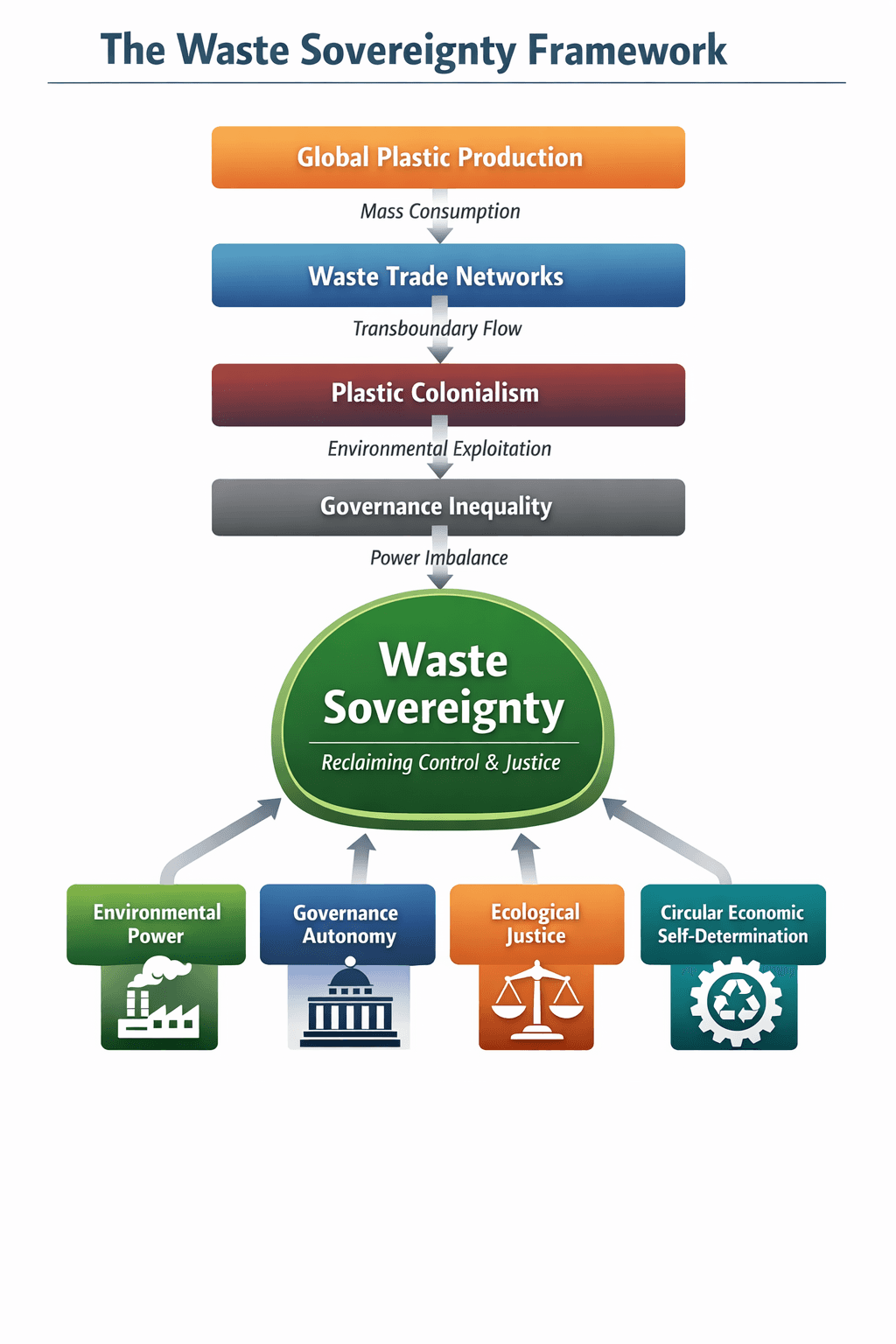
Figure 1 presents a schematic view of Waste Sovereignty Theory. It presents global plastic governance as a multilayered structure, starting from the production of industrial plastic, to transnational waste trade flows that create a plastic colonialism. These flows are what produce plastic colonialism, by shifting the environmental burden of the economies of the Global North to states of the Global South where regulation infrastructure may be limited. In turn, the inequality in governance structures that arises from differences in institutional capacities and political power generates inequality in governance. Waste sovereignty, thus, refers to the reciprocal politics of this system that is put into place by states and local communities that want to have agency and control over environmental governance. The framework conceptualizes global waste governance as a sequential process linking plastic production, transnational waste trade, governance inequality, and sovereignty claims. It highlights how environmental power operates through these interconnected dynamics to reproduce uneven distributions of ecological risk.
Conceptualizing Waste Sovereignty: A Framework for Understanding Global Waste Governance
The Waste Sovereignty Theory Framework (WST Framework) is the analytical mechanism through which the connection between global waste trade, environmental power and inequality in global waste governance is explored in this study. Waste sovereignty is an approach to analyzing how the convergence of environmental power, the global waste trade and inequalities in global waste governance produces unequal distributions of environmental burdens in the global political economy. While plastic waste pollution is widely perceived as an environmental and management issue, the perpetuation of uneven waste streams points to the fundamentally political nature of the problem.
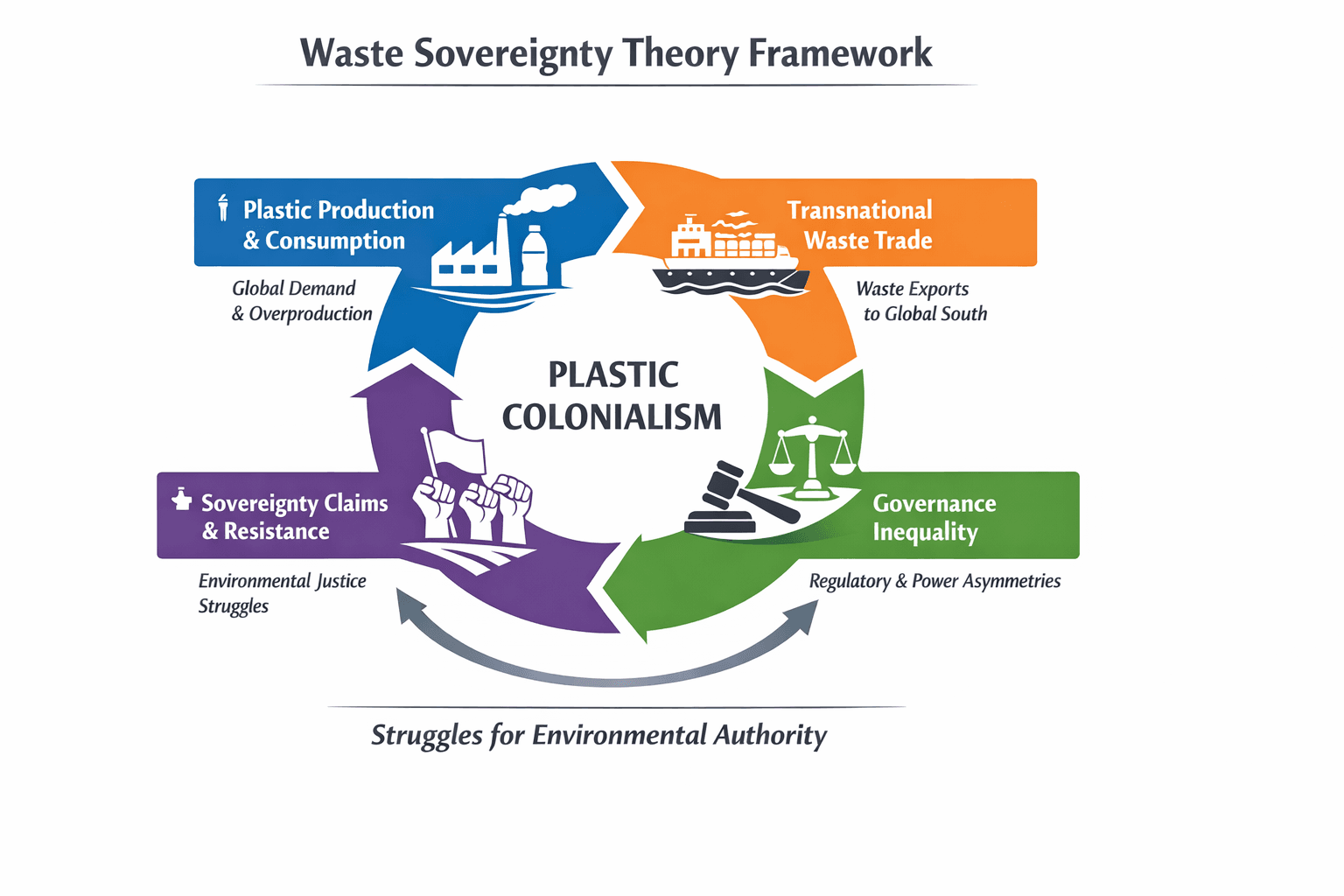
This paper's concept framework situates plastic waste within global environmental governance as shaped by economic, legal and geo-political systems. First, it situates plastic production and consumption in global production, which has escalated considerably in recent decades. With its efficiency, durability and the low cost of its production, plastics are central to contemporary global industrial and consumer markets. Their qualities are also what make plastics persist in the environment, creating growing waste streams across ecosystems globally. An increase in plastic production necessitates that disposal of the resulting material surplus be handled by increasingly transnational waste systems.
Second, such systems constitute the global waste trade, which entails trans-boundary transit of recyclable and non-recyclable goods in complex logistics chains spanning producers, exporters, recycling markets and dumpsites. Although global waste trade is often framed as an economically efficient mechanism for resource recovery, recent scholarship demonstrates that these systems frequently reproduce structural inequalities in environmental governance and shift ecological burdens toward countries with weaker regulatory capacities (Clapp, 2021; O’Neill, 2022; Smakgahn, 2025). The globalization of recycling markets has thus created uneven spatial distributions of the environmental cost of consumption in the world political system.
Third, plastic colonialism describes the political and historically constituted nature of these flows: structural mechanisms that enable the systematically biased transfer of the environmental risks associated with plastic waste production from North to South. Such a structure rests not only on economic inequality but also on enduring continuities in global environmental governance: industrialized economies maintain ultimate control over production processes and environmental risks while offloading ecological impacts to peripheries. As a result, the Global South often becomes a final dumping grounds for waste generated from global consumer societies.
The fourth component of waste sovereignty theory is governance inequality, the imbalance of the capabilities that governments and communities possess for managing environmental risks and the structures of waste management. Recipient states frequently face inadequate regulatory capacity, limited waste-processing infrastructure, and structural dependence on global recycling markets. These factors constrain national governments from preventing environmentally damaging waste imports or overseeing ethical and safe waste handling. As a reaction, waste sovereignty emerges as the political and institutional effort to take back ownership of waste management and decision-making and to challenge the externalization of the ecological costs of consumption.
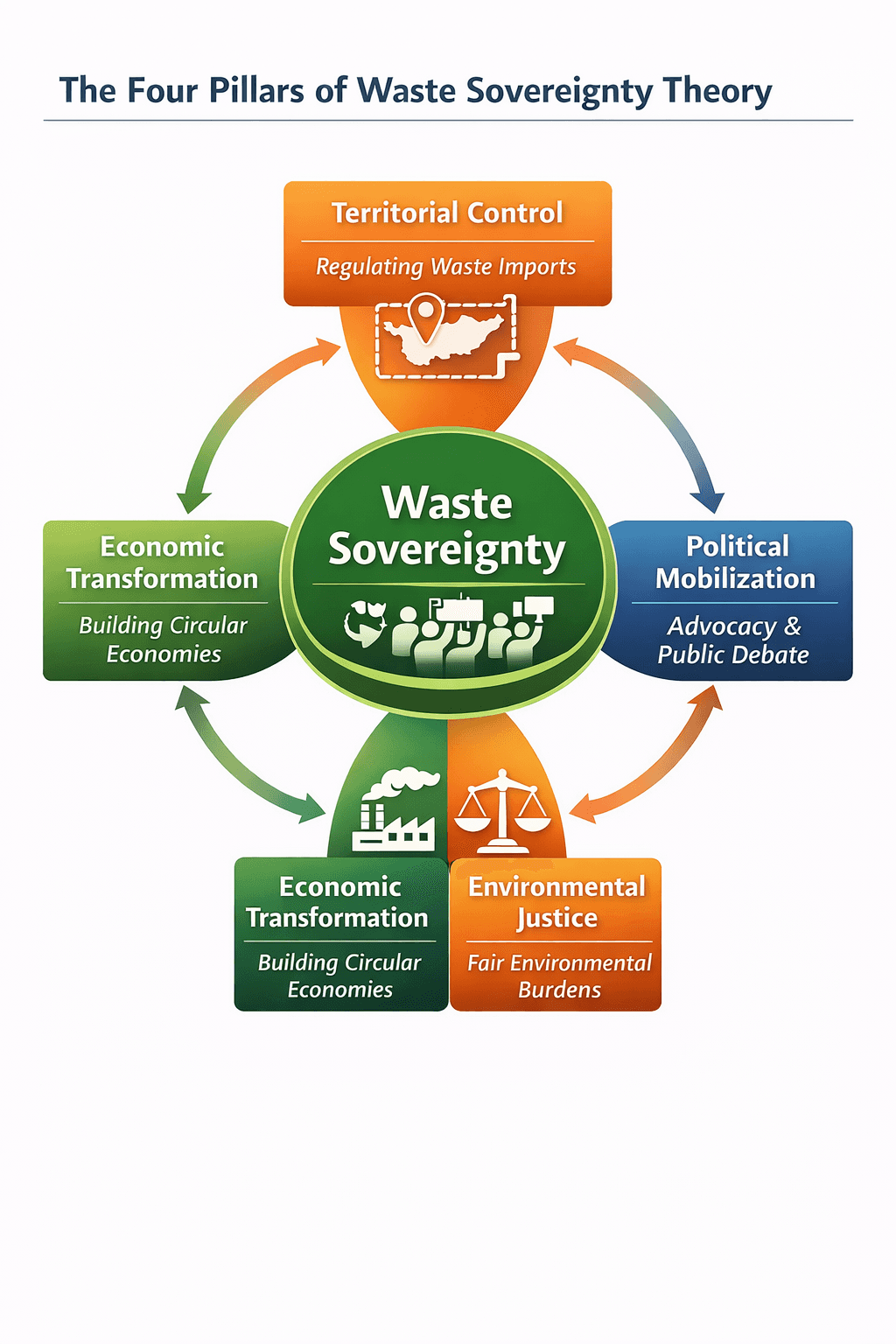
In the framework, waste sovereignty has four related dimensions: Environmental sovereignty; Governance autonomy; Ecological justice; Circular economic self-determination. Environmental sovereignty refers to the capacity of political actors to shape the distribution of risks and benefits arising from environmental hazards. Governance autonomy denotes the institutional power of states in managing waste streams and guaranteeing environmental protection. Ecological justice consists of equal environmental protection for all communities, and acknowledgement of rights of all victims affected by environmental problems. The last aspect, circular economic self-determination, indicates the need to foster a national system of recycling for the creation of domestic economic values instead of merely perpetuating foreign waste dependency. The combination of the four aspects makes waste governance understood as the interplay of the four interconnected political factors in terms of waste.
Waste Sovereignty and Environmental Populism
Waste sovereignty theory also aids the growing literature on environmental populism. Political scientists characterize populist politics as the struggle between "the people" and a political, economic, or technocratic elite. In environmental governance, environmental populism occurs when groups challenge environmental regulations that they believe are dictated by remote political, economic or technocratic elites that do not represent their interests. The global waste trade is a site of particular significance for understanding environmental populism. Communities receiving transboundary waste, in particular, frequently perceive the environmental risk they face as imposed by an external set of actors including multinational corporations, exporting states, waste brokers and global market regimes, that can be contrasted with the local population.
In reaction to these processes, local actors have made claims regarding environmental protection, rights to a territory and ecological control, as well as ecological sovereignty; all of which resonates with popular rhetoric against expert-driven regimes and call for greater popular control over environmental issues. Waste sovereignty can be therefore characterized as environmental populism whereby states and communities contest the unequally structured global system of waste governance and re-establish claims to environmental resources, waste streams, and ecological futures, broadening environmental populism to not only domestic environmental disputes, but to transnational contexts of environmental governance and disparity.
Theoretical Propositions of Waste Sovereignty Theory
From the conceptual framework discussed above, Waste Sovereignty Theory (WST) draws a series of theoretical propositions that help explain the structural linkages between the global waste trade, governance inequality and claims of sovereignty. The propositions illuminate the nature of environmental power in contemporary waste regimes, and the reactions to environmental burdens by states and societies.
Proposition 1: Contemporary systems of the global waste trade are reproduced through existing power asymmetries between exporting and importing countries. As the world political economy has become increasingly transnationalized and globally interconnected, transnational waste flows are structured by asymmetries in technological capacities, political influence and resources. Waste trade arrangements often reflect and exacerbate existing imbalances of power. Exporting countries often benefit from this unequal structuring, and these arrangements generally reinforce established power imbalances, particularly those between the Global North and South.
Proposition 2: Transnational waste exports result in forms of plastic colonialism. Reliance upon exporting environmental consequences across the planet through the waste trade produces a continued cycle of historical ecological domination and expropriation. Plastic colonialism occurs when developing nations or peripheral areas in the global economy are required to bear the environmental costs of Western consumption patterns and industrial production.
Proposition 3: Existing governance inequalities within global waste regimes foster claims to sovereignty by affected states and communities. By amassing cumulative impacts of waste disposals, those countries and societies that are burdened by waste import arrangements seek to develop a variety of state and non-state responses that challenge such inequalities.
Proposition 4: Waste sovereignty constitutes a form of political struggle in which states and communities attempt to restore authority over waste governance systems. The strategy of waste sovereignty provides a direct challenge to the patterns of ecological domination created by waste export systems by re-asserting the rights of sovereign states and communities over waste flows, regulations, and recycling infrastructure. The following cases provide illustrative examples of how the dynamics identified in Waste Sovereignty Theory manifest in contemporary waste governance conflicts across the Global South.
Methodological Note
This paper focuses more on theory development and concept building rather than providing in-depth case study comparisons. Cases are included not so much as detailed comparison but as illustration of how Waste Sovereignty Theory might be empirically tested. Cases were selected on the basis of their relevance within current discourse regarding transboundary waste trade, plastic waste governance, and environmental sovereignty using purposive sampling. Malaysia, the Philippines, Indonesia, Ghana, and Nigeria are included as each case has experienced notable difficulties arising from imported waste flows and attempted to develop policies that reclaim greater control over its own waste governance. The cases relied on existing secondary research (academic journals, policy reports, IGO reports, reports on government responses, etc.) and are not presented as definitive or comparative cases in themselves but as heuristic vehicles for understanding Waste Sovereignty Theory's conceptual framework.
Illustrative Cases: Emerging Struggles for Waste Sovereignty in the Global South
The issues that waste sovereignty discourse address are becoming increasingly apparent in policies and governance struggles across the Global South. The changing nature of global waste markets in recent years, and a growing number of states pushing back against the unfair distribution of environmental burdens in international waste trade, confirms that issues of sovereignty are central to current global governance regimes.
In one instance, China enforced National Sword policy in 2018, effectively banning imports of most plastic waste. For years, China had been receiving most of the recycled goods dumped by the Global North; this regulation upended global waste streams, and rerouted the plastic waste to other states in Asia (Malaysia, Indonesia, Thailand), and Africa. Within months of this shift, several states, now overwhelmed with waste imports that the local recycling industry and systems could not handle, reported increases in the volume of waste shipments received. This case illustrates Proposition 1 of Waste Sovereignty Theory, whereby governance inequalities stimulate sovereignty claims among affected states
Malaysia quickly became a primary receiving country for the plastic waste streams that had been previously redirected from the Global North. These high volumes of plastic waste exports had devastating environmental consequences, resulting in the creation of numerous illegal dump sites and pollution of local rivers through the air pollution generated by unregulated informal recycling processes and the direct dumping of plastic waste. As a result, Malaysian authorities imposed new, stricter laws on waste imports, and began sending shipments of waste back to the sending countries, claiming greater control over its domestic waste management regime.
Similar situations have been occurring in other parts of the Global South. The Philippines recently repatriated multiple containers of illegal plastic waste exported from Canada, following a contentious public outcry, and taken steps to reform its waste importation regime to end its role as a dumping ground for the rest of the world.
Indonesia has also put forth new laws governing the importation of plastic waste, increasing monitoring of recycling industries, to show an emerging determination of countries to challenge the unjust geographical distribution of global waste, and reassert claims over their environmental sovereignty. This case illustrates Proposition 3 of Waste Sovereignty Theory, whereby governance inequalities stimulate sovereignty claims among affected states
The impact of global waste trade has not overlooked African countries. Many African states have become major receivers of used electronic equipment and waste from richer countries. While there is informal processing in sites like Agbogbloshie (Ghana), for urban citizens to sustain themselves, and generate income, this informal sector of waste management presents immense health risks to those who have the arduous tasks of sorting through electronic equipment and burning plastics in order to salvage the precious metals.
Nigeria’s challenges with its waste management systems demonstrate why waste sovereignty matters. Nigeria’s fast pace of urbanization and increasing domestic demand for newly produced consumer goods have created overwhelming volumes of plastic waste that are integrated into global waste streams through legal and informal trade. Its challenge of effectively handling the surging domestic waste streams, through governmental policies and monitoring activities, illustrates the relevance of waste sovereignty in terms of obtaining sovereignty over its own waste. Its ongoing efforts to build and promote local recycling industries and incorporate the idea of circular economy practices in the nation showcase the beginning of struggle over waste sovereignty in the region.
Above all, these are just a few instances which reveal that waste sovereignty is not just an academic notion but a real and present concern that has been translated into actionable policy and governance strategies by states in the Global South as they fight to retain sovereignty over their environments and health. Such initiatives as export bans, increased regulation on waste imports, and repatriating illegally imported waste, speak to this claim. These policies clearly show the need for global solutions to plastic waste management challenges. With ongoing United Nations negotiations toward a global plastics treaty, debates surrounding transboundary waste trade, environmental justice, and sovereign regulatory authority have become increasingly central to discussions of global plastic governance (UNEP, 2018; Gündoğdu et al., 2025; Xu et al., 2025). Without carefully reviewing and attempting to alleviate the structural injustices in global waste trade, plastic waste prevention initiatives will likely repeat past cycles of environmental externalization that have been predominant in the global waste economy for decades.
Discussion: Waste Sovereignty and the Transformation of Global Environmental Governance
This study reinforces the argument that it is necessary to understand waste governance not solely as a technical problem solvable through efficiencies of recycling technology, waste management infrastructure, and circular economy transitions. Rather, it becomes necessary to analyze waste governance as an intrinsically political issue embedded in political, social, economic and ecological relations. The results of this investigation also reveal that the global plastic waste economy is not just an instrument for managing discarded materials but the site of political struggle over environmental sovereignty, control over environmental decision-making authority, and the equitable distribution of ecological risk across the international system. WST helps to emphasize the role that governance relations in waste matter to understanding how environments and state control over them are both reproduced and challenged.
A key implication of this investigation is that environmental injustice cannot be understood only as the disproportionate allocation of environmental harms; in fact the findings suggest that it must also be understood through an analysis of the uneven allocation of governance authority and control over environmental decision-making. Environmental justice has made tremendous contributions to demonstrating how risks and burdens are disproportionately born by vulnerable groups and places. The findings of this research indicate that authority is similarly important; state and local communities that lack the capacity, authority or political leverage to regulate imports, enforce standards and negotiate fair terms in global waste markets remain structurally vulnerable to environmental externalization. This perspective is in line with extending environmental justice to also recognize that the allocation of decision-making authority is what leads to ecologically just and unjust outcomes.
This study also contributes to discussions on global environmental governance and in particular demonstrates the inadequacies of present international regulatory arrangements. International instruments such as the Basel Convention aim to control transboundary movements, but persistent regulatory gaps, uneven enforcement and market pressures continue to allow environmental burdens to be transferred from richer to poorer states. This finding suggests that governance requires more than coordination of, or regulation of, environmental problems, but requires more fundamental changes in the power relations, resource control, and institutional capacity of states. In this sense, waste sovereignty extends the possibilities for thinking about global environmental governance through the lens of accountability, justice and environmental self-determination.
Another key finding of this research is the rise of sovereignty-based governance mechanisms in response to plastic colonialism. Policy instruments, from waste import bans to state-level policies encouraging waste repatriation and domestic reprocessing to strong enforcement of national regulations can only be properly understood when recognized not as a mere technical solution, but as political expressions of states to reaffirm control over environmental decision-making and challenge the inherent dependencies built into global waste flows. This suggests that environmental governance is increasingly an arena where sovereignty and political legitimacy are negotiated and contested.
Findings from this study also have important implications for present-day, and future circular economy initiatives. The framework for circular economies holds significant promise in terms of reducing the consumption of raw materials and creating more efficient, waste-reducing systems of production and consumption. However the findings of this investigation demonstrate that, without addressing how, why and between which groups wastes are managed, it will remain difficult to move beyond a form of circularity that simply exports environmental costs, and reproduce environmental externalization in new forms. It suggests that technology transfer cannot suffice for solving this political challenge; but rather circularity depends on the development of governance models, that address power, responsibility and environmental justice.
Broadly, this study reaffirms some of the most basic assumptions of political ecology - that problems are not technical, but inextricably linked to broader systems of social, political, economic and ecological power relations. Waste flow is not simply movement of objects across the earth, but a marker of global relations defining who gains benefit from production, who pays the price in terms of ecological harm and who decides what shall be done with the material resources that we extract and use. By placing the idea of waste sovereignty in the center of analysis WST articulates how a global waste governance regime may reinforce or challenge these broader political-economic dynamics.
The findings of this investigation also shed light on the developing phenomenon of environmental populism. Sovereignty-based policy arguments are an important site where political movements that contest dominant environmental governance regimes attempt to articulate new understandings of the environment, state sovereignty, and collective autonomy. In many cases, opposition to plastic colonialism can be understood through this perspective; that movements against this form of environmental externalization reflect the agency of communities and local states to fight back against imposed burdens by elites who make policy from a distance, and therefore have the political capacity to decide the fates of others. In this way, WST contributes to scholarship on environmental populism by offering insight into the specific forms that demands for self-determination and sovereignty over environment take at local levels within a transnational world system of environmental inequality and unsustainable governance.
Further research is called for, but two areas in particular demand more attention. The first is the actual mechanisms through which states, or their agents, successfully reclaim sovereignty over environmental governance. Secondly, studies must begin to address the link between waste sovereignty and environmental populism by understanding the kinds of policy alternatives that can come out of such resistance movements, and what kinds of support states need in order to sustain these alternatives to existing unequal waste relations. The eventual outcome of these research endeavors will be a critical analysis of what a successful, more just, and sustainable waste economy should look like, and what it takes for states and their citizens to take meaningful control over it.
Theoretical Contributions
This article makes four mutually reinforcing contributions to the literature on environmental governance, environmental justice, plastic colonialism, and environmental populism. Drawing on four distinctive streams of scholarship, these traditions have provided some crucial insights into the political economy of waste, transboundary waste flows, and environmental inequality but the studies has been largely separated by traditions and in their analytical focus. The article's contribution is to offer Waste Sovereignty Theory (WST) as an integrated analytical framework by incorporating and analyzing political economy of waste, power relations on waste governance, the inequality in environmental power, ecological justice, sovereignty claim and all these elements within a single analytical framework. The theoretical contribution enables us to advance an understanding of how environmental inequality is reproduced within the global governance systems of waste, and how affected states and citizens react to this inequality.
First Contribution: Waste Sovereignty Theory as a New Framework for Global Waste Governance
The principal theoretical contribution of this article is Waste Sovereignty Theory (WST). It is a new framework used to understand the political dynamics on global waste governance systems. Most of the previous research on waste governance has been framed by themes of environmental management, recycling practices, the regulation of waste management, and circular economic strategies. These theoretical frameworks have considerably added to our understanding of waste management practices, but failed to address how the question of waste has emerged as a tool of power struggle rather than only a technical/administrative issue.
Unlike the traditional models on waste governance, WST focuses more on 'waste governance' than 'waste management.' This theory posits that the global waste flows is more than just the transportation of waste materials, rather it reflects the power asymmetry inherent in the global political-economic system. The theory conceptualizes the control of waste flows, regulatory systems, recycling infrastructure and management as the basis for environmental power and waste governance as a space for the political competition of environmental authority. The article therefore goes further than existing theory on environmental governance by linking the issue of waste, with politics of sovereignty claims, political control and legitimation of power over the environmental domain.
Furthermore, the theory introduces four interrelated variables of waste sovereignty, namely environmental sovereignty, governance autonomy, ecological justice and circular economic self-determination, within an analytical tool that help in systematically describing and analyzing the responses toward the transnational waste flow. These four dimensions provide conceptual tools with which researchers can analyze how the environmental inequality in waste management is sustained within the current waste systems.
Second Contribution: Extending Environmental Justice Theory into the Issue of Governance Authority
Second, this study adds to the literature on environmental justice by shifting it away from the focus on unequal distribution of environmental harms and risks. Environmental justice studies have provided much valuable insights into how the deprived social communities are disproportionately exposed to environmental risks such as pollution, toxics and degradation. But the literature predominantly looks at distribution, while failing to adequately analyze the problem of governance authority. WST argues that the environmental inequality results not only from the fact that the disadvantaged are disproportionately exposed to the environmental impacts of the waste regime but from their inability to make decisions over the management, and transfer of waste materials and relevant governance systems. Hence, environmental inequality can be defined as the failure to give adequate attention and control over environmental governance decision-making, to those communities affected.
WST therefore provides a governance framework within the environmental justice theory. This theory argues that there must be not only environmental justice but governance justice as well that means, an equitable opportunity to determine and shape environmental decision-making process in order to avoid any potential environmental harms, to ensure a fair distribution of environmental benefits and to ensure overall sustainable environment and livelihood for those directly affected by the waste flow. The environmental justice approach is thus extended from "What is in for them?" to "Who is in control over this for them?"
Third Contribution: Elaboration on the Notion of Plastic Colonialism Through a Concept of Resistance
Third, the paper is in dialogue with literature on plastic colonialism and waste colonialism. The previous studies has proven beyond doubt how the contemporary practice of global waste trade, often reproduces historical relations of domination whereby environmental harms are transferred to less powerful states in the Global South. Studies of waste colonialism and plastic colonialism have successfully illustrated the ways in which contemporary waste trade represents and reproduces broader political-economic structures of environmental inequality, externalization and geopolitical asymmetry.
These literature focus mostly on diagnosing and explaining mechanisms of domination, however, it largely overlooks to analyze the ways in which affected communities and countries may resists such oppressive regimes and struggle against them. Waste Sovereignty Theory responds to this lack of emphasis on resistance in environmental governance. According to WST, sovereignty is a form of political struggle that aims to defy and regain autonomy in decision-making over environmental issues and the flows of waste. Measures such as transboundary waste import bans, repatriation of illegal waste exports, stricter regulations and import controls of waste and a robust recycling and processing regime are examples of sovereignty claims.
These represent mechanisms through which countries and communities reclaim their environmental control against the politics of environmental externalization. It, therefore, adds the politics of resistance, agency and environmental transformative practices to studies on plastic colonialism. WST shows that affected communities are not passively affected by the environmental costs of the current waste regime but are active agents struggling to change their environmental destiny.
Fourth Contribution: Understanding Environmental Populism from the Perspective of Sovereignty Claims
Finally, I establish a connection between the theory and the discourse on environmental populism. Populism can be defined as a type of political strategy that seeks to pit "ordinary people" against the "corrupt elites." Applied to environmental matters, environmental populism takes the form of populist claims regarding politics of authority, legitimacy and representation as far as environmental management, pollution control and allocation of environmental goods and bads are concerned. This literature explains the political movements within and by communities against perceived imposition of environmental decisions by political elites. WST builds upon these insights and frames current environmental movements against environmental inequality and environmental externalization of waste, as expressions of popular sovereignty claims.
The claims made for waste sovereignty represent a form of environmental populism that arises from environmental injustice. Affected populations claim for sovereignty to counter what is seen as political manipulation and control over their environmental future by distant actors namely governments of the exporting countries, multinational corporations and world economic organizations. This differs from most studies of environmental populism which have tended to discuss the phenomenon within the frame of nation-state and local politics. Waste Sovereignty Theory demonstrates that environmental populism is a political logic that can be applied to understand the global waste regime as a locus of environmental justice struggle and as a manifestation of popular resistance against global political economy. It establishes an argument about political struggle over environmental power, not only between states and communities, but more significantly between communities and citizens on one side and global political actors and global capitalism on the other side in which each claims over environmental sovereignty.
Conclusion
Although plastic pollution is one of the biggest environmental problems in the 21st century, current arrangements of governance over this issue are highly uneven. This article has argued that it is impossible to comprehend the movement of global plastic waste trade simply as a technical problem of waste management. The process of crossing and transferring plastic waste beyond the international boundaries itself indicates the existence of an environmental power regime within which environmental burden is distributed in accord with geoeconomic and geopolitical hierarchies. By referring to political ecology, environmental justice, and postcolonial environmental governance studies, waste sovereignty has been articulated in this paper as the political-ecological-economic agency to gain political-ecological-economic power and autonomy over waste governance regime, which will shift the focus from technical solution to the structural politics of the externalization of environmental harms.
Waste Sovereignty Theory highlights how global waste governance is fundamentally structured by unequal relations of environmental power within the global political economy. By conceptualizing transnational waste flows as arenas of political struggle over environmental authority, the framework demonstrates that addressing the global plastic crisis requires not only technological innovation but also institutional transformations that confront the structural inequalities embedded in contemporary systems of production, consumption, and environmental governance. The theorized framework suggests that the global generation and consumption of plastic products gives rise to transnationally dispersed flows of waste, in which the operation of plastic colonialism and governance inequality reinforces environmental externalization pattern and is manifested in unequal distribution of the ecological burdens from the consumptive practices in developed countries to the developing countries.
The study also suggests that these practices are subject to increasing challenges in terms of policy regulation, and the emergent desire for environmental sovereignty. As indicated by cases from Southeast Asia and Africa, governmental regulations to restrict plastic waste imports and strengthening national waste management frameworks including investment in recycling infrastructure has been interpreted as attempts of claiming governance autonomy and ecological integrity. This implies waste sovereignty will become an increasingly significant component of global environmental governance. The analysis of waste sovereignty holds important implications beyond the issue of plastic waste. With aggravating environmental crises around the world, debates about governance sovereignty and ecological justice would occupy an increasingly salient position in the discussions about sustainable development. Therefore, struggles over waste sovereignty have a deeper meaning of restructuring global environmental governance in ways to give greater political, economic and ecological sovereignty back to individual countries and communities.
The concept of waste sovereignty urges policymakers to critically evaluate the structural inequality in the current global governance system on environment, and to move beyond the narrow definition of the technical problem of plastic waste management to recognize the systemic politics. Policymakers should make efforts to strengthen international regulations of waste trade and develop domestic capacity and equitable circular economy models for a truly just and sustainable governance system. Based on Waste Sovereignty Theory and the Waste Sovereignty Theory Framework (WST Framework), this paper offers a new analytical perspective through which the globally dispersed, unjust distribution and disposal of waste is explained as an expression of the politics of environmental power, economic inequality, and ecological justice.
By highlighting the political implications of waste systems in the global environmental order and revealing how countries attempt to re-claim political authority over environmental governance, waste sovereignty is presented as a critical tool to analyze and overcome the challenge to the sustainable development from globally distributed waste impacts. The challenge of plastic waste is inseparable from the issue of who controls the waste and who pays the cost, and the concept of waste sovereignty provides a framework for reinventing global environmental governance in ways to advance the goals of ecological justice, democracy and sustainability. While this article develops a conceptual framework supported by illustrative cases, further empirical research is needed to test the applicability of Waste Sovereignty Theory across different regional contexts and waste governance systems. Comparative empirical studies could further explore how varying political, economic, and regulatory conditions influence the emergence of waste sovereignty claims.
References
Ali, S. H. & Jenkins, M. (2020). “Governing international waste flows: The Basel Convention and environmental governance.” Global Environmental Politics, 20(3), 15–36.
Brooks, A. L.; Wang, S. & Jambeck, J. R. (2018). “The Chinese import ban and its impact on global plastic waste trade.” Science Advances, 4(6), eaat0131. https://doi.org/10.1126/sciadv.aat0131
Bullard, R. D. (2000). Dumping in Dixie: Race, class, and environmental quality (3rd ed.). Westview Press.
Clapp, J. (2021). Toxic exports: The transfer of hazardous wastes from rich to poor countries (2nd ed.). Cornell University Press.
Clapp, J. (2022). “The political economy of plastic waste and recycling.” Annual Review of Environment and Resources, 47, 287–310. https://doi.org/10.1146/annurev-environ-120920-105059
Fidayanti, A. F. (2025). “Sustainable plastic waste management practices and circular economy strategies.” Waste and Sustainable Society, 6(2), 1–12.
Geyer, R.; Jambeck, J. R. & Law, K. L. (2017). “Production, use, and fate of all plastics ever made.” Science Advances, 3(7), e1700782. https://doi.org/10.1126/sciadv.1700782
Gündoğdu, S.; Walker, T. R. & Liboiron, M. (2025). “The global plastics treaty must include strict global controls on plastic waste trade.” Cambridge Prisms: Plastics, 3, 1–9.
Jackson, T. & Rix, D. (1998). “Waste management and environmental policy: Economic instruments and policy integration.” Environmental Politics, 7(1), 1–23.
Liboiron, M. (2021). Pollution is colonialism. Duke University Press.
Liboiron, M.; Zahara, A.; Schoot, I.; Kramm, J.; Liboiron, F. & Zöle, E. (2021). “Equity in author order: A feminist laboratory’s approach.” Catalyst: Feminism, Theory, Technoscience, 7(1).
Martinez-Alier, J. (2002). The environmentalism of the poor: A study of ecological conflicts and valuation. Edward Elgar Publishing.
Nixon, R. (2011). Slow violence and the environmentalism of the poor. Harvard University Press.
O’Neill, K. (2022). “Waste as a global environmental governance problem.” Global Environmental Politics, 22(1), 1–12.
Pellow, D. N. (2018). What is critical environmental justice? Polity Press.
Robbins, P. (2012). Political ecology: A critical introduction (2nd ed.). Wiley-Blackwell.
Smakgahn, K. (2025). “Transboundary trade in plastic waste and environmental governance challenges.” Nature Environment and Pollution Technology, 24(1), 1–12.
Swyngedouw, E. (2004). Social power and the urbanization of water: Flows of power. Oxford University Press.
Tehrani, M. (2025). “Governance and innovation in plastic waste management systems.” Journal of Environmental Policy and Governance, 35(2), 1–14.
Tiamiyu, A. (2026). “Grassroots-led democratized plastic governance for planetary health.” Humanities and Social Sciences Communications, 17(1), 1–12.
United Nations Environment Programme. (2018). Single-use plastics: A roadmap for sustainability. UNEP.
Van den Beukel, J.; Ruisch, A.; Oosten, M.; De Heer, M. & Wijnen, M. (2021). “Circular economy transitions and waste governance.” Sustainability, 13(8), 4352. https://doi.org/10.3390/su13084352
Waste Sovereignty and Plastic Colonialism: Environmental Power and Populism in the Global Political Economy of Waste
Oludele Mayowa Solaja
Introduction
Plastic waste constitutes one of the leading contemporary environmental problems in the 21st century. Over the last decades, production of plastics in the global South have rapidly increase from less than 1 million tons per year in the 1950s to more than 400 million tons in a year and rapidly growing international plastic waste trade networks (Geyer et al., 2017; Zhao et al., 2021; Clapp, 2022). Although plastic waste is created around the globe, its environmental burden has been distributed unevenly, that is, wealthy industrialized countries ship vast amounts of their waste to the Global South countries whose institutions and capabilities are often unable to manage this commodity (Brooks et al., 2018; Clapp, 2021). This paper considers that what often appears as technical problems with waste management or efficiency of recycling, are the consequences of underlying structural power relations within political economy that shaped global politics of waste management.
The political ecology literature frames such dynamics within a politics of unequal access to environmental resources. International industrial and consumer economies are producing vast flows of unwanted materials whose disposal is often externalized, whereby they can find an outlet within the weaker regulatory systems found in some Global South countries, leading to environmental contamination and informal dumping and recycling networks (Pellow, 2018; Liboiron, 2021). This is a pattern of waste colonialism where environmental harm produced by global industrial capitalism can be displaced from wealthy consumer economies to the periphery through the waste trade (Pellow, 2018; Liboiron, 2021). This in turn constitutes ecological distribution conflicts, whereby environmental burdens and their subsequent harm fall unevenly between social groups and geographic territories (Martinez-Alier, 2002).
Emergent trends in international waste markets highlight the politicization of these dynamics. The closure of the Chinese market to the majority of foreign waste exports under the National Sword policy in 2018 led to the redirection of massive flows of plastic waste to countries in Southeast Asia and Africa, overwhelming the existing domestic waste management systems of these recipient countries. Consequently, governments from the Global South such as Malaysia, Indonesia, Philippines and a host of African states have since imposed new regulations and repatriated illegal shipments of plastic waste, showing the burgeoning politics of the waste system.
Most academic literature on the global plastic crisis frames plastic waste as a technical problem of recycling efficiency or waste management systems, however there is an important politics of why environmental problems and the burden of waste are distributed unevenly. More focus has not been paid to the issue of environmental sovereignty – a State’s/Community’s authority over their environmental resource system, including regulation of trans-boundary flows and their control over development pathways, as a source of environmental power and control within global waste flows governed by the trade regime, global corporate supply chains, and disparities in regulation.
This article theorizes the politics of global waste governance by developing the Waste Sovereignty Theory (WST), which frames global waste systems as arenas of political struggle over authority where States and communities contest the uneven distribution of ecological burden. Waste Sovereignty Theory framework links four key mechanisms-production, trade networks, disparity in regulation, and sovereignty claims-to illuminate the operation of environmental power within current waste regimes. Waste sovereignty, within WST, signifies the authority of States, communities and social movements to assert control over the management of waste systems, including import flows, domestic recycling industry development and environmental common preservation.
In this article, waste sovereignty is defined as the capacity of states, communities, and social institutions to exercise political, ecological, and economic authority over the governance of waste within their territories. This includes the power to regulate transboundary waste flows, control domestic recycling infrastructures, determine environmental standards, and shape the economic systems through which waste materials are managed or transformed into resources. Within the Waste Sovereignty Theory Framework (WST Framework), waste sovereignty therefore represents a form of environmental authority through which political actors contest the unequal distribution of ecological burdens generated by global production and consumption systems.
The theory of Waste Sovereignty extends the field of environmental governance in three main ways; first, situating the plastic crisis within the politics of production, consumption and the externalization of environmental impact. Second, it develops the discourse of environmental justice by placing issues of ecological inequity alongside control over environmental governance systems. Third, it theorizes responses to plastic waste in the Global South as claims to sovereignty from the peripheries in the form of restrictions on imports, new legislation, domestic recycling industries development etc.
Therefore this paper answers the questions: how does global plastic waste trade create a power disparity and how can the Waste Sovereignty Theory frame the emergence of fights for environmental governance in the Global South? Showing the dynamics of the WST through cases from Southeast Asia and Africa, the paper argues that plastic waste has become a politically embedded global issue and its solutions need to transcend purely technical strategies of waste management and recycling, and include the politics of environmental power and sovereignty within the waste system.
Contributions of the Article
This paper contributes to literature on political ecology and global environmental governance in three primary ways: First, this paper theorizes waste sovereignty (WS) as a useful lens to understand how the transnational plastic trade, for instance, reproduces environmental power differences between exporting and importing countries. Second, drawing on this, this article theorizes the Waste Sovereignty Theory Framework (WST Framework) to demonstrate the interconnectedness between plastic production, transnational waste trade, governance disparities, and sovereignty claims, and therefore to understand the emerging contests for environmental power in the Global South. Finally, placing the idea of plastic colonialism within larger debates of environmental justice and global political economy, this paper joins in an expanding conversation on how systems of environmental governance perpetuate unbalanced distribution of environmental burdens in the Anthropocene. Combined together, the papers are able to provide the academic world with a new way to analyze political challenges within the context of global waste trade, sovereignty claims, and environmental externalization.
Theoretical Foundations: Environmental Power, Plastic Colonialism, and Governance Inequality
Understanding contemporary politics of global plastic waste necessitates framing waste governance in relation to wider political ecologies of power and inequality. While the problem of plastic waste has been frequently framed in technical terms of management or recycling capacity, the spatial distribution of the plastic waste stream has historically and structurally been one that reflects politically and economically embedded hierarchies. Thus, cross-border waste flows have not only been logistic rather than technical challenges but are also "an instance of ecological distribution conflicts", wherein "different social groups, different territories, different political institutions and different national legal systems [are allocated] an unequal share of ecological goods and burdens" (Martinez-Alier, 2002: 7).
Political ecologies provide a theoretical backdrop for analyzing waste sovereignty within existing inequalities in international political economy, although waste sovereignty is an analytical frame that distinguishes itself from both earlier ecological distribution conflict perspectives in political ecology and research on unequal environmental burdens in environmental justice. It specifically aims to shift analytical focus to the authority dimension in struggles within the global waste regime (see also Liboiron et al., 2021). Waste sovereignty is therefore not an argument for environmental justice, but a characteristic of existing governance relations shaped by the flows of waste, regulatory systems, and material infrastructures where pollution occurs.
Political ecologists are keenly aware that environmental struggles often hinge upon conflicts over distribution of ecological burdens and resources. Joan Martinez-Alier's seminal work on ecological distribution conflicts vividly describes struggles between marginalized communities and expanding industry, where development's by-products disproportionately contaminate the territories of the vulnerable. Nixon's (2011) work on slow violence also sheds light on a similar aspect of pollution where the material impact of production and consumption accumulates gradually, with disastrous outcomes for already disenfranchised and politically powerless communities. Political ecologists are keenly interested in the governance of material flows as this determines whose territories are preserved from environmental harm and whose bodies and surroundings are used as waste dumping grounds (Swyngedouw, 2004). These power differentials in the global economy shape the material and political topography that results in environmental dirty work being dislocated to regions with less political leverage and weak regulation, ultimately producing a globalized waste economy where dumping networks extend across national boundaries and rely on the capacity of the Global South to accept their discarded products.
The concept of plastic colonialism explains how global waste flows reproduce historically embedded patterns of environmental inequality and dependency, whereby ecological burdens generated in industrialized economies are displaced onto less powerful regions of the global political economy (Liboiron, 2021; Şeker, 2025). It is essentially a re-staging of earlier resource colonialism through material disposability. Instead of retaining the value generated through resource extraction for the global North while burdening the South with ecological contamination from that activity, plastic colonialism means that the Global South has come to assume the role of accepting environmental waste that accrues from consumption patterns within the Global North, therefore carrying the burden of dealing with the toxic consequences of plastic production and consumption in poorer countries of the world, who generally receive a lower benefit. Communities within waste importing countries face exposure to highly toxic levels of pollution and waste in their communities and environments due to the fact that the existing regulatory infrastructure and material capacity within their countries does not support safe processing of imported wastes.
These dynamics of governance exist because international trade in waste operates under conditions where those that benefit from consumption are able to offload and outsource the cost of managing the ensuing pollution onto others without being held accountable for those externalities. International trade in waste flows operate through an opaque network of brokers, brokers, shippers, intermediaries, and corporate entities, such that blame for the eventual disposal of wastes is often diffuse (Clapp, 2021). Although some treaties such as the Basel Convention aim to prevent this phenomenon, they can only do so effectively where their enforcement mechanisms are strong and regulatory loopholes that allow for reclassification and misdeclaration of waste products are absent. Without strong, well-enforced international governance structures for trade, such externalization remains facilitated, with the predictable result that many of the exporting countries continue to reap economic benefits associated with the consumption of the products derived from plastic waste without taking the burden of cleaning them up.
These processes highlight an unequal state capacity for environmental governance between the Global North and South. While most southern states' governance capacity regarding waste is underdeveloped and under-resourced, and whilst their developmental priorities may come ahead of comprehensive, efficient environmental regulation, a significant portion of global waste disposal is managed through informal domestic systems such as those involving scavenging, sorting and recycling of waste products. While these informal systems often serve as the source of livelihood for many, they generate highly toxic working environments. In essence, the political economy of waste is one where an underdeveloped public policy approach to waste disposal and recycling has intersected with the development of private markets for waste, to create governance structures where regulation is weak, and environmental risk becomes disproportionately borne by vulnerable communities with little power, and by less developed nations. Environmental Justice literature often examines the location of environmentally degrading facilities such as toxic-waste dumping sites in areas populated by marginalized communities lacking the political representation and power to challenge their location, i.e., environmental sacrifice zones (Bullard, 2000; Pellow, 2018). In this context, trans-border waste imports can be seen as generating what some scholars term environmental injustice between nations, whereby developing nations bear the brunt of the ecological fallout from the consumerist patterns of more developed ones.
Slow violence-a term developed by Rob Nixon (2011)-refers to a type of violence characterized by a slow process that culminates into major harms over time. This concept perfectly captures many impacts of the global plastic waste trade. The toxicity, chemical breakdown, and physical accumulation of plastic waste may seem like issues for the future, but its slow impacts on soils, marine life, and human health occur with rapid regularity, causing long-term pollution of air, soil, water, and marine ecosystems through direct exposure or through incorporation into human diets, creating persistent environmental injustice through a lack of opportunity for those suffering it to respond or mitigate.
It is here that the concept of environmental sovereignty comes into play. Sovereignty originally referred to the capacity of a state to rule itself over a certain territory, but it also pertains to states' authority to control the movement of goods into and out of their nation, to protect its population and environmental commons from outside sources, and to dictate economic relations within its borders. The ability of the Global North to dispose of its wastes on the Global South represents a violation of sovereignty, whereby external economic forces, largely through the global trade system, undermine states' authority and capacity to control their environment and economy. Waste import and export transactions, specifically the import of wastes from wealthier to poorer countries, therefore can be understood as constituting a threat to sovereignty when this import undermines domestic capacity and sovereignty for environmental management. Many states in the Global South have recently begun asserting sovereignty over waste by implementing bans on imported wastes (e.g., Malaysia, Indonesia and the Philippines subsequent to China's ban on imports of foreign recyclables), developing tighter regulations, engaging in intra-regional negotiations, or promoting domestic circular economic initiatives and investment in recycling technologies (see also Ali and Jenkins, 2020). Ghana and Nigeria have made concerted efforts to regulate their waste imports through legislation. This pattern signals a challenge to the established order and norms within the global waste management infrastructure.
It is at these junctures that the idea of waste sovereignty becomes important to the political analyses of the contemporary plastic waste problem. Waste Sovereignty Theory is an argument that defines and theorizes the capacity of states, local governments, and communities to assume the agency and authority for managing local environmental resources (especially waste) and associated ecologies, in order to guarantee an environment that can support their existence (see Liboiron et al., 2021). Unlike conventional waste management studies, which tend to focus on solutions that can reduce environmental harms through improved technology or more efficient processes (see Jackson and Rix, 1998; den Beukel et al., 2021; United Nations, 2018), Waste Sovereignty Theory explicitly challenges the existing political arrangements for managing environmental risks, asserting that these may be fundamentally flawed because they reproduce and reinforce social and political inequalities.
Waste Sovereignty Theory is most useful in explaining relations of transnational waste trade characterized by significant political, regulatory and economic inequalities in the global political economy. In cases of importing nations that accept large quantities of waste but do not have sufficient institutional capacity to regulate and safely dispose of those wastes, contests over the governance of waste become intertwined with debates about environmental justice, sovereignty and political authority. Although the theory can provide useful insights in describing waste governance within industrial nations, its power is best employed when discussing questions of externalizing environmental burdens and inequitable governance inherent in North-South waste trade relationships.
Specifically, four dimensions of waste sovereignty need to be brought together to comprehend what constitutes its analytical relevance and what political struggles comprise it: firstly, the ability to influence the distribution of environmental risks and benefits-an act of 'environmental power'; secondly, 'governance autonomy,' or the ability of state or other levels of authority to formulate policies related to the trade and movement of waste; thirdly, 'ecological justice,' which implies ensuring protection from environmental damages and ensuring adequate remedies are available for communities adversely affected by wastes; and fourthly, 'circular economic self-determination,' meaning the control of domestic markets and resources needed to achieve circularity instead of remaining dependent on imports of waste as a material inputs into domestic production processes.
Distinguishing Waste Sovereignty Theory from Existing Frameworks
Theory | Focus | Limitation | WST Contribution |
Political Ecology | Power and environment | Limited sovereignty focus | Emphasizes governance authority |
Environmental Justice | Distribution of harms | Less attention to governance autonomy | Adds sovereignty dimension |
Ecological Unequal Exchange | North–South inequalities | Economic emphasis | Incorporates governance struggles |
Plastic Colonialism | Waste externalization | Focus on domination | Explains resistance and sovereignty claims |
Environmental Sovereignty | State control | Limited waste governance focus | Waste-specific governance framework |
Waste Sovereignty Theory differs from existing approaches by positioning environmental authority and governance autonomy as central analytical categories through which struggles over global waste flows are understood. While political ecology scholarship has emphasized ecological distribution conflicts and environmental justice research has focused on unequal exposure to environmental harms, Waste Sovereignty Theory shifts analytical attention to struggles over authority in environmental governance systems. In this sense, the framework highlights how control over waste flows, regulatory institutions, and recycling infrastructures constitutes a key dimension of environmental power within the global political economy.
Figure 1 presents a schematic view of Waste Sovereignty Theory. It presents global plastic governance as a multilayered structure, starting from the production of industrial plastic, to transnational waste trade flows that create a plastic colonialism. These flows are what produce plastic colonialism, by shifting the environmental burden of the economies of the Global North to states of the Global South where regulation infrastructure may be limited. In turn, the inequality in governance structures that arises from differences in institutional capacities and political power generates inequality in governance. Waste sovereignty, thus, refers to the reciprocal politics of this system that is put into place by states and local communities that want to have agency and control over environmental governance. The framework conceptualizes global waste governance as a sequential process linking plastic production, transnational waste trade, governance inequality, and sovereignty claims. It highlights how environmental power operates through these interconnected dynamics to reproduce uneven distributions of ecological risk.
Conceptualizing Waste Sovereignty: A Framework for Understanding Global Waste Governance
The Waste Sovereignty Theory Framework (WST Framework) is the analytical mechanism through which the connection between global waste trade, environmental power and inequality in global waste governance is explored in this study. Waste sovereignty is an approach to analyzing how the convergence of environmental power, the global waste trade and inequalities in global waste governance produces unequal distributions of environmental burdens in the global political economy. While plastic waste pollution is widely perceived as an environmental and management issue, the perpetuation of uneven waste streams points to the fundamentally political nature of the problem.
This paper's concept framework situates plastic waste within global environmental governance as shaped by economic, legal and geo-political systems. First, it situates plastic production and consumption in global production, which has escalated considerably in recent decades. With its efficiency, durability and the low cost of its production, plastics are central to contemporary global industrial and consumer markets. Their qualities are also what make plastics persist in the environment, creating growing waste streams across ecosystems globally. An increase in plastic production necessitates that disposal of the resulting material surplus be handled by increasingly transnational waste systems.
Second, such systems constitute the global waste trade, which entails trans-boundary transit of recyclable and non-recyclable goods in complex logistics chains spanning producers, exporters, recycling markets and dumpsites. Although global waste trade is often framed as an economically efficient mechanism for resource recovery, recent scholarship demonstrates that these systems frequently reproduce structural inequalities in environmental governance and shift ecological burdens toward countries with weaker regulatory capacities (Clapp, 2021; O’Neill, 2022; Smakgahn, 2025). The globalization of recycling markets has thus created uneven spatial distributions of the environmental cost of consumption in the world political system.
Third, plastic colonialism describes the political and historically constituted nature of these flows: structural mechanisms that enable the systematically biased transfer of the environmental risks associated with plastic waste production from North to South. Such a structure rests not only on economic inequality but also on enduring continuities in global environmental governance: industrialized economies maintain ultimate control over production processes and environmental risks while offloading ecological impacts to peripheries. As a result, the Global South often becomes a final dumping grounds for waste generated from global consumer societies.
The fourth component of waste sovereignty theory is governance inequality, the imbalance of the capabilities that governments and communities possess for managing environmental risks and the structures of waste management. Recipient states frequently face inadequate regulatory capacity, limited waste-processing infrastructure, and structural dependence on global recycling markets. These factors constrain national governments from preventing environmentally damaging waste imports or overseeing ethical and safe waste handling. As a reaction, waste sovereignty emerges as the political and institutional effort to take back ownership of waste management and decision-making and to challenge the externalization of the ecological costs of consumption.
In the framework, waste sovereignty has four related dimensions: Environmental sovereignty; Governance autonomy; Ecological justice; Circular economic self-determination. Environmental sovereignty refers to the capacity of political actors to shape the distribution of risks and benefits arising from environmental hazards. Governance autonomy denotes the institutional power of states in managing waste streams and guaranteeing environmental protection. Ecological justice consists of equal environmental protection for all communities, and acknowledgement of rights of all victims affected by environmental problems. The last aspect, circular economic self-determination, indicates the need to foster a national system of recycling for the creation of domestic economic values instead of merely perpetuating foreign waste dependency. The combination of the four aspects makes waste governance understood as the interplay of the four interconnected political factors in terms of waste.
Waste Sovereignty and Environmental Populism
Waste sovereignty theory also aids the growing literature on environmental populism. Political scientists characterize populist politics as the struggle between "the people" and a political, economic, or technocratic elite. In environmental governance, environmental populism occurs when groups challenge environmental regulations that they believe are dictated by remote political, economic or technocratic elites that do not represent their interests. The global waste trade is a site of particular significance for understanding environmental populism. Communities receiving transboundary waste, in particular, frequently perceive the environmental risk they face as imposed by an external set of actors including multinational corporations, exporting states, waste brokers and global market regimes, that can be contrasted with the local population.
In reaction to these processes, local actors have made claims regarding environmental protection, rights to a territory and ecological control, as well as ecological sovereignty; all of which resonates with popular rhetoric against expert-driven regimes and call for greater popular control over environmental issues. Waste sovereignty can be therefore characterized as environmental populism whereby states and communities contest the unequally structured global system of waste governance and re-establish claims to environmental resources, waste streams, and ecological futures, broadening environmental populism to not only domestic environmental disputes, but to transnational contexts of environmental governance and disparity.
Theoretical Propositions of Waste Sovereignty Theory
From the conceptual framework discussed above, Waste Sovereignty Theory (WST) draws a series of theoretical propositions that help explain the structural linkages between the global waste trade, governance inequality and claims of sovereignty. The propositions illuminate the nature of environmental power in contemporary waste regimes, and the reactions to environmental burdens by states and societies.
Proposition 1: Contemporary systems of the global waste trade are reproduced through existing power asymmetries between exporting and importing countries. As the world political economy has become increasingly transnationalized and globally interconnected, transnational waste flows are structured by asymmetries in technological capacities, political influence and resources. Waste trade arrangements often reflect and exacerbate existing imbalances of power. Exporting countries often benefit from this unequal structuring, and these arrangements generally reinforce established power imbalances, particularly those between the Global North and South.
Proposition 2: Transnational waste exports result in forms of plastic colonialism. Reliance upon exporting environmental consequences across the planet through the waste trade produces a continued cycle of historical ecological domination and expropriation. Plastic colonialism occurs when developing nations or peripheral areas in the global economy are required to bear the environmental costs of Western consumption patterns and industrial production.
Proposition 3: Existing governance inequalities within global waste regimes foster claims to sovereignty by affected states and communities. By amassing cumulative impacts of waste disposals, those countries and societies that are burdened by waste import arrangements seek to develop a variety of state and non-state responses that challenge such inequalities.
Proposition 4: Waste sovereignty constitutes a form of political struggle in which states and communities attempt to restore authority over waste governance systems. The strategy of waste sovereignty provides a direct challenge to the patterns of ecological domination created by waste export systems by re-asserting the rights of sovereign states and communities over waste flows, regulations, and recycling infrastructure. The following cases provide illustrative examples of how the dynamics identified in Waste Sovereignty Theory manifest in contemporary waste governance conflicts across the Global South.
Methodological Note
This paper focuses more on theory development and concept building rather than providing in-depth case study comparisons. Cases are included not so much as detailed comparison but as illustration of how Waste Sovereignty Theory might be empirically tested. Cases were selected on the basis of their relevance within current discourse regarding transboundary waste trade, plastic waste governance, and environmental sovereignty using purposive sampling. Malaysia, the Philippines, Indonesia, Ghana, and Nigeria are included as each case has experienced notable difficulties arising from imported waste flows and attempted to develop policies that reclaim greater control over its own waste governance. The cases relied on existing secondary research (academic journals, policy reports, IGO reports, reports on government responses, etc.) and are not presented as definitive or comparative cases in themselves but as heuristic vehicles for understanding Waste Sovereignty Theory's conceptual framework.
Illustrative Cases: Emerging Struggles for Waste Sovereignty in the Global South
The issues that waste sovereignty discourse address are becoming increasingly apparent in policies and governance struggles across the Global South. The changing nature of global waste markets in recent years, and a growing number of states pushing back against the unfair distribution of environmental burdens in international waste trade, confirms that issues of sovereignty are central to current global governance regimes.
In one instance, China enforced National Sword policy in 2018, effectively banning imports of most plastic waste. For years, China had been receiving most of the recycled goods dumped by the Global North; this regulation upended global waste streams, and rerouted the plastic waste to other states in Asia (Malaysia, Indonesia, Thailand), and Africa. Within months of this shift, several states, now overwhelmed with waste imports that the local recycling industry and systems could not handle, reported increases in the volume of waste shipments received. This case illustrates Proposition 1 of Waste Sovereignty Theory, whereby governance inequalities stimulate sovereignty claims among affected states
Malaysia quickly became a primary receiving country for the plastic waste streams that had been previously redirected from the Global North. These high volumes of plastic waste exports had devastating environmental consequences, resulting in the creation of numerous illegal dump sites and pollution of local rivers through the air pollution generated by unregulated informal recycling processes and the direct dumping of plastic waste. As a result, Malaysian authorities imposed new, stricter laws on waste imports, and began sending shipments of waste back to the sending countries, claiming greater control over its domestic waste management regime.
Similar situations have been occurring in other parts of the Global South. The Philippines recently repatriated multiple containers of illegal plastic waste exported from Canada, following a contentious public outcry, and taken steps to reform its waste importation regime to end its role as a dumping ground for the rest of the world.
Indonesia has also put forth new laws governing the importation of plastic waste, increasing monitoring of recycling industries, to show an emerging determination of countries to challenge the unjust geographical distribution of global waste, and reassert claims over their environmental sovereignty. This case illustrates Proposition 3 of Waste Sovereignty Theory, whereby governance inequalities stimulate sovereignty claims among affected states
The impact of global waste trade has not overlooked African countries. Many African states have become major receivers of used electronic equipment and waste from richer countries. While there is informal processing in sites like Agbogbloshie (Ghana), for urban citizens to sustain themselves, and generate income, this informal sector of waste management presents immense health risks to those who have the arduous tasks of sorting through electronic equipment and burning plastics in order to salvage the precious metals.
Nigeria’s challenges with its waste management systems demonstrate why waste sovereignty matters. Nigeria’s fast pace of urbanization and increasing domestic demand for newly produced consumer goods have created overwhelming volumes of plastic waste that are integrated into global waste streams through legal and informal trade. Its challenge of effectively handling the surging domestic waste streams, through governmental policies and monitoring activities, illustrates the relevance of waste sovereignty in terms of obtaining sovereignty over its own waste. Its ongoing efforts to build and promote local recycling industries and incorporate the idea of circular economy practices in the nation showcase the beginning of struggle over waste sovereignty in the region.
Above all, these are just a few instances which reveal that waste sovereignty is not just an academic notion but a real and present concern that has been translated into actionable policy and governance strategies by states in the Global South as they fight to retain sovereignty over their environments and health. Such initiatives as export bans, increased regulation on waste imports, and repatriating illegally imported waste, speak to this claim. These policies clearly show the need for global solutions to plastic waste management challenges. With ongoing United Nations negotiations toward a global plastics treaty, debates surrounding transboundary waste trade, environmental justice, and sovereign regulatory authority have become increasingly central to discussions of global plastic governance (UNEP, 2018; Gündoğdu et al., 2025; Xu et al., 2025). Without carefully reviewing and attempting to alleviate the structural injustices in global waste trade, plastic waste prevention initiatives will likely repeat past cycles of environmental externalization that have been predominant in the global waste economy for decades.
Discussion: Waste Sovereignty and the Transformation of Global Environmental Governance
This study reinforces the argument that it is necessary to understand waste governance not solely as a technical problem solvable through efficiencies of recycling technology, waste management infrastructure, and circular economy transitions. Rather, it becomes necessary to analyze waste governance as an intrinsically political issue embedded in political, social, economic and ecological relations. The results of this investigation also reveal that the global plastic waste economy is not just an instrument for managing discarded materials but the site of political struggle over environmental sovereignty, control over environmental decision-making authority, and the equitable distribution of ecological risk across the international system. WST helps to emphasize the role that governance relations in waste matter to understanding how environments and state control over them are both reproduced and challenged.
A key implication of this investigation is that environmental injustice cannot be understood only as the disproportionate allocation of environmental harms; in fact the findings suggest that it must also be understood through an analysis of the uneven allocation of governance authority and control over environmental decision-making. Environmental justice has made tremendous contributions to demonstrating how risks and burdens are disproportionately born by vulnerable groups and places. The findings of this research indicate that authority is similarly important; state and local communities that lack the capacity, authority or political leverage to regulate imports, enforce standards and negotiate fair terms in global waste markets remain structurally vulnerable to environmental externalization. This perspective is in line with extending environmental justice to also recognize that the allocation of decision-making authority is what leads to ecologically just and unjust outcomes.
This study also contributes to discussions on global environmental governance and in particular demonstrates the inadequacies of present international regulatory arrangements. International instruments such as the Basel Convention aim to control transboundary movements, but persistent regulatory gaps, uneven enforcement and market pressures continue to allow environmental burdens to be transferred from richer to poorer states. This finding suggests that governance requires more than coordination of, or regulation of, environmental problems, but requires more fundamental changes in the power relations, resource control, and institutional capacity of states. In this sense, waste sovereignty extends the possibilities for thinking about global environmental governance through the lens of accountability, justice and environmental self-determination.
Another key finding of this research is the rise of sovereignty-based governance mechanisms in response to plastic colonialism. Policy instruments, from waste import bans to state-level policies encouraging waste repatriation and domestic reprocessing to strong enforcement of national regulations can only be properly understood when recognized not as a mere technical solution, but as political expressions of states to reaffirm control over environmental decision-making and challenge the inherent dependencies built into global waste flows. This suggests that environmental governance is increasingly an arena where sovereignty and political legitimacy are negotiated and contested.
Findings from this study also have important implications for present-day, and future circular economy initiatives. The framework for circular economies holds significant promise in terms of reducing the consumption of raw materials and creating more efficient, waste-reducing systems of production and consumption. However the findings of this investigation demonstrate that, without addressing how, why and between which groups wastes are managed, it will remain difficult to move beyond a form of circularity that simply exports environmental costs, and reproduce environmental externalization in new forms. It suggests that technology transfer cannot suffice for solving this political challenge; but rather circularity depends on the development of governance models, that address power, responsibility and environmental justice.
Broadly, this study reaffirms some of the most basic assumptions of political ecology - that problems are not technical, but inextricably linked to broader systems of social, political, economic and ecological power relations. Waste flow is not simply movement of objects across the earth, but a marker of global relations defining who gains benefit from production, who pays the price in terms of ecological harm and who decides what shall be done with the material resources that we extract and use. By placing the idea of waste sovereignty in the center of analysis WST articulates how a global waste governance regime may reinforce or challenge these broader political-economic dynamics.
The findings of this investigation also shed light on the developing phenomenon of environmental populism. Sovereignty-based policy arguments are an important site where political movements that contest dominant environmental governance regimes attempt to articulate new understandings of the environment, state sovereignty, and collective autonomy. In many cases, opposition to plastic colonialism can be understood through this perspective; that movements against this form of environmental externalization reflect the agency of communities and local states to fight back against imposed burdens by elites who make policy from a distance, and therefore have the political capacity to decide the fates of others. In this way, WST contributes to scholarship on environmental populism by offering insight into the specific forms that demands for self-determination and sovereignty over environment take at local levels within a transnational world system of environmental inequality and unsustainable governance.
Further research is called for, but two areas in particular demand more attention. The first is the actual mechanisms through which states, or their agents, successfully reclaim sovereignty over environmental governance. Secondly, studies must begin to address the link between waste sovereignty and environmental populism by understanding the kinds of policy alternatives that can come out of such resistance movements, and what kinds of support states need in order to sustain these alternatives to existing unequal waste relations. The eventual outcome of these research endeavors will be a critical analysis of what a successful, more just, and sustainable waste economy should look like, and what it takes for states and their citizens to take meaningful control over it.
Theoretical Contributions
This article makes four mutually reinforcing contributions to the literature on environmental governance, environmental justice, plastic colonialism, and environmental populism. Drawing on four distinctive streams of scholarship, these traditions have provided some crucial insights into the political economy of waste, transboundary waste flows, and environmental inequality but the studies has been largely separated by traditions and in their analytical focus. The article's contribution is to offer Waste Sovereignty Theory (WST) as an integrated analytical framework by incorporating and analyzing political economy of waste, power relations on waste governance, the inequality in environmental power, ecological justice, sovereignty claim and all these elements within a single analytical framework. The theoretical contribution enables us to advance an understanding of how environmental inequality is reproduced within the global governance systems of waste, and how affected states and citizens react to this inequality.
First Contribution: Waste Sovereignty Theory as a New Framework for Global Waste Governance
The principal theoretical contribution of this article is Waste Sovereignty Theory (WST). It is a new framework used to understand the political dynamics on global waste governance systems. Most of the previous research on waste governance has been framed by themes of environmental management, recycling practices, the regulation of waste management, and circular economic strategies. These theoretical frameworks have considerably added to our understanding of waste management practices, but failed to address how the question of waste has emerged as a tool of power struggle rather than only a technical/administrative issue.
Unlike the traditional models on waste governance, WST focuses more on 'waste governance' than 'waste management.' This theory posits that the global waste flows is more than just the transportation of waste materials, rather it reflects the power asymmetry inherent in the global political-economic system. The theory conceptualizes the control of waste flows, regulatory systems, recycling infrastructure and management as the basis for environmental power and waste governance as a space for the political competition of environmental authority. The article therefore goes further than existing theory on environmental governance by linking the issue of waste, with politics of sovereignty claims, political control and legitimation of power over the environmental domain.
Furthermore, the theory introduces four interrelated variables of waste sovereignty, namely environmental sovereignty, governance autonomy, ecological justice and circular economic self-determination, within an analytical tool that help in systematically describing and analyzing the responses toward the transnational waste flow. These four dimensions provide conceptual tools with which researchers can analyze how the environmental inequality in waste management is sustained within the current waste systems.
Second Contribution: Extending Environmental Justice Theory into the Issue of Governance Authority
Second, this study adds to the literature on environmental justice by shifting it away from the focus on unequal distribution of environmental harms and risks. Environmental justice studies have provided much valuable insights into how the deprived social communities are disproportionately exposed to environmental risks such as pollution, toxics and degradation. But the literature predominantly looks at distribution, while failing to adequately analyze the problem of governance authority. WST argues that the environmental inequality results not only from the fact that the disadvantaged are disproportionately exposed to the environmental impacts of the waste regime but from their inability to make decisions over the management, and transfer of waste materials and relevant governance systems. Hence, environmental inequality can be defined as the failure to give adequate attention and control over environmental governance decision-making, to those communities affected.
WST therefore provides a governance framework within the environmental justice theory. This theory argues that there must be not only environmental justice but governance justice as well that means, an equitable opportunity to determine and shape environmental decision-making process in order to avoid any potential environmental harms, to ensure a fair distribution of environmental benefits and to ensure overall sustainable environment and livelihood for those directly affected by the waste flow. The environmental justice approach is thus extended from "What is in for them?" to "Who is in control over this for them?"
Third Contribution: Elaboration on the Notion of Plastic Colonialism Through a Concept of Resistance
Third, the paper is in dialogue with literature on plastic colonialism and waste colonialism. The previous studies has proven beyond doubt how the contemporary practice of global waste trade, often reproduces historical relations of domination whereby environmental harms are transferred to less powerful states in the Global South. Studies of waste colonialism and plastic colonialism have successfully illustrated the ways in which contemporary waste trade represents and reproduces broader political-economic structures of environmental inequality, externalization and geopolitical asymmetry.
These literature focus mostly on diagnosing and explaining mechanisms of domination, however, it largely overlooks to analyze the ways in which affected communities and countries may resists such oppressive regimes and struggle against them. Waste Sovereignty Theory responds to this lack of emphasis on resistance in environmental governance. According to WST, sovereignty is a form of political struggle that aims to defy and regain autonomy in decision-making over environmental issues and the flows of waste. Measures such as transboundary waste import bans, repatriation of illegal waste exports, stricter regulations and import controls of waste and a robust recycling and processing regime are examples of sovereignty claims.
These represent mechanisms through which countries and communities reclaim their environmental control against the politics of environmental externalization. It, therefore, adds the politics of resistance, agency and environmental transformative practices to studies on plastic colonialism. WST shows that affected communities are not passively affected by the environmental costs of the current waste regime but are active agents struggling to change their environmental destiny.
Fourth Contribution: Understanding Environmental Populism from the Perspective of Sovereignty Claims
Finally, I establish a connection between the theory and the discourse on environmental populism. Populism can be defined as a type of political strategy that seeks to pit "ordinary people" against the "corrupt elites." Applied to environmental matters, environmental populism takes the form of populist claims regarding politics of authority, legitimacy and representation as far as environmental management, pollution control and allocation of environmental goods and bads are concerned. This literature explains the political movements within and by communities against perceived imposition of environmental decisions by political elites. WST builds upon these insights and frames current environmental movements against environmental inequality and environmental externalization of waste, as expressions of popular sovereignty claims.
The claims made for waste sovereignty represent a form of environmental populism that arises from environmental injustice. Affected populations claim for sovereignty to counter what is seen as political manipulation and control over their environmental future by distant actors namely governments of the exporting countries, multinational corporations and world economic organizations. This differs from most studies of environmental populism which have tended to discuss the phenomenon within the frame of nation-state and local politics. Waste Sovereignty Theory demonstrates that environmental populism is a political logic that can be applied to understand the global waste regime as a locus of environmental justice struggle and as a manifestation of popular resistance against global political economy. It establishes an argument about political struggle over environmental power, not only between states and communities, but more significantly between communities and citizens on one side and global political actors and global capitalism on the other side in which each claims over environmental sovereignty.
Conclusion
Although plastic pollution is one of the biggest environmental problems in the 21st century, current arrangements of governance over this issue are highly uneven. This article has argued that it is impossible to comprehend the movement of global plastic waste trade simply as a technical problem of waste management. The process of crossing and transferring plastic waste beyond the international boundaries itself indicates the existence of an environmental power regime within which environmental burden is distributed in accord with geoeconomic and geopolitical hierarchies. By referring to political ecology, environmental justice, and postcolonial environmental governance studies, waste sovereignty has been articulated in this paper as the political-ecological-economic agency to gain political-ecological-economic power and autonomy over waste governance regime, which will shift the focus from technical solution to the structural politics of the externalization of environmental harms.
Waste Sovereignty Theory highlights how global waste governance is fundamentally structured by unequal relations of environmental power within the global political economy. By conceptualizing transnational waste flows as arenas of political struggle over environmental authority, the framework demonstrates that addressing the global plastic crisis requires not only technological innovation but also institutional transformations that confront the structural inequalities embedded in contemporary systems of production, consumption, and environmental governance. The theorized framework suggests that the global generation and consumption of plastic products gives rise to transnationally dispersed flows of waste, in which the operation of plastic colonialism and governance inequality reinforces environmental externalization pattern and is manifested in unequal distribution of the ecological burdens from the consumptive practices in developed countries to the developing countries.
The study also suggests that these practices are subject to increasing challenges in terms of policy regulation, and the emergent desire for environmental sovereignty. As indicated by cases from Southeast Asia and Africa, governmental regulations to restrict plastic waste imports and strengthening national waste management frameworks including investment in recycling infrastructure has been interpreted as attempts of claiming governance autonomy and ecological integrity. This implies waste sovereignty will become an increasingly significant component of global environmental governance. The analysis of waste sovereignty holds important implications beyond the issue of plastic waste. With aggravating environmental crises around the world, debates about governance sovereignty and ecological justice would occupy an increasingly salient position in the discussions about sustainable development. Therefore, struggles over waste sovereignty have a deeper meaning of restructuring global environmental governance in ways to give greater political, economic and ecological sovereignty back to individual countries and communities.
The concept of waste sovereignty urges policymakers to critically evaluate the structural inequality in the current global governance system on environment, and to move beyond the narrow definition of the technical problem of plastic waste management to recognize the systemic politics. Policymakers should make efforts to strengthen international regulations of waste trade and develop domestic capacity and equitable circular economy models for a truly just and sustainable governance system. Based on Waste Sovereignty Theory and the Waste Sovereignty Theory Framework (WST Framework), this paper offers a new analytical perspective through which the globally dispersed, unjust distribution and disposal of waste is explained as an expression of the politics of environmental power, economic inequality, and ecological justice.
By highlighting the political implications of waste systems in the global environmental order and revealing how countries attempt to re-claim political authority over environmental governance, waste sovereignty is presented as a critical tool to analyze and overcome the challenge to the sustainable development from globally distributed waste impacts. The challenge of plastic waste is inseparable from the issue of who controls the waste and who pays the cost, and the concept of waste sovereignty provides a framework for reinventing global environmental governance in ways to advance the goals of ecological justice, democracy and sustainability. While this article develops a conceptual framework supported by illustrative cases, further empirical research is needed to test the applicability of Waste Sovereignty Theory across different regional contexts and waste governance systems. Comparative empirical studies could further explore how varying political, economic, and regulatory conditions influence the emergence of waste sovereignty claims.
References
Ali, S. H. & Jenkins, M. (2020). “Governing international waste flows: The Basel Convention and environmental governance.” Global Environmental Politics, 20(3), 15–36.
Brooks, A. L.; Wang, S. & Jambeck, J. R. (2018). “The Chinese import ban and its impact on global plastic waste trade.” Science Advances, 4(6), eaat0131. https://doi.org/10.1126/sciadv.aat0131
Bullard, R. D. (2000). Dumping in Dixie: Race, class, and environmental quality (3rd ed.). Westview Press.
Clapp, J. (2021). Toxic exports: The transfer of hazardous wastes from rich to poor countries (2nd ed.). Cornell University Press.
Clapp, J. (2022). “The political economy of plastic waste and recycling.” Annual Review of Environment and Resources, 47, 287–310. https://doi.org/10.1146/annurev-environ-120920-105059
Fidayanti, A. F. (2025). “Sustainable plastic waste management practices and circular economy strategies.” Waste and Sustainable Society, 6(2), 1–12.
Geyer, R.; Jambeck, J. R. & Law, K. L. (2017). “Production, use, and fate of all plastics ever made.” Science Advances, 3(7), e1700782. https://doi.org/10.1126/sciadv.1700782
Gündoğdu, S.; Walker, T. R. & Liboiron, M. (2025). “The global plastics treaty must include strict global controls on plastic waste trade.” Cambridge Prisms: Plastics, 3, 1–9.
Jackson, T. & Rix, D. (1998). “Waste management and environmental policy: Economic instruments and policy integration.” Environmental Politics, 7(1), 1–23.
Liboiron, M. (2021). Pollution is colonialism. Duke University Press.
Liboiron, M.; Zahara, A.; Schoot, I.; Kramm, J.; Liboiron, F. & Zöle, E. (2021). “Equity in author order: A feminist laboratory’s approach.” Catalyst: Feminism, Theory, Technoscience, 7(1).
Martinez-Alier, J. (2002). The environmentalism of the poor: A study of ecological conflicts and valuation. Edward Elgar Publishing.
Nixon, R. (2011). Slow violence and the environmentalism of the poor. Harvard University Press.
O’Neill, K. (2022). “Waste as a global environmental governance problem.” Global Environmental Politics, 22(1), 1–12.
Pellow, D. N. (2018). What is critical environmental justice? Polity Press.
Robbins, P. (2012). Political ecology: A critical introduction (2nd ed.). Wiley-Blackwell.
Smakgahn, K. (2025). “Transboundary trade in plastic waste and environmental governance challenges.” Nature Environment and Pollution Technology, 24(1), 1–12.
Swyngedouw, E. (2004). Social power and the urbanization of water: Flows of power. Oxford University Press.
Tehrani, M. (2025). “Governance and innovation in plastic waste management systems.” Journal of Environmental Policy and Governance, 35(2), 1–14.
Tiamiyu, A. (2026). “Grassroots-led democratized plastic governance for planetary health.” Humanities and Social Sciences Communications, 17(1), 1–12.
United Nations Environment Programme. (2018). Single-use plastics: A roadmap for sustainability. UNEP.
Van den Beukel, J.; Ruisch, A.; Oosten, M.; De Heer, M. & Wijnen, M. (2021). “Circular economy transitions and waste governance.” Sustainability, 13(8), 4352. https://doi.org/10.3390/su13084352